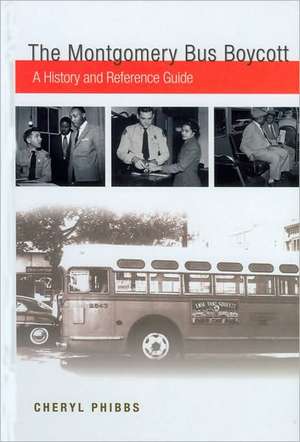
The Montgomery Bus Boycott: A History and Reference Guide
Autor Cheryl Phibbsen Limba Engleză Hardback – 23 iul 2009
The Montgomery Bus Boycott: A History and Reference Guide offers a comprehensive account of a critical turning point in American history. It offers a richly detailed chronological trip through post-World War II Southern society to the early 1960s, then focuses on the day-to-day frustrations, challenges, and victories of the people behind the protest that inspired a nationwide movement.
The Montgomery Bus Boycott fills a gap in available resources with its comprehensive portrait of mid-1950s Montgomery-the mainly black, uneducated female protestors, activist Rosa Parks, Dr. King, and the white society desperate to keep intact the only culture they understood. Firsthand news reports, editorials, quotes, eyewitness accounts, and behind-the-scenes stories of political maneuvering help readers experience this dramatic-and still reverberating-victory over oppression.
Preț: 421.25 lei
Preț vechi: 767.88 lei
-45%
Puncte Express: 632
Carte tipărită la comandă
Livrare economică 26 noiembrie-10 decembrie
Livrare prin curier în România Termenul estimat este afișat lângă disponibilitate.
Transport gratuit pentru acest produs Plată online sau ramburs, în funcție de opțiunile comenzii.
Retur gratuit în 14 zile Comandă securizată și suport în română.
Specificații
ISBN-13: 9780313358876
ISBN-10: 0313358877
Pagini: 180
Dimensiuni: 156 x 235 x 18 mm
Greutate: 0.4 kg
Editura: Bloomsbury Publishing
Colecția Greenwood
Locul publicării:New York, United States
ISBN-10: 0313358877
Pagini: 180
Dimensiuni: 156 x 235 x 18 mm
Greutate: 0.4 kg
Editura: Bloomsbury Publishing
Colecția Greenwood
Locul publicării:New York, United States
V-ar putea interesa
-
 Dismantling Public Policy: Preferences, Strategies, and EffectsMichael W. Bauer-21%Preț: 417.48 lei531.79 lei
 -
 -28%Preț: 411.78 lei575.19 lei
 -
 Islamic Law and International Human Rights LawAnver M. Emon-16%Preț: 386.39 lei458.90 lei
 -
 -22%Preț: 387.37 lei494.08 lei
 -
 After the CataclysmNoam Chomsky-8%Preț: 649.18 lei705.64 lei
 -
 -27%Preț: 1218.84 lei1660.40 lei
 -
 -27%Preț: 1022.70 lei1395.23 lei
 -
 Ethnic Conflicts & Global InterventionsMaureen Wells-27%Preț: 724.00 lei987.93 lei
 -
 -25%Preț: 54.53 lei72.78 lei
 -
 Breadline BritainJoanna MackPreț: 86.11 lei
 -
 Preț: 216.81 lei
 -
 La LuchaJon SackPreț: 96.77 lei
 -
 Where Vultures FeastIke OkontaPreț: 108.19 lei
Cuprins
Preface
1. Indignation
2. Just Plain Tired
3. Something Big
4. The Leader
5. Creating a Legacy
6. Challenges to Overcome
7. All Out Attack
8. White Opinion
9. Dignity, Discipline, Dedication
10. A New Era
11. Boot Camp
12. The Legacy
Appendix A: Biographies
Appendix B: Primary Documents
Glossary
Bibliography
Index
1. Indignation
2. Just Plain Tired
3. Something Big
4. The Leader
5. Creating a Legacy
6. Challenges to Overcome
7. All Out Attack
8. White Opinion
9. Dignity, Discipline, Dedication
10. A New Era
11. Boot Camp
12. The Legacy
Appendix A: Biographies
Appendix B: Primary Documents
Glossary
Bibliography
Index
Recenzii
. . . this reference guide will be most useful for senior high school and undergraduate students. . .This title is recommended for undergraduate history collections.
Drawing on firsthand news reports, editorials, and eyewitness accounts, this detailed account of the 1957 Bus Boycott in Alabama, which became the catalyst for the civil rights movement, chronicles Southern society from the post-World War II era to the early 1960s, then focuses on the people behind the protest. Original documents, interviews, letters to the editor, and transcripts of court testimony shed light on the roles of lessknown figures, including the mainly black, uneducated female protestors, and the ordinary members of white society desperate to maintain the status quo, in addition to more well-known personalities such as activist Rosa Parks and leader Dr. Martin Luther King. Numerous B&W historical photos of meetings, boycott leaders, mug shots, and courtroom scenes give a visual portrait of the era. Other features include a
chronology of civil rights events from the 1863 Emancipation Proclamation to the outcome of the boycott, biographies of eight key figures, and a glossary of legal terms and federal amendments of the era.
Drawing on firsthand news reports, editorials, and eyewitness accounts, this detailed account of the 1957 Bus Boycott in Alabama, which became the catalyst for the civil rights movement, chronicles Southern society from the post-World War II era to the early 1960s, then focuses on the people behind the protest. Original documents, interviews, letters to the editor, and transcripts of court testimony shed light on the roles of lessknown figures, including the mainly black, uneducated female protestors, and the ordinary members of white society desperate to maintain the status quo, in addition to more well-known personalities such as activist Rosa Parks and leader Dr. Martin Luther King. Numerous B&W historical photos of meetings, boycott leaders, mug shots, and courtroom scenes give a visual portrait of the era. Other features include a
chronology of civil rights events from the 1863 Emancipation Proclamation to the outcome of the boycott, biographies of eight key figures, and a glossary of legal terms and federal amendments of the era.