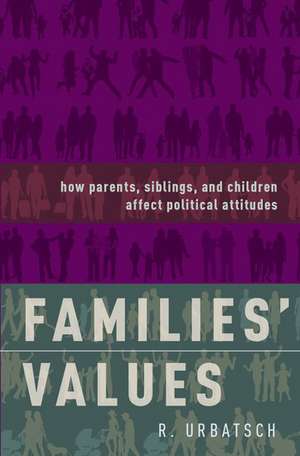
Families' Values: How Parents, Siblings, and Children Affect Political Attitudes
Autor R. Urbatschen Limba Engleză Hardback – 25 sep 2014
Preț: 411.78 lei
Preț vechi: 575.19 lei
-28%
Puncte Express: 618
Carte tipărită la comandă
Livrare economică 26 noiembrie-02 decembrie
Livrare prin curier în România Termenul estimat este afișat lângă disponibilitate.
Transport gratuit pentru acest produs Plată online sau ramburs, în funcție de opțiunile comenzii.
Retur gratuit în 14 zile Comandă securizată și suport în română.
Specificații
ISBN-13: 9780199373604
ISBN-10: 0199373604
Pagini: 208
Dimensiuni: 157 x 236 x 20 mm
Greutate: 0.41 kg
Editura: Oxford University Press
Colecția OUP USA
Locul publicării:New York, United States
ISBN-10: 0199373604
Pagini: 208
Dimensiuni: 157 x 236 x 20 mm
Greutate: 0.41 kg
Editura: Oxford University Press
Colecția OUP USA
Locul publicării:New York, United States
V-ar putea interesa
-
 -22%Preț: 393.21 lei503.06 lei
 -
 Judges, Transition, and Human RightsJohn Morison-24%Preț: 669.39 lei878.95 lei
 -
 -29%Preț: 448.70 lei629.41 lei
 -
 The Ultimate Rule of LawDavid M. Beatty-28%Preț: 364.18 lei509.30 lei
 -
 -33%Preț: 852.22 lei1266.83 lei
 -
 Independence of MindTimothy Macklem-12%Preț: 335.93 lei379.71 lei
 -
 The Cultural Dimension of Human RightsAna Filipa Vrdoljak-31%Preț: 901.70 lei1314.10 lei
 -
 Social Policy: Theory and Practice - Third EditionPaul SpickerPreț: 279.69 lei
 -
 Obamacare SimplifiedZephyros PressPreț: 63.27 lei
 -
 Preț: 216.81 lei
 -
 Comradely GreetingsSlavoj ZizekPreț: 109.34 lei
 -
 La LuchaJon SackPreț: 96.77 lei
Recenzii
Though acknowledging that the questions raised in his book must remain unsettled, Urbatsch (Iowa State Univ.) explores the influence of family structure, including birth order, gender of siblings, predominance of male or female children, and the careers of mothers, on political attitudes. Families' Values offers a useful exploratory analysis of correlations found within survey research data between family structure and political attitudes.
Of all the institutions political scientists study, the home often gets short shrift. And yet it is where we form our most intimate relationships that, in turn, shape our worldview. It makes sense that families are the seedbeds of one's political perspective. In this book, R. Urbatsch makes the case that families matter, by moving from bromide to careful analysis to show us how, when, and why the home affects political attitudes.
Families' Values is a lucidly-written, intriguing demonstration of how the structure and composition of families can affect people's political attitudes in their roles as parents and as siblings. By going beyond traditional approaches and with the use of national survey data, the book documents several illuminating examples and opens up a number of possibilities for enriching our understanding of familial influences.
Past research on the role of families in political socialization has focused primarily on the transmission of partisanship from parents to offspring. This research breaks new ground in looking at a variety of other, subtler family influences, in a highly innovative, creative, out-of-the-box mode. We learn about stay-at-home-moms, siblings, birth order, and mother-father differences. A definite step ahead.
Of all the institutions political scientists study, the home often gets short shrift. And yet it is where we form our most intimate relationships that, in turn, shape our worldview. It makes sense that families are the seedbeds of one's political perspective. In this book, R. Urbatsch makes the case that families matter, by moving from bromide to careful analysis to show us how, when, and why the home affects political attitudes.
Families' Values is a lucidly-written, intriguing demonstration of how the structure and composition of families can affect people's political attitudes in their roles as parents and as siblings. By going beyond traditional approaches and with the use of national survey data, the book documents several illuminating examples and opens up a number of possibilities for enriching our understanding of familial influences.
Past research on the role of families in political socialization has focused primarily on the transmission of partisanship from parents to offspring. This research breaks new ground in looking at a variety of other, subtler family influences, in a highly innovative, creative, out-of-the-box mode. We learn about stay-at-home-moms, siblings, birth order, and mother-father differences. A definite step ahead.
Notă biografică
R. Urbatsch is Associate Professor of Political Science at Iowa State University