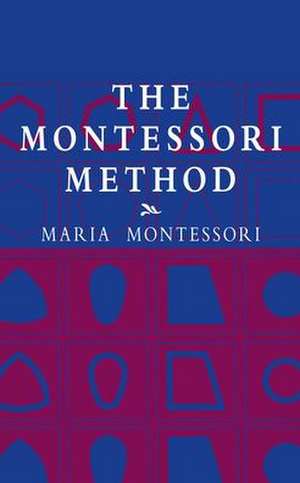
The Montessori Method
Autor Maria Montessorien Limba Engleză Paperback – 14 aug 2002
Preț: 102.29 lei
Puncte Express: 153
Carte disponibilă
Livrare economică 09-23 noiembrie
Livrare prin curier în România Termenul estimat este afișat lângă disponibilitate.
Transport gratuit de la 400.00 lei Plată online sau ramburs, în funcție de opțiunile comenzii.
Retur gratuit în 14 zile Comandă securizată și suport în română.
Specificații
ISBN-13: 9780486421629
ISBN-10: 0486421627
Pagini: 416
Dimensiuni: 162 x 209 x 22 mm
Greutate: 0.41 kg
Editura: Dover Publications
ISBN-10: 0486421627
Pagini: 416
Dimensiuni: 162 x 209 x 22 mm
Greutate: 0.41 kg
Editura: Dover Publications
V-ar putea interesa
-
 -17%Preț: 88.20 lei106.45 lei
 -
 -17%Preț: 103.35 lei123.88 lei
 -
 The Secret of ChildhoodMaria MontessoriPreț: 60.06 lei
 -
 TEACHING MONTESSORI IN The HomeElizabeth G HainstockPreț: 81.33 lei
 -
 Maria MontessoriE M StandingPreț: 100.24 lei
 -
 The Montessori Way, Revised and ExpandedTim Seldin-15%Preț: 121.18 lei142.59 lei
 -
 Montessori from the StartPaula Polk LillardPreț: 157.46 lei
 -
 Preț: 142.69 lei
 -
 Preț: 132.83 lei
 -
 My First Keyboard BookSam TaplinPreț: 109.22 lei
 -
 Montessori: Letter WorkBobby George-8%Preț: 55.21 lei59.95 lei
 -
 MontessoriBobby George-9%Preț: 53.49 lei58.93 lei
 -
 -22%Preț: 98.93 lei126.44 lei
 -
 The Absorbent MindMaria MontessoriPreț: 87.80 lei
 -
 The Child Is the Teacher: A Life of Maria MontessoriCristina De Stefano-23%Preț: 165.05 lei215.66 lei
 -
 The Child is the Teacher: A Life of Maria MontessoriCristina De Stefano-19%Preț: 103.37 lei128.11 lei
 -
 Maria MontessoriMaria Isabel Sanchez VegaraPreț: 94.71 lei
 -
 The Society of Timid Souls: Or, How to be BravePolly Morland-21%Preț: 69.90 lei88.57 lei
 -
 Kumon Easy MazesKumonPreț: 65.83 lei
 -
 Follow Me, Little One!Agnese BaruzziPreț: 40.14 lei
 -
 Dr. Montessori's Own Handbook - IllustratedMaria MontessoriPreț: 83.61 lei
 -
 Preț: 128.56 lei
Notă biografică
Maria Montessori (1870-1952) was an Italian educator and physician. Born in Chiaravalle, she came from a prominent, well-educated family of scientists and government officials. Raised in Florence and Rome, Montessori excelled in school from a young age, graduating from technical school in 1886. In 1890, she completed her degree in physics and mathematics, yet decided to pursue medicine rather than a career in engineering. At the University of Rome, she overcame prejudice from the predominately male faculty and student body, winning academic prizes and focusing her studies on pediatric medicine and psychiatry. She graduated in 1896 as a doctor in medicine and began working with mentally disabled children, for whom she also became a prominent public advocate. In 1901, she left her private practice to reenroll at the University of Rome for a degree in philosophy, dedicating herself to the study of scientific pedagogy and lecturing on the topic from 1904 to 1908. In 1906, she opened her Casa dei Bambini, a school for children from low-income families. As word of her endeavor spread, schools using the Montessori educational method began opening around the world. In the United States, the publication of The Montessori Method (1912) in English and her 1913 lecture tour fostered a rapid increase of Montessori schools in the country. For her groundbreaking status as one of Italy¿s first female public intellectuals and her role in developing a more individualized, psychologically informed approach to education, Maria Montessori continues to be recognized as one of the twentieth century¿s most influential figures.