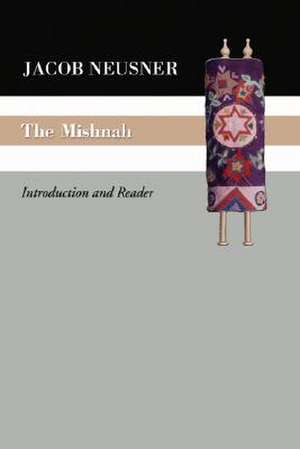
The Mishnah
Autor Jacob Neusneren Limba Engleză Paperback – 30 ian 2004
This publication has also been published in hardback, please click here for details.
Preț: 172.93 lei
Puncte Express: 259
Carte disponibilă
Livrare economică 14-28 noiembrie
Livrare prin curier în România Termenul estimat este afișat lângă disponibilitate.
Transport gratuit de la 400.00 lei Plată online sau ramburs, în funcție de opțiunile comenzii.
Retur gratuit în 14 zile Comandă securizată și suport în română.
Specificații
ISBN-13: 9781592445189
ISBN-10: 1592445187
Pagini: 240
Dimensiuni: 140 x 216 x 14 mm
Greutate: 0.31 kg
Editura: Wipf and Stock
ISBN-10: 1592445187
Pagini: 240
Dimensiuni: 140 x 216 x 14 mm
Greutate: 0.31 kg
Editura: Wipf and Stock
V-ar putea interesa
-
 The Buddha and his Dhamma: A Critical EditionAakash Singh Rathore-20%Preț: 359.27 lei447.98 lei
 -
 Debating the Dasam GranthRobin Rinehart-30%Preț: 764.29 lei1094.53 lei
 -
 Aleister Crowley and Western EsotericismHenrik Bogdan-20%Preț: 408.64 lei509.28 lei
 -
 The Treasures of Darkness: A History of Mesopotamian ReligionThorkild JacobsenPreț: 217.99 lei
 -
 Kabbalah and ErosMoshe Idel-23%Preț: 480.63 lei624.20 lei
 -
 The First Thousand Years: A Global History of ChristianityRobert Louis WilkenPreț: 178.20 lei
 -
 I Asked for WonderAbraham Joshua HeschelPreț: 121.11 lei
 -
 The Middle Length Discourses of the BuddhaBodhi Bhikkhu-18%Preț: 475.55 lei582.37 lei
 -
 Understanding the Qur'an TodayMahmoud HusseinPreț: 76.01 lei
 -
 Preț: 57.15 lei
 -
 Preț: 87.46 lei
 -
 Aleister Crowley: The BiographyTobias ChurtonPreț: 233.00 lei
 -
 The Wakeful WorldEmma Restall OrrPreț: 94.12 lei
 -
 The Mosaic of IslamSuleiman MouradPreț: 120.52 lei
 -
 Runes – a HandbookMichael P. Barnes-11%Preț: 579.32 lei650.93 lei
 -
 Reading the Qur'anZiauddin Sardar-15%Preț: 89.85 lei106.12 lei
Notă biografică
Jacob Neusner is Research Professor of Religion and Theology at Bard College and Senior Fellow of the Institute of Advanced Theology at Bard. He has published more than 900 books and unnumbered articles, both scholarly and academic, popular and journalistic, and is the most published humanities scholar in the world. He has been awarded nine honorary degrees, including seven US and European honorary doctorates. He received his A.B. from Harvard College in 1953, his Ph.D. from Columbia University and Union Theological Seminary in 1961, and Rabbinical Ordination and the degree of Master of Hebrew Letters from the Jewish Theological Seminary of America in 1960. Neusner is editor of the 'Encyclopedia of Judaism' (Brill, 1999. I-III) and its Supplements; Chair of the Editorial Board of 'The Review of Rabbinic Judaism,' and Editor in Chief of 'The Brill Reference Library of Judaism', both published by E. J. Brill, Leiden, The Netherlands. He is editor of 'Studies in Judaism', University Press of America. Neusner resides with his wife in Rhinebeck, New York. They have a daughter, three sons and three daughters-in-law, six granddaughters and two grandsons.
Cuprins
Table of Contents Preface ix Acknowledgements and Permissions xiii 1. The Mishnah as Literature 1 Identifying the Mishnah 1 Mishnah Tractate Berakhot 1:1 2 Mishnah Tractate Uqsin 3:11 2 Using the Evidence in Hand 6 The Contents and Organization of the Mishnah 10 An Outline of the Topical Program of the Mishnah 13 The Rhetoric of the Mishnah: Patterning Language 17 The Logic of the Mishnah: Proving Propositions 26 The Meaning of the Mishnah¿s Rhetoric and Logic 34 The Purpose of the Mishnah: Law Code or Schoolbook? 37 2. The Mishnah as Religion 40 Defining a Religion and a Judaism 40 The Mishnah¿s Judaism before 70 C.E. 42 The Mishnah¿s Judaism after the Destruction of the Temple: 70-132 C.E. 45 The Mishnah after 135 C.E.: The System Seen Whole 51 The Judaism of the Mishnah 53 3. The Mishnah¿s Social Vision: Means of Production, Market, Wealth 61 The Building Block of Society in the Mishnah¿s Social Vision 61 The Household: Baba Batra Chapter 3 64 The Market: Baba Mesia Chapter 4 79 Wealth: Baba Mesia Chapter 5 97 The Steady-State Economy in a Static Social World 118 4. The Mishnah¿s Social Vision: Woman and Caste 121 Women in the Household 121 Women: Yebamot Chapter 10 123 Case Structure: Qiddushin Chapter 4 131 The Social Vision of the Mishnah 140 5. The Mishnah¿s Theological and Philosophical Vision 149 History and the Laws of History: Rosh Hashanah Chapter 4, Taanit Chapter 4, Zebahim Chapter 14, Sotah Chapter 9 149 Israel and God, Partners in the Land: Maaserot Chapter 1 172 Intention: Makhshirin Chapter 4 181 Humanity in Crisis: What Can Israel Do? 198 6. The Mishnah and the Torah: The Impact of the Mishnah on the Formation of Judaism 200 The Problem of the Mishnah 200 Tractate Avot Chapter 1 206 The Mishnah and the Torah: The Theory of Tractate Avot 211 The Yerushalmi Talmud¿s Theory of the Mishnah 214 The Mishnah and the Judaism of the Dual Torah 220 The Relevance of the Mishnah to Judaism in the Twenty-First Century 227 Structure of the Mishnah 230 Index 231
Descriere
Descriere de la o altă ediție sau format:
Drawing on his own recent translation, Neusner introduces The Mishnah, the 2nd century classic codification of oral Jewish law, explaining its internal logic and structure, and its relevance to modern life. Annotation c. Book News, Inc., Portland, OR (booknews.com)
Drawing on his own recent translation, Neusner introduces The Mishnah, the 2nd century classic codification of oral Jewish law, explaining its internal logic and structure, and its relevance to modern life. Annotation c. Book News, Inc., Portland, OR (booknews.com)