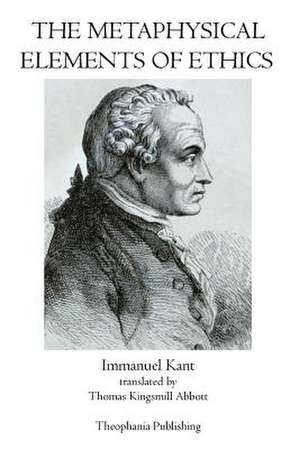
The Metaphysical Elements of Ethics
Autor Immanuel Kanten Limba Engleză Paperback
Preț: 61.69 lei
Puncte Express: 93
Carte tipărită la comandă
Livrare economică 16-30 noiembrie
Livrare prin curier în România Termenul estimat este afișat lângă disponibilitate.
Transport gratuit de la 400.00 lei Plată online sau ramburs, în funcție de opțiunile comenzii.
Retur gratuit în 14 zile Comandă securizată și suport în română.
Specificații
ISBN-13: 9781770830646
ISBN-10: 1770830642
Pagini: 48
Dimensiuni: 152 x 229 x 3 mm
Greutate: 0.08 kg
Editura: Theophania Publishing
ISBN-10: 1770830642
Pagini: 48
Dimensiuni: 152 x 229 x 3 mm
Greutate: 0.08 kg
Editura: Theophania Publishing
Notă biografică
Immanuel Kant war ein deutscher Philosoph der Aufklärung. Kant zählt zu den bedeutendsten Vertretern der abendländischen Philosophie. Sein Werk Kritik der reinen Vernunft kennzeichnet einen Wendepunkt in der Philosophiegeschichte und den Beginn der modernen Philosophie.
Kant schuf eine neue, umfassende Perspektive in der Philosophie, welche die Diskussion bis ins 21. Jahrhundert maßgeblich beeinflusst. Dazu gehört nicht nur sein Einfluss auf die Erkenntnistheorie und Metaphysik mit der Kritik der reinen Vernunft, sondern auch auf die Ethik mit der Kritik der praktischen Vernunft und die Ästhetik mit der Kritik der Urteilskraft. Zudem verfasste Kant bedeutende Schriften zur Religions-, Rechts- und Geschichtsphilosophie sowie Beiträge zur Astronomie und den Geowissenschaften.
Kant schuf eine neue, umfassende Perspektive in der Philosophie, welche die Diskussion bis ins 21. Jahrhundert maßgeblich beeinflusst. Dazu gehört nicht nur sein Einfluss auf die Erkenntnistheorie und Metaphysik mit der Kritik der reinen Vernunft, sondern auch auf die Ethik mit der Kritik der praktischen Vernunft und die Ästhetik mit der Kritik der Urteilskraft. Zudem verfasste Kant bedeutende Schriften zur Religions-, Rechts- und Geschichtsphilosophie sowie Beiträge zur Astronomie und den Geowissenschaften.