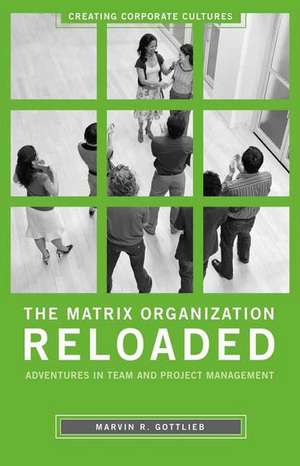
The Matrix Organization Reloaded: Adventures in Team and Project Management: Creating Corporate Cultures
Autor Marvin R. Gottlieb Ph.D.en Limba Engleză Hardback – 30 aug 2007
Marvin Gottlieb, who has studied and applied the principles of matrix management for over 25 years, takes us on a tour of this phenomenon-its evolution, current practices, and future applications. He argues that most organizations are taking on characteristics of matrix structure, with fluid teams and dotted-line reporting relationships across departments and divisions. Featuring case studies of successes and failures, he shows readers how to harness the power of the matrix structure while minimizing the conflict, disorientation, and resistance that often accompany the approach. In an environment where every company-large or small, entrepreneurial or established-is wrestling with the question of how to organize for maximum performance in a harshly competitive world, this book will give leaders and managers valuable insights and tools for promoting cultures that reward creativity and teamwork while maintaining strong leadership and accountability.
Preț: 376.61 lei
Preț vechi: 543.11 lei
-31%
Puncte Express: 565
Carte tipărită la comandă
Livrare economică 08-22 iunie
Specificații
ISBN-13: 9780275991333
ISBN-10: 0275991334
Pagini: 192
Dimensiuni: 156 x 235 x 21 mm
Greutate: 0.45 kg
Editura: Bloomsbury Publishing
Colecția Praeger
Seria Creating Corporate Cultures
Locul publicării:New York, United States
ISBN-10: 0275991334
Pagini: 192
Dimensiuni: 156 x 235 x 21 mm
Greutate: 0.45 kg
Editura: Bloomsbury Publishing
Colecția Praeger
Seria Creating Corporate Cultures
Locul publicării:New York, United States
V-ar putea interesa
-
 -12%Preț: 140.19 lei159.27 lei
 -
 Enterprise MobilityC. Sørensen-15%Preț: 620.62 lei730.15 lei
 -
 Selling the Dream: Why Advertising Is Good BusinessJohn M. Hood-26%Preț: 186.20 lei252.96 lei
 -
 How People TickMike LeiblingPreț: 133.43 lei
 -
 Preț: 101.52 lei
 -
 The Time Trap: The Classic Book on Time ManagementAlec MackenziePreț: 111.81 lei
 -
 Preț: 103.36 lei
 -
 The Busy Manager's Guide to DelegationRichard LueckePreț: 85.91 lei
 -
 Preț: 244.07 lei
 -
 Living in More Than One WorldBruce RosensteinPreț: 123.27 lei
 -
 Preț: 157.40 lei
Recenzii
Matrix management, an approach in which people are assigned to projects rather than department managers, was introduced in the 1970's, fell out of favor in the 1990's, and has now reemerged as a viable alternative. Gottlieb, an organizational trainer and consultant, reviews the evolution of matrix management and looks at its current practices and future applications. He argues that most organizations are taking on characteristics of matrix structure, with fluid teams and dotted line reporting relationships across departments. He uses case studies of successes and failures to show to how to use matrix configurations without the conflict and resistance that often accompany the approach. The audience for the book includes executives, regional and department managers, project managers, and team leaders.