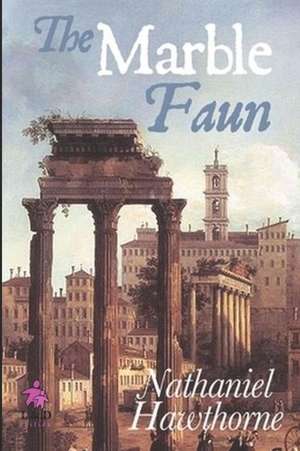
The Marble Faun
Autor Nathaniel Hawthorneen Limba Engleză Paperback – 28 iun 2018
Preț: 124.97 lei
Puncte Express: 187
Carte indisponibilă temporar
Doresc să fiu notificat când acest titlu va fi disponibil:
Se trimite...
Specificații
ISBN-13: 9781983306617
ISBN-10: 1983306614
Pagini: 404
Dimensiuni: 152 x 229 x 21 mm
Greutate: 0.54 kg
Editura: LIGHTNING SOURCE INC
ISBN-10: 1983306614
Pagini: 404
Dimensiuni: 152 x 229 x 21 mm
Greutate: 0.54 kg
Editura: LIGHTNING SOURCE INC
V-ar putea interesa
-
 Madame BovaryGustave FlaubertPreț: 28.01 lei
 -
 The Scarlet LetterNathaniel HawthornePreț: 64.31 lei
 -
 Einstein's MonstersMartin Amis-20%Preț: 51.13 lei63.84 lei
 -
 The AmbassadorsHenry JamesPreț: 60.54 lei
 -
 The Birth of Tragedy and The Case of WagnerFriedrich NietzschePreț: 78.08 lei
 -
 The House of the Seven GablesNathaniel HawthornePreț: 36.76 lei
 -
 Heart of DarknessJoseph Conrad-19%Preț: 23.18 lei28.58 lei
 -
 The Picture of Dorian GrayOscar WildePreț: 35.93 lei
 -
 Hawthorne in ConcordPhilip McFarlandPreț: 100.85 lei
 -
 Classical MythologyNathaniel HawthornePreț: 148.68 lei
 -
 The Scarlet Letter (Graphic Art Collector's Edition)Nathaniel Hawthorne-30%Preț: 70.66 lei101.37 lei
 -
 Swann's WayMarcel ProustPreț: 57.52 lei
 -
 The ProphetKahlil GibranPreț: 27.21 lei
 -
 The Blithedale RomanceNathaniel HawthornePreț: 48.16 lei
 -
 No Way BackTheodor FontanePreț: 79.80 lei
 -
 The Amalfi CurseSarah PennerPreț: 137.33 lei
 -
 The Maiden FaustConor FarringtonPreț: 26.21 lei
 -
 The Scarlet LetterNathaniel HawthornePreț: 40.86 lei
 -
 FeathertopNathaniel HawthornePreț: 47.70 lei
 -
 UtopiaThomas MorePreț: 33.19 lei
Descriere
Descriere de la o altă ediție sau format:
'any narrative of human action and adventure - whether we call it history or Romance - is certain to be a fragile handiwork, more easily rent than mended'The fragility - and the durability - of human life and art dominate this story of American expatriates in Italy in the mid-nineteenth century. Befriended by Donatello, a young Italian with the classical grace of the 'Marble Faun', Miriam, Hilda, and Kenyon find their pursuit of art taking a sinister turn as Miriam's unhappy past precipitates the present into tragedy.Hawthorne's 'International Novel' dramatizes the confrontation of the Old World and the New and the uncertain relationship between the 'authentic' and the 'fake', in life as in art. The author's evocative descriptions of classic sites made The Marble Faun a favourite guidebook to Rome for Victorian tourists, but this richly ambiguous symbolic romance is also the story of a murder, and a parable of the Fall of Man. As the characters find their civilized existence disrupted by the awful consequences of impulse, Hawthorne leads his readers to question the value of Art and Culture and addresses the great evolutionary debate which was beginning to shake Victorian society. ABOUT THE SERIES: For over 100 years Oxford World's Classics has made available the widest range of literature from around the globe. Each affordable volume reflects Oxford's commitment to scholarship, providing the most accurate text plus a wealth of other valuable features, including expert introductions by leading authorities, helpful notes to clarify the text, up-to-date bibliographies for further study, and much more.
'any narrative of human action and adventure - whether we call it history or Romance - is certain to be a fragile handiwork, more easily rent than mended'The fragility - and the durability - of human life and art dominate this story of American expatriates in Italy in the mid-nineteenth century. Befriended by Donatello, a young Italian with the classical grace of the 'Marble Faun', Miriam, Hilda, and Kenyon find their pursuit of art taking a sinister turn as Miriam's unhappy past precipitates the present into tragedy.Hawthorne's 'International Novel' dramatizes the confrontation of the Old World and the New and the uncertain relationship between the 'authentic' and the 'fake', in life as in art. The author's evocative descriptions of classic sites made The Marble Faun a favourite guidebook to Rome for Victorian tourists, but this richly ambiguous symbolic romance is also the story of a murder, and a parable of the Fall of Man. As the characters find their civilized existence disrupted by the awful consequences of impulse, Hawthorne leads his readers to question the value of Art and Culture and addresses the great evolutionary debate which was beginning to shake Victorian society. ABOUT THE SERIES: For over 100 years Oxford World's Classics has made available the widest range of literature from around the globe. Each affordable volume reflects Oxford's commitment to scholarship, providing the most accurate text plus a wealth of other valuable features, including expert introductions by leading authorities, helpful notes to clarify the text, up-to-date bibliographies for further study, and much more.
Notă biografică
Nathaniel Hawthorne was born in 1804 in Salem, Massachusetts. After graduating from university in 1825, he returned to Salem determined to become a writer and worked on short stories and historical sketches. In 1828 he published the novel Fanshawe at his own expense; it was a failure but led to a productive relationship with publisher Samuel Goodrich. He returned to writing short fiction, then worked for Goodrich as hack writer and editor. Hawthorne became a surveyor of the Boston Custom House in 1839, then left in 1841 to invest in a communal experiment, when he also married. Disappointed in communal life, he moved to Concord, Massachusetts and returned to serious writing in 1846 with Mosses from an Old Manse. After a further three years as a customs surveyor, he finally produced his first significant novel and masterwork, The Scarlet Letter, in 1850, followed by two more major novels and some of his best short stories. In 1853 a college friend became President and Hawthorne was appointed US consul at Liverpool, living in England and Italy for six years. He published a further novel and some essays on England on his return; four unfinished novels and passages from his notebooks were published on his death in 1864.