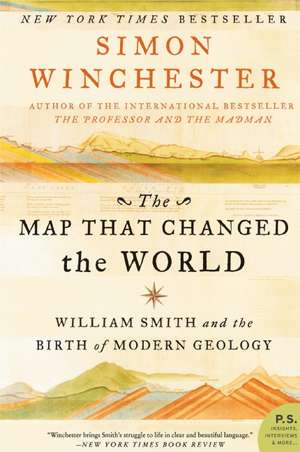
The Map That Changed the World
Autor Simon Winchesteren Limba Engleză Paperback – 15 ian 2020
Scrisă de Simon Winchester, un autor cu o vastă experiență jurnalistică la publicații de prestigiu precum The Guardian, această lucrare fundamentează istoria geologiei moderne printr-o documentare riguroasă și o perspectivă umană profundă. Observăm cum Winchester, fidel stilului său de a explora intersecția dintre știință și destinul uman, reconstruiește viața lui William Smith, un autodidact care a sfidat dogmele religioase și științifice ale secolului al XIX-lea. Apreciem modul în care autorul reușește să transforme procesul tehnic de cartografiere a straturilor pământului într-o narațiune despre perseverență și sacrificiu. Premisa cărții se concentrează pe momentul 1793, când Smith, în timp ce săpa canale, a realizat că fosilele sunt indicatori preciși ai succesiunii straturilor de rocă. Această „epifanie” a condus la crearea primei hărți geologice a Angliei în 1815, o operă de artă pictată manual, înaltă de peste doi metri. Cititorii familiarizați cu Reading the Rocks de Brenda Maddox vor aprecia modul în care Winchester se concentrează pe figura centrală a lui Smith, oferind o biografie mult mai intimă și detaliată a omului din spatele hărții, spre deosebire de abordarea de grup din lucrarea menționată. În contextul operei sale, The Map That Changed the World continuă preocuparea lui Winchester pentru istoria pământului și a cartografiei, teme explorate și în Land. Dacă în Exactly autorul analiza precizia inginerească, aici se apleacă asupra intuiției brute și a muncii de teren care au pus bazele industriilor moderne de petrol, cărbune și infrastructură rutieră. Structura volumului, îmbogățită cu facsimile și un glosar terminologic, facilitează înțelegerea unui domeniu tehnic fără a sacrifica ritmul narativ.
Preț: 111.60 lei
Carte disponibilă
Livrare economică 18 noiembrie-02 decembrie
Specificații
ISBN-10: 0061767905
Pagini: 368
Dimensiuni: 133 x 203 x 22 mm
Greutate: 0.28 kg
Editura: Harper Perennial
V-ar putea interesa
-
 Map AddictMike ParkerPreț: 80.56 lei
 -
 Principles of GeologyCharles Lyell-19%Preț: 88.07 lei108.10 lei
 -
 Strata: William Smith’s Geological MapsOxford University Museum of Natural History-8%Preț: 488.93 lei531.45 lei
 -
 Preț: 187.52 lei
 -
 -10%Preț: 226.47 lei252.11 leiRecomandat
 -
 Preț: 193.24 lei
 -
 STRATAOxford University Museum of Natural History-17%Preț: 430.20 lei515.73 lei
 -
 Jedediah Smith and the Opening of the WestDale L. MorganPreț: 132.60 lei
 -
 -32%Preț: 151.93 lei224.48 lei
 -
 S.J.J. AbramsPreț: 316.61 lei
 -
 -36%Preț: 68.61 lei107.16 lei
 -
 On Solid GroundDavid GoldsmithPreț: 163.75 lei
 -
 The Library of Lost MapsJames CheshirePreț: 275.46 lei
 -
 Preț: 164.91 lei
 -
 -18%Preț: 70.71 lei86.18 lei
 -
 On The Map: Why the world looks the way it doesSimon Garfield-17%Preț: 78.24 lei94.83 lei
 -
 Map Of A NationRachel HewittPreț: 93.21 lei
 -
 The Queen's Atlas: Saxton's Elizabethan MasterpieceDavid FletcherPreț: 300.49 lei
 -
 Der ScheiterhaufenGyörgy DragománPreț: 195.43 lei
De ce să citești această carte
Această carte este esențială pentru pasionații de istoria științei și geografie istorică. Cititorul va descoperi cum o singură hartă a revoluționat economia mondială și a schimbat înțelegerea vârstei Pământului. Este o recomandare excelentă pentru cei care caută o biografie captivantă despre un geniu neînțeles care, în ciuda sărăciei și a închisorii, a reușit să pună bazele geologiei moderne.
Despre autor
Simon Winchester (născut la 28 septembrie 1944) este un autor și jurnalist britanic-american renumit pentru capacitatea sa de a populariza subiecte complexe de istorie și știință. Cariera sa la The Guardian i-a oferit o perspectivă unică asupra marilor evenimente mondiale, de la scandalul Watergate la Bloody Sunday. Cu peste zece cărți de non-ficțiune publicate, Winchester s-a specializat în narațiuni care explorează mari invenții, catastrofe naturale și personalități care au modelat lumea modernă. Experiența sa de teren și stilul erudit, dar accesibil, l-au consacrat ca unul dintre cei mai importanți scriitori contemporani de literatură documentară.
Descriere scurtă
In 1793 William Smith, a canal digger, made a startling discovery that was to turn the fledgling science of the history of the earth -- and a central plank of established Christian religion -- on its head. He noticed that the rocks he was excavating were arranged in layers; more important, he could see quite clearly that the fossils found in one layer were very different from those found in another. And out of that realization came an epiphany: that by following the fossils, one could trace layers of rocks as they dipped and rose and fell -- clear across England and, indeed, clear across the world. Determined to publish his discovery by creating a map that would display the hidden underside of England, he spent twenty years traveling the length and breadth of the kingdom by stagecoach and on foot, studying rock outcrops and fossils, piecing together the image of this unseen universe.
In 1815 he published his epochal beautiful hand-painted map, more than eight feet tall and six feet wide. But four years after its triumphant publication, and with his young wife going steadily mad to the point of nymphomania, Smith ended up in debtors' prison, a victim of plagiarism, swindled out of his recognition and his profits. He left London for the north of England and remained homeless for ten long years as he searched for work. It wasn't until 1831, when his employer, a sympathetic nobleman, brought him into contact with the Geological Society of London -- which had earlier denied him a fellowship -- that at last this quiet genius was showered with the honors long overdue him. He was summoned south to receive the society's highest award, and King William IV offered him a lifetime pension.
The Map That Changed the World is, at its foundation, a tale of endurance and achievement, of one man's dedication in the face of ruin and homelessness. The world's coal and oil industry, its gold mining, its highway systems, and its railroad routes were all derived entirely from the creation of Smith's first map.; and with a keen eye and thoughtful detail, Simon Winchester unfolds the poignant sacrifice behind this world-changing discovery.
Textul de pe ultima copertă
The Map That Changed the World is a very human tale of endurance and achievement, of one man's dedication in the face of ruin. With a keen eye and thoughtful detail, Simon Winchester unfolds the poignant sacrifice behind this world-changing discovery.
Recenzii
"Winchester has once again captured the essence of persistence against odds resulting in achievement. His fascinating account will not disappoint." — Library Journal (starred review)
“Winchester brings Smith’s struggle to life in clear and beautiful language, the richness of which he continues to celebrate.” — New York Times Book Review
"Winchester has once again captured the essence of persistence against odds resulting in achievement." — Library Journal (starred review)
"Smith's life provides a terrific plot to frame his contribution to science. Winchester's wonderful account does credit to it." — Publishers Weekly (*Starred Review*)
“Winchester masterfully weaves a compelling history.” — Newsday
“Smith’s unsung life provides the perfect backdrop for yet another entertaining intellectual history.” — Denver Post
"A compelling human story" — Boston Sunday Herald
"Well-researched narrative" — BusinessWeek
“a marvellous book ” — The Independent (London)
Notă biografică
Descriere
Hidden behind velvet curtains above a stairway in a house in London's Piccadilly is an enormous and beautiful hand-coloured map - the first geological map of anywhere in the world. Its maker was a farmer's son named William Smith. Born in 1769 his life was beset by troubles. This title tells his story.