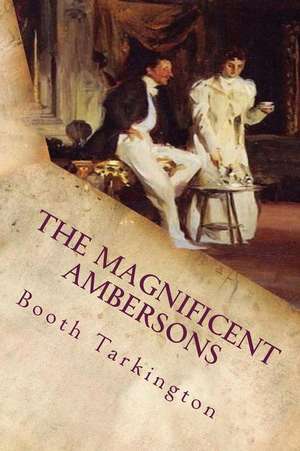
The Magnificent Ambersons
Autor Booth Tarkington Ilustrat de Arthur William Brownen Limba Engleză Paperback
Preț: 74.60 lei
Puncte Express: 112
Carte indisponibilă temporar
Livrare prin curier în România Termenul estimat este afișat lângă disponibilitate.
Transport gratuit de la 400.00 lei Plată online sau ramburs, în funcție de opțiunile comenzii.
Retur gratuit în 14 zile Comandă securizată și suport în română.
Specificații
ISBN-13: 9781517516895
ISBN-10: 1517516897
Pagini: 274
Dimensiuni: 152 x 229 x 15 mm
Greutate: 0.37 kg
Editura: CREATESPACE
ISBN-10: 1517516897
Pagini: 274
Dimensiuni: 152 x 229 x 15 mm
Greutate: 0.37 kg
Editura: CREATESPACE
V-ar putea interesa
-
 RagtimeE. L. Doctorow-25%Preț: 59.26 lei79.10 lei
-
 The Guermantes WayMarcel ProustPreț: 68.72 lei
-
 The Grapes of WrathJohn Steinbeck-25%Preț: 55.22 lei73.18 lei
-
 Some LuckJane SmileyPreț: 93.44 lei
-
 The Human ComedyWilliam SaroyanPreț: 53.45 lei
-
 This Side Of ParadiseF. Scott FitzgeraldPreț: 40.30 lei
-
 The JungleUpton SinclairPreț: 48.12 lei
-
 BuddenbrooksThomas Mann-26%Preț: 82.95 lei111.47 lei
-
 God's Little AcreErskine CaldwellPreț: 133.43 lei
-
 CliffsNotes on Faulkner's The Sound and the FuryJames L. RobertsPreț: 29.96 lei
-
 Booth TarkingtonBooth TarkingtonPreț: 199.07 lei
-
 Alice AdamsBooth TarkingtonPreț: 51.42 lei
-
 This Side of Paradise / The Beautiful and DamnedF. Scott FitzgeraldPreț: 40.28 lei
-
 The Ragged Trousered PhilanthropistsRobert TressellPreț: 28.01 lei
-
 All The Sad Young MenF. Scott FitzgeraldPreț: 57.30 lei
-
 Age of InnocenceEdith WhartonPreț: 28.01 lei
-
 The Time MachineH. G. WellsPreț: 33.23 lei
-
 The Great Gatsby: 100th Anniversary Edition (The Original 1925 Classic)F. Scott Fitzgerald-13%Preț: 19.78 lei22.82 lei
Notă biografică
Newton Booth Tarkington was an American author and playwright who lived from July 29, 1869, to May 19, 1946. His books The Magnificent Ambersons (1918) and Alice Adams (1921) are his most famous works. He has won the Pulitzer Prize for Fiction more than once. The other three are William Faulkner, John Updike, and Colson Whitehead. In the 1910s and 1920s, he was thought to be the best live American author. A number of his stories have been turned into movies. Tarkington, Meredith Nicholson, George Ade, and James Whitcomb Riley were some of the writers who helped Indiana have a Golden Age of writing in the first quarter of the 20th century. Booth Tarkington was in the Indiana House of Representatives for one term. He didn't like how cars came about, and many of his stories took place in the Midwest. He finally moved to Kennebunkport, Maine, and kept doing the work he had always done, even though he lost his sight. Tarkington was born on July 29, 1869, in Indianapolis, Indiana. His father was a judge, and his mother was an officer. He came from a wealthy family in the Midwest that had lost a lot of money in the Panic of 1873.