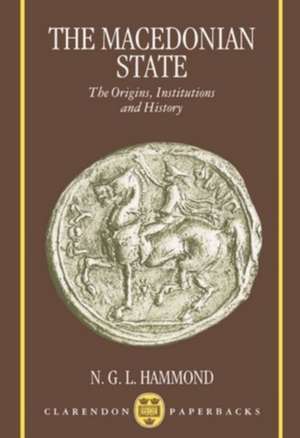
The Macedonian State: The Origins, Institutions, and History
Autor N. G. L. Hammonden Limba Engleză Hardback – 21 dec 1989
Preț: 935.82 lei
Preț vechi: 1388.08 lei
-33%
Puncte Express: 1404
Carte tipărită la comandă
Livrare economică 26 noiembrie-01 decembrie
Livrare prin curier în România Termenul estimat este afișat lângă disponibilitate.
Transport gratuit pentru acest produs Plată online sau ramburs, în funcție de opțiunile comenzii.
Retur gratuit în 14 zile Comandă securizată și suport în română.
Specificații
ISBN-13: 9780198148838
ISBN-10: 0198148836
Pagini: 440
Ilustrații: 8 black and white figures, map, endpapers
Dimensiuni: 163 x 235 x 31 mm
Greutate: 0.79 kg
Editura: Clarendon Press
Colecția Clarendon Press
Locul publicării:Oxford, United Kingdom
ISBN-10: 0198148836
Pagini: 440
Ilustrații: 8 black and white figures, map, endpapers
Dimensiuni: 163 x 235 x 31 mm
Greutate: 0.79 kg
Editura: Clarendon Press
Colecția Clarendon Press
Locul publicării:Oxford, United Kingdom
V-ar putea interesa
-
 A Commentary on Livy: Books XXXI-XXXIIIJohn Briscoe-20%Preț: 304.78 lei381.68 lei
 -
 -31%Preț: 722.12 lei1051.53 lei
 -
 Placing the Gods: Sanctuaries and Sacred Space in Ancient GreeceSusan E. Alcock-29%Preț: 477.74 lei668.18 lei
 -
 Greek HistoriographySimon Hornblower-28%Preț: 371.76 lei519.18 lei
 -
 -33%Preț: 639.15 lei948.63 lei
 -
 The Roman Army at War 100 BC - AD 200Adrian Keith Goldsworthy-13%Preț: 258.71 lei296.43 lei
 -
 The Great Sophists in Periclean AthensJacqueline de Romilly-28%Preț: 405.07 lei565.84 lei
 -
 A Viking Way of LifeSteven P AshbyPreț: 142.67 lei
 -
 Memory and Urban Religion in the Ancient WorldDr Martin BommasPreț: 280.05 lei
 -
 Confronting the Classics: Traditions, Adventures and InnovationsProfessor Mary Beard-18%Preț: 70.61 lei86.56 lei
 -
 The Carthaginians 6th–2nd Century BCAndrea Salimbeti-33%Preț: 77.07 lei114.21 lei
 -
 Preț: 142.70 lei
Cuprins
The land and the people; The monarchy and the Temenid Kings; The Macedonians and their neighbours down to 452; The organization of the Macedonian State under Temenid rule; A period of weakness 452-359; The winning of military supremacy 359-323; The consolidation and expansion of the Macedonian State 359-323; Government and ideas in Europe in the period of greatness 359-323; The Macedonians and the Greeks of the Common Peace; The Civil War and the splitting of the Macedonian World 323-304; The wars of the Kings and the division of the Macedonian Kingdom 303-281; The heirs of strife and the intrusion of foreign powers 281-221; Philip V's policy in Greece and his war with Rome 221-196; Macedonia siding with Rome and at war with Rome 196-167; Institutions of the Macedonian State c.267-167
Recenzii
`a very useful one-volume summary, with some updating and changes of mind, of the three-volume "Oxford History of Macedonia.'History
'N.G.L. Hammond's name has become virtually synonomous with the study of the history of Macedonia. Hammond remains a much-loved figure to his colleagues, students, and fellow scholars ... He is, in short, an institution, and a venerable one at that. Macedonian State is the vintage Hammond. Indeed, it can function as the summary of and key to all other Hammond scholarship ... his vision of the unity of Macedonian past and present can often be compelling ... His strengths are well known ... Hammonds knowledge of the now largely vanished traditional culture he encountered in his early travels in Macedonia has profoundly affected his understanding of ancient Macedonian history.'Elizabeth Carney, Clemson University, Ancient History Bulletin, 5.5/6 (1991)
'A 1992 reprint as a Clarendon Paperback ... should make an essential study ... more readily available. The brief account of 'sopme Royal Tombs' ... and, even more, 'the women of the royal house' ... ought to be compulsory reading for all.'P. Walcot, Greece and Rome, October 1993
'N.G.L. Hammond's name has become virtually synonomous with the study of the history of Macedonia. Hammond remains a much-loved figure to his colleagues, students, and fellow scholars ... He is, in short, an institution, and a venerable one at that. Macedonian State is the vintage Hammond. Indeed, it can function as the summary of and key to all other Hammond scholarship ... his vision of the unity of Macedonian past and present can often be compelling ... His strengths are well known ... Hammonds knowledge of the now largely vanished traditional culture he encountered in his early travels in Macedonia has profoundly affected his understanding of ancient Macedonian history.'Elizabeth Carney, Clemson University, Ancient History Bulletin, 5.5/6 (1991)
'A 1992 reprint as a Clarendon Paperback ... should make an essential study ... more readily available. The brief account of 'sopme Royal Tombs' ... and, even more, 'the women of the royal house' ... ought to be compulsory reading for all.'P. Walcot, Greece and Rome, October 1993