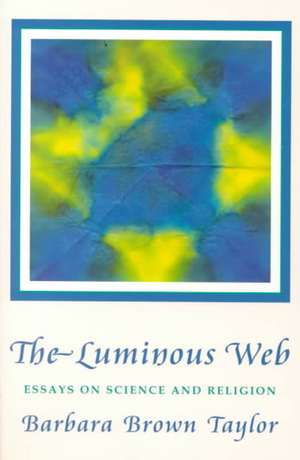
The Luminous Web: Essays on Science and Religion: Cowley Publications
Autor Barbara Brown Tayloren Limba Engleză Paperback – 25 ian 2000
In explaining why the church should care about the new insights of science, Taylor suggests ways we might close the gap between spirit and matter, between the sacred and the secular. We live in the midst of a "web of creation" where nothing is without consequence and where all things coexist, even in such a way that each of us changes the world, whether we know it or not. In this luminous web faith and science join on a single path, seeking to learn the same truths about life in the universe. "For a moment," Taylor writes, "we see through a glass darkly. We live in the illusion that we are all separate 'I ams.' When the fog finally clears, we shall know there is only One."
Preț: 80.53 lei
Preț vechi: 96.40 lei
-16%
Puncte Express: 121
Carte tipărită la comandă
Livrare economică 05-19 decembrie
Livrare prin curier în România Termenul estimat este afișat lângă disponibilitate.
Transport gratuit de la 400.00 lei Plată online sau ramburs, în funcție de opțiunile comenzii.
Retur gratuit în 14 zile Comandă securizată și suport în română.
Specificații
ISBN-13: 9781561011698
ISBN-10: 156101169X
Pagini: 90
Dimensiuni: 142 x 215 x 8 mm
Greutate: 0.14 kg
Editura: Bloomsbury Publishing
Colecția Cowley Publications
Seria Cowley Publications
Locul publicării:New York, United States
ISBN-10: 156101169X
Pagini: 90
Dimensiuni: 142 x 215 x 8 mm
Greutate: 0.14 kg
Editura: Bloomsbury Publishing
Colecția Cowley Publications
Seria Cowley Publications
Locul publicării:New York, United States
V-ar putea interesa
-
 -11%Preț: 509.89 lei572.90 lei
 -
 -34%Preț: 730.85 lei1102.29 lei
 -
 -31%Preț: 694.63 lei1008.68 lei
 -
 Faith Under FireEdward MadiganPreț: 409.67 lei
 -
 Marriage, Mitres and Being MyselfJane WilliamsPreț: 87.28 lei
 -
 Henry VIII and the English ReformationDavid G NewcombePreț: 397.09 lei
 -
 Christ the Stranger: The Theology of Rowan WilliamsDr Benjamin Myers-17%Preț: 176.36 lei212.79 lei
 -
 Preț: 335.34 lei
 -
 Why I Am Still an AnglicanCaroline Chartres-41%Preț: 102.44 lei173.90 lei
 -
 Preț: 289.59 lei
 -
 Leaving ChurchBarbara Brown TaylorPreț: 150.04 lei
 -
 A Church at War: Anglicans and HomosexualityStephen Bates-25%Preț: 384.34 lei512.71 lei
 -
 The Circling YearRonald BlythePreț: 91.90 lei
Recenzii
The book is profound in its implications and a must-read for anyone seeking to reconcile the faith they cling to with the science they encounter.
In explaining why the church should care about new discoveries and insights into the physical world that modern science has to offer, Taylor suggests ways that Christians might close the gap between spirit and matter, between the secular and the sacred. The Luminous Web is profoundly rewarding reading.
Barbara Brown Taylor, an Episcopal priest whom Newsweek named as one of the country's leading preachers, says that . . . science and religion aren't irreconciliable. Scientists, she says, speak about mystery and enigma; they often draw on the awe-filled language of the Psalms. And religious folk care-or ought to, anyway-about new scientific findings. . . . Taylor's fans won't be disappointed. She offers her usual down-to-earth honesty and eloquent wordsmithing even when her subject is quarks.
In these four short, readable essays, Taylor seeks to relate some of the insights she has gained as a Christian from the discoveries of modern science. She rejects the view that science and religion are unconnected; instead, both scientists and believers are engaged with the mystery and the wonder of the universe we inhabit.
In explaining why the church should care about new discoveries and insights into the physical world that modern science has to offer, Taylor suggests ways that Christians might close the gap between spirit and matter, between the secular and the sacred. The Luminous Web is profoundly rewarding reading.
Barbara Brown Taylor, an Episcopal priest whom Newsweek named as one of the country's leading preachers, says that . . . science and religion aren't irreconciliable. Scientists, she says, speak about mystery and enigma; they often draw on the awe-filled language of the Psalms. And religious folk care-or ought to, anyway-about new scientific findings. . . . Taylor's fans won't be disappointed. She offers her usual down-to-earth honesty and eloquent wordsmithing even when her subject is quarks.
In these four short, readable essays, Taylor seeks to relate some of the insights she has gained as a Christian from the discoveries of modern science. She rejects the view that science and religion are unconnected; instead, both scientists and believers are engaged with the mystery and the wonder of the universe we inhabit.
Notă biografică
Barbara Brown Taylor is an Episcopal priest, professor, author, and theologian and is one of the best-known preachers in the United States. She is the author of many books, including New York Times bestsellers Leaving Church, An Altar in the World, and Holy Envy.