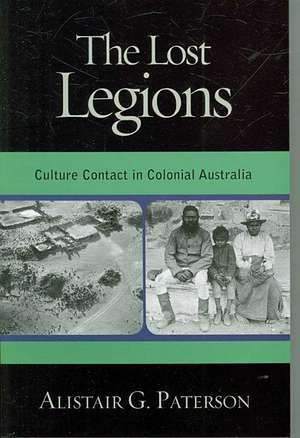
The Lost Legions: Culture Contact in Colonial Australia: Indigenous Archaeologies Series
Autor Alistair G. Patersonen Limba Engleză Paperback – 17 ian 2008
Preț: 368.35 lei
Preț vechi: 462.60 lei
-20%
Puncte Express: 553
Carte tipărită la comandă
Livrare economică 12-26 noiembrie
Livrare prin curier în România Termenul estimat este afișat lângă disponibilitate.
Transport gratuit de la 400.00 lei Plată online sau ramburs, în funcție de opțiunile comenzii.
Retur gratuit în 14 zile Comandă securizată și suport în română.
Specificații
ISBN-13: 9780759106840
ISBN-10: 0759106843
Pagini: 267
Dimensiuni: 150 x 226 x 18 mm
Greutate: 0.46 kg
Editura: Bloomsbury Publishing
Colecția AltaMira Press
Seria Indigenous Archaeologies Series
Locul publicării:New York, United States
ISBN-10: 0759106843
Pagini: 267
Dimensiuni: 150 x 226 x 18 mm
Greutate: 0.46 kg
Editura: Bloomsbury Publishing
Colecția AltaMira Press
Seria Indigenous Archaeologies Series
Locul publicării:New York, United States
V-ar putea interesa
-
 Techniques of Archaeological ExcavationPhilip Barker-15%Preț: 428.25 lei503.82 lei
 -
 Preț: 479.22 lei
 -
 -15%Preț: 448.12 lei527.19 lei
 -
 Museum Texts: Comunication FrameworksLouise RavelliPreț: 407.04 lei
 -
 -15%Preț: 430.06 lei505.95 lei
 -
 Objects: Reluctant Witnesses to the PastChris CaplePreț: 382.81 lei
 -
 Preț: 440.06 lei
 -
 Uses of HeritageLaurajane SmithPreț: 384.86 lei
 -
 The PersiansMaria BrosiusPreț: 357.18 lei
 -
 The Heritage ReaderGraham Fairclough-15%Preț: 478.99 lei563.51 lei
 -
 LithicsJr William Andrefsky-11%Preț: 472.50 lei530.90 lei
 -
 Quantitative PaleozoologyR. Lee LymanPreț: 361.36 lei
 -
 Digging Up the PastJohn Collis-16%Preț: 113.56 lei135.73 lei
Cuprins
Chapter 1 Prologue: Central Australia from a Cessna
Chapter 2 Chapter 1. The Lost Legions: Historical Pastoral Industries, Culture Contact, and Colonialism
Chapter 3 Chapter 2. The Ends of the Earth Were Our Portion
Chapter 4 Chapter 3. Pangki Warruna/ Strangways Springs Sheep Station (Central Australia)
Chapter 5 Chapter 4. A Documentary History of Strangways Springs Station
Chapter 6 Chapter 5. The Texture of Agency
Chapter 7 Chapter 6. Further Down the Wallaby Track
Chapter 8 Chapter 7. Listing the Legions
Chapter 9 Epilogue: Central Australia From a Cessna
Chapter 2 Chapter 1. The Lost Legions: Historical Pastoral Industries, Culture Contact, and Colonialism
Chapter 3 Chapter 2. The Ends of the Earth Were Our Portion
Chapter 4 Chapter 3. Pangki Warruna/ Strangways Springs Sheep Station (Central Australia)
Chapter 5 Chapter 4. A Documentary History of Strangways Springs Station
Chapter 6 Chapter 5. The Texture of Agency
Chapter 7 Chapter 6. Further Down the Wallaby Track
Chapter 8 Chapter 7. Listing the Legions
Chapter 9 Epilogue: Central Australia From a Cessna
Recenzii
In this deeply contextualized study of culture contact in central Australia, Paterson touches on, and expands, all of the topics of central concern to historical archaeologists of contact. The Lost Legions is a must-read for all historical archaeologists, even those who believe they do not work with issues of post-Columbian colonialism.
A work that is a valuable addition to the historical archaeology of the Australian frontier.
This new book makes a valuable contribution to the archaeological study of culture contact in general, but in Australia more particularly, where monograph-length studies which demonstrate the potential for a nuanced and in-depth analysis of the historical archaeology of Indigenous people remain rare. Paterson's book is a welcome addition, not only in drawing together the results of his research and publication in Australian contact archaeology over the course of almost a decade, but also in pointing to the potential for Australian historical archaeology to contribute to broader international debates regarding the nature and impact of settler colonialism, and the role of archaeology in giving voice to marginalised and subaltern peoples....Paterson's volume is engagingly written and should appeal not only to archaeologists but to a broader audience who are interested in the hidden histories of life on the Australian pastoral frontier. This is an important book which emonstrates the potential contribution of Australian historical archaeology to broader global debates and to issues of contemporary public concern.
Paterson offers a well-considered and thoroughly engaging study of pastoralism as a context for colonialism and culture contact. With breadth of international coverage and depth of local nuance, the book examines carefully the ways in which Indigenous peoples in Australia and worldwide came to terms with the variable but pervasive impacts of European-introduced herding. Given its scope, sophistication, timeliness, and accessibility, this work will be required reading for anyone with interests in Indigenous and colonial histories.
The volume offers a thoughtful and well-documented study of culture contact on one frontier. As such, it offers a useful beginning for a comparative analysis of the processes and practices that have shaped settler pastoralism in other world areas and will prove of value to those with interests in these processes in southern Africa and elsewhere.
A work that is a valuable addition to the historical archaeology of the Australian frontier.
This new book makes a valuable contribution to the archaeological study of culture contact in general, but in Australia more particularly, where monograph-length studies which demonstrate the potential for a nuanced and in-depth analysis of the historical archaeology of Indigenous people remain rare. Paterson's book is a welcome addition, not only in drawing together the results of his research and publication in Australian contact archaeology over the course of almost a decade, but also in pointing to the potential for Australian historical archaeology to contribute to broader international debates regarding the nature and impact of settler colonialism, and the role of archaeology in giving voice to marginalised and subaltern peoples....Paterson's volume is engagingly written and should appeal not only to archaeologists but to a broader audience who are interested in the hidden histories of life on the Australian pastoral frontier. This is an important book which emonstrates the potential contribution of Australian historical archaeology to broader global debates and to issues of contemporary public concern.
Paterson offers a well-considered and thoroughly engaging study of pastoralism as a context for colonialism and culture contact. With breadth of international coverage and depth of local nuance, the book examines carefully the ways in which Indigenous peoples in Australia and worldwide came to terms with the variable but pervasive impacts of European-introduced herding. Given its scope, sophistication, timeliness, and accessibility, this work will be required reading for anyone with interests in Indigenous and colonial histories.
The volume offers a thoughtful and well-documented study of culture contact on one frontier. As such, it offers a useful beginning for a comparative analysis of the processes and practices that have shaped settler pastoralism in other world areas and will prove of value to those with interests in these processes in southern Africa and elsewhere.