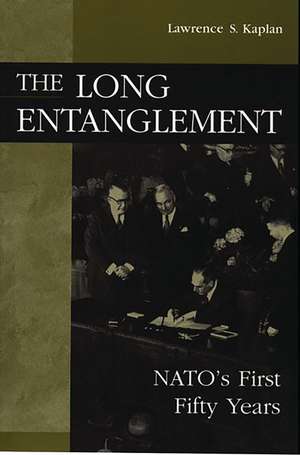
The Long Entanglement: NATO's First Fifty Years
Autor Lawrence Kaplanen Limba Engleză Hardback – 29 mar 1999 – vârsta până la 17 ani
Preț: 476.94 lei
Preț vechi: 691.09 lei
-31%
Puncte Express: 715
Carte tipărită la comandă
Livrare economică 07-21 decembrie
Livrare prin curier în România Termenul estimat este afișat lângă disponibilitate.
Transport gratuit pentru acest produs Plată online sau ramburs, în funcție de opțiunile comenzii.
Retur gratuit în 14 zile Comandă securizată și suport în română.
Specificații
ISBN-13: 9780275964184
ISBN-10: 0275964183
Pagini: 280
Dimensiuni: 156 x 235 x 27 mm
Greutate: 0.61 kg
Ediția:New.
Editura: Bloomsbury Publishing
Colecția Praeger
Locul publicării:New York, United States
ISBN-10: 0275964183
Pagini: 280
Dimensiuni: 156 x 235 x 27 mm
Greutate: 0.61 kg
Ediția:New.
Editura: Bloomsbury Publishing
Colecția Praeger
Locul publicării:New York, United States
V-ar putea interesa
-
 War Without FrontsBernd GreinerPreț: 125.81 lei
 -
 The CageGordon WeissPreț: 114.71 lei
 -
 The Cold WarJohn Lamberton Harper-15%Preț: 222.58 lei261.96 lei
 -
 -12%Preț: 365.05 lei416.46 lei
 -
 The Chechen StruggleI. AkhmadovPreț: 442.87 lei
 -
 Preț: 468.78 lei
 -
 Hunting EvilGuy Walters-17%Preț: 92.05 lei110.47 lei
 -
 Manhattan '45Jan MorrisPreț: 91.71 lei
 -
 To The Last RoundAndrew Salmon-19%Preț: 114.16 lei141.34 lei
 -
 Impotent WarriorsSusie KilshawPreț: 159.65 lei
Notă biografică
LAWRENCE S. KAPLAN is University Professor Emeritus of History and Director Emeritus of the Lyman L. Lemnitzer Center for NATO and European Union Studies at Kent State University. He is currently Adjunct Professor of History at Georgetown University./e He was formerly a member of the Historical Office, Office of the Secretary of Defense. During his tenure at Kent State he was a Fulbright Lecturer at the Universities of Bonn, Louvain, and Nice, as well as a visiting lecturer at University College London.
Cuprins
Origins of the Alliance, 1948-1949An Unequal TriadThe "Atlantic" Component of NATOThe Mutal Defense Assistance Act of 1949NATO in the First Generation, 1950-1967The Impact of Sputnik on NATOThe Berlin Crisis, 1958-1962Les débats stratégiquesNATO in the Second Generation, 1968-1989The U.S. and NATO in the Johnson YearsNATO and the Nixon DoctrineThe INF Treaty and the Future of NATONATO in the Third Generation, from 1991NATO after the Cold WarNATO at FiftyNATO: A Counterfactual HistoryAppendix: Text of North Atlantic TreatyBibliographical EssayIndex
Descriere
Descriere de la o altă ediție sau format:
The fiftieth anniversary of the long entanglement between the United States and NATO is an appropriate occasion to reflect. One of the few NATO studies to concentrate on the history of the alliance, particularly the relationship between its senior partner and its European allies, this study examines critical issues in depth, to uncover the ability of the allies to surmount their internal divisions and to confront their Soviet adversary. While NATO archives are still not fully open, the use of declassified documents from the National Archives and the presidential libraries are of invaluable assistance in considering the historical role of America in the alliance, and the continuing relevance of the organization in U.S. foreign policy.
The twelve chapters of this book, provide analyses of important issues in the organization's history, and are connected by brief contexual narratives. The resulting picture depicts a fifty-year history in which the difficulties in arriving at a consensus among the fifteen allies, each understandably concerned with its own national interests, rival those of the alliance in dealing with the Communist threat. The implosion of the Soviet empire in the early 1990s left the organization in search of new reasons for its own existence. While centrifugal forces are arguably greater today than they were during the Cold War, none of the allies seeks to terminate this long entanglement.
The fiftieth anniversary of the long entanglement between the United States and NATO is an appropriate occasion to reflect. One of the few NATO studies to concentrate on the history of the alliance, particularly the relationship between its senior partner and its European allies, this study examines critical issues in depth, to uncover the ability of the allies to surmount their internal divisions and to confront their Soviet adversary. While NATO archives are still not fully open, the use of declassified documents from the National Archives and the presidential libraries are of invaluable assistance in considering the historical role of America in the alliance, and the continuing relevance of the organization in U.S. foreign policy.
The twelve chapters of this book, provide analyses of important issues in the organization's history, and are connected by brief contexual narratives. The resulting picture depicts a fifty-year history in which the difficulties in arriving at a consensus among the fifteen allies, each understandably concerned with its own national interests, rival those of the alliance in dealing with the Communist threat. The implosion of the Soviet empire in the early 1990s left the organization in search of new reasons for its own existence. While centrifugal forces are arguably greater today than they were during the Cold War, none of the allies seeks to terminate this long entanglement.