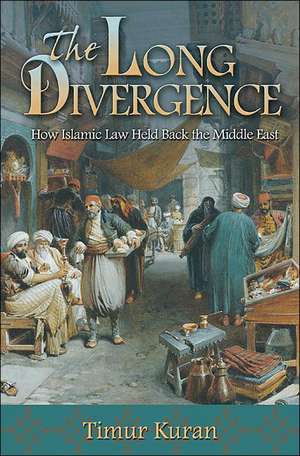
The Long Divergence
Autor Timur Kuranen Limba Engleză Hardback – 5 dec 2010
Timur Kuran argues that what slowed the economic development of the Middle East was not colonialism or geography, still less Muslim attitudes or some incompatibility between Islam and capitalism. Rather, starting around the tenth century, Islamic legal institutions, which had benefitted the Middle Eastern economy in the early centuries of Islam, began to act as a drag on development by slowing or blocking the emergence of central features of modern economic life--including private capital accumulation, corporations, large-scale production, and impersonal exchange. By the nineteenth century, modern economic institutions began to be transplanted to the Middle East, but its economy has not caught up. And there is no quick fix today. Low trust, rampant corruption, and weak civil societies--all characteristic of the region's economies today and all legacies of its economic history--will take generations to overcome.
The Long Divergence opens up a frank and honest debate on a crucial issue that even some of the most ardent secularists in the Muslim world have hesitated to discuss.
Preț: 296.11 lei
Puncte Express: 444
Carte tipărită la comandă
Livrare economică 07-21 decembrie
Livrare prin curier în România Termenul estimat este afișat lângă disponibilitate.
Transport gratuit de la 400.00 lei Plată online sau ramburs, în funcție de opțiunile comenzii.
Retur gratuit în 14 zile Comandă securizată și suport în română.
Specificații
ISBN-13: 9780691147567
ISBN-10: 0691147566
Pagini: 422
Ilustrații: 12 halftones. 8 line illus. 10 tables. 2 maps.
Dimensiuni: 161 x 240 x 29 mm
Greutate: 0.87 kg
Editura: Princeton University Press
Locul publicării:Princeton, United States
ISBN-10: 0691147566
Pagini: 422
Ilustrații: 12 halftones. 8 line illus. 10 tables. 2 maps.
Dimensiuni: 161 x 240 x 29 mm
Greutate: 0.87 kg
Editura: Princeton University Press
Locul publicării:Princeton, United States
Descriere
In the year 1000, the economy of the Middle East was at least as advanced as that of Europe. But by 1800, the region had fallen dramatically behind. What caused this long divergence? And why does the Middle East remain drastically underdeveloped compared to the West? This title provides an answer to these long-debated questions.