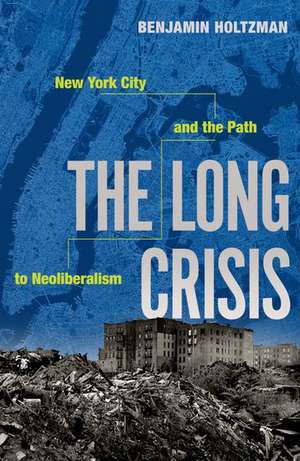
The Long Crisis: New York City and the Path to Neoliberalism
Autor Benjamin Holtzmanen Limba Engleză Paperback – aug 2023
Preț: 147.03 lei
Preț vechi: 174.18 lei
-16%
Puncte Express: 221
Carte disponibilă
Livrare economică 30 octombrie-04 noiembrie
Livrare prin curier în România Termenul estimat este afișat lângă disponibilitate.
Transport gratuit de la 400.00 lei Plată online sau ramburs, în funcție de opțiunile comenzii.
Retur gratuit în 14 zile Comandă securizată și suport în română.
Specificații
ISBN-13: 9780197746264
ISBN-10: 0197746268
Pagini: 352
Ilustrații: 18 halftones
Dimensiuni: 147 x 228 x 24 mm
Greutate: 0.45 kg
Editura: Oxford University Press
Colecția OUP USA
Locul publicării:New York, United States
ISBN-10: 0197746268
Pagini: 352
Ilustrații: 18 halftones
Dimensiuni: 147 x 228 x 24 mm
Greutate: 0.45 kg
Editura: Oxford University Press
Colecția OUP USA
Locul publicării:New York, United States
Recenzii
An impressive blending of social and political history, The Long Crisis chronicles the labors of urban homesteaders, tenant organizers, neighborhood watch groups, and park volunteers who, fed up with dysfunctional city governance, worked to improve city life through sweat equity and private investment....The strength of The Long Crisis lies in how it explains why so many New Yorkers adopted the practice of market solutions to urban problems, even if they did not agree with the conservative theory behind the city's neoliberal turn....Based on meticulous research...[it] should be read by scholars of contemporary social history, urban history, and the history of neoliberalism.
Holtzman's is a fresh, lively account that adds new complexity and detail to the narrative of how New York emerged from austerity and bankruptcy in the 1970s to become a playground for the wealthy today. The book also raises fascinating and urgent questions about how, exactly, privatization shapes governance.
Holtzman describes how New York City rebounded from urban decline and loss of faith in municipal governance in the last decades of the 20th century. City officials and neighborhood associations embraced marketization, namely greater reliance on private-public partnerships to 'save' New York from crime, decaying housing stock, corporate abandonment, and white flight....Yet, as Holtzman effectively points out, this neoliberal strategy, which replaced New Deal liberalism, produced greater income inequity, led to the decline of rent stabilization and increased homelessness, ended free public college tuition, led to higher bus and subway fares, loosened zoning restrictions for developers and gave them more tax abatements, and weakened overall city services....Recommended. Advanced undergraduates through faculty.
Holtzman is a thoughtful, careful, even-handed writer, and makes a compelling case that New Yorkers, whether poor people living in abandoned Bronx tenements or CEOs worried about their employees'safety in Bryant Park, turned to their own market-based experimentation not out of top-down ideology, but out of bottom-up desperation. His book is worth reading.
A history... traced with precision and care...The Long Crisis soars...in its granular mapping of the experimental, ad hoc, and contingent initiatives cooked up by an abandoned populace...By parsing these complexities, The Long Crisis, which refuses to put bounds on the temporal frame of 'crisis,'offers a guidebook and a cautionary tale for those organizing today.
An impressive blending of social and political history, The Long Crisis chronicles the labors of urban homesteaders, tenant organizers, neighborhood watch groups, and park volunteers who, fed up with dysfunctional city governance, worked to improve city life through sweat equity and private investment...The many accomplishments of The Long Crisisâ should be read by scholars of contemporary social history, urban history, and the history of neoliberalism.
Benjamin Holtzman's political history brilliantly complicates while reasserting neoliberalism's dominance over urban geographies by detailing how the political and social practices that are associated with neoliberalism emerged and, in some cases, originated among the groups it most adversely affected...Holtzman's book provides plenty of well researched and new topics about New York City's neoliberal history to discuss, debate, and cite for years to come.
At a time when all cities are struggling to come to terms with a new reality, in... The Long Crisis: New York City and the Path to Neoliberalism, Ben Holtzman provides an important and timely analysis of how one of them was transformed by a concerted socio-economic project.
As crises of different sorts continue to define our current moment, we would do well to not just learn from Holtzman's history but to follow its model.
In New York City, the failure of government to overcome the sustained urban crisis from the late 1960s through the 1980s inspired an ideologically diverse range of residents and civic groups, not just corporations and conservative elites, to 'take matters into our own hands.' The Long Crisis charts how liberal policymakers and grassroots activists embraced policies of marketization that included privatization of rent-regulated apartments, private management of public parks, citizen security patrols, and tax incentives for luxury real estate development and affordable housing construction. Holtzman demonstrates persuasively that Mayor Rudy Giuliani's neoliberal privatization agenda was the culmination, not the cause, of this profound shift toward private-sector solutions that ultimately accelerated social inequality. This is political history at its most capacious and creative.
Holtzman has written a compelling account of how ordinary New Yorkers navigated the 1970s financial crisis that eventually gave the private sector far more control of city services. He masterfully shows how South Bronx renters' eagerness to take over buildings, Queens residents' decision to volunteer, and Manhattanites' willingness to use business donations to clean up public parks were just as important as the spending cuts and tax breaks that brought an end to working-class New York.
How did we get to a point wherein the United States not only has such paltry public services but the fundamental belief in public institutions and public places is so discredited and disdained? Holtzman uncovers surprising wellsprings for the sweeping ascendance of privatization, market ideology, and elite political power in the 1980s. From Mayor Koch onward, city leaders opted for policies that invited corporate and monied elites to take control, push working-class and poor people out of the way, and reap the rewards of tax exemptions, release of rent-controlled apartments, private contracts, and Business Improvement Districts — market 'solutions' that spread well beyond New York. Dive in to the rich social struggles and political fights of The Long Crisis and find out how the wealthy took over Central Park and market triumphalism subverted municipal need.
Reacting to a period of crisis and decline in the 1970s, New York City increasingly turned to market solutions and public-private partnerships. In The Long Crisis, Benjamin Holtzman deftly eschews simplistic or conspiratorial narratives of this turn toward marketization and traces its rise to more complex and surprising forces. As the city now confronts a new set of crises, The Long Crisis forces us to think deeply about what roles both private and public sectors should play in urban life.
The Long Crisis is an engaging and revelatory history of New York's transformation into a neoliberal metropolis. Going beyond well-worn stories led by national politicians, technocrats, and corporate leaders, Holtzman takes us from housing to parks to policing to show how the efforts of New Yorkers shaped a privatized, market-oriented city from the bottom up. A book filled with colorful characters and rife with irony, this is a much-needed and novel explanation of how a city once known for the generosity of its public sector came to serve the market first.
The Long Crisis is an engaging empirical study of New York between the 1960s and the 1990s. Chapters on how city parks came to be maintained by private citizens, on how the growth of private security allowed affluent residents and business owners to police public space, and on how tax incentives spurred the private development of luxury housing provide richly textured descriptions of often opaque processes that should interest urbanists from all disciplines. Chapters on housing and houselessness offer nuanced, deeply humanized accounts of what readers might (incorrectly) anticipate will be familiar stories. The book is recommended for anyone interested in late twentieth-century urban, social, or political history.
Holtzman's is a fresh, lively account that adds new complexity and detail to the narrative of how New York emerged from austerity and bankruptcy in the 1970s to become a playground for the wealthy today. The book also raises fascinating and urgent questions about how, exactly, privatization shapes governance.
Holtzman describes how New York City rebounded from urban decline and loss of faith in municipal governance in the last decades of the 20th century. City officials and neighborhood associations embraced marketization, namely greater reliance on private-public partnerships to 'save' New York from crime, decaying housing stock, corporate abandonment, and white flight....Yet, as Holtzman effectively points out, this neoliberal strategy, which replaced New Deal liberalism, produced greater income inequity, led to the decline of rent stabilization and increased homelessness, ended free public college tuition, led to higher bus and subway fares, loosened zoning restrictions for developers and gave them more tax abatements, and weakened overall city services....Recommended. Advanced undergraduates through faculty.
Holtzman is a thoughtful, careful, even-handed writer, and makes a compelling case that New Yorkers, whether poor people living in abandoned Bronx tenements or CEOs worried about their employees'safety in Bryant Park, turned to their own market-based experimentation not out of top-down ideology, but out of bottom-up desperation. His book is worth reading.
A history... traced with precision and care...The Long Crisis soars...in its granular mapping of the experimental, ad hoc, and contingent initiatives cooked up by an abandoned populace...By parsing these complexities, The Long Crisis, which refuses to put bounds on the temporal frame of 'crisis,'offers a guidebook and a cautionary tale for those organizing today.
An impressive blending of social and political history, The Long Crisis chronicles the labors of urban homesteaders, tenant organizers, neighborhood watch groups, and park volunteers who, fed up with dysfunctional city governance, worked to improve city life through sweat equity and private investment...The many accomplishments of The Long Crisisâ should be read by scholars of contemporary social history, urban history, and the history of neoliberalism.
Benjamin Holtzman's political history brilliantly complicates while reasserting neoliberalism's dominance over urban geographies by detailing how the political and social practices that are associated with neoliberalism emerged and, in some cases, originated among the groups it most adversely affected...Holtzman's book provides plenty of well researched and new topics about New York City's neoliberal history to discuss, debate, and cite for years to come.
At a time when all cities are struggling to come to terms with a new reality, in... The Long Crisis: New York City and the Path to Neoliberalism, Ben Holtzman provides an important and timely analysis of how one of them was transformed by a concerted socio-economic project.
As crises of different sorts continue to define our current moment, we would do well to not just learn from Holtzman's history but to follow its model.
In New York City, the failure of government to overcome the sustained urban crisis from the late 1960s through the 1980s inspired an ideologically diverse range of residents and civic groups, not just corporations and conservative elites, to 'take matters into our own hands.' The Long Crisis charts how liberal policymakers and grassroots activists embraced policies of marketization that included privatization of rent-regulated apartments, private management of public parks, citizen security patrols, and tax incentives for luxury real estate development and affordable housing construction. Holtzman demonstrates persuasively that Mayor Rudy Giuliani's neoliberal privatization agenda was the culmination, not the cause, of this profound shift toward private-sector solutions that ultimately accelerated social inequality. This is political history at its most capacious and creative.
Holtzman has written a compelling account of how ordinary New Yorkers navigated the 1970s financial crisis that eventually gave the private sector far more control of city services. He masterfully shows how South Bronx renters' eagerness to take over buildings, Queens residents' decision to volunteer, and Manhattanites' willingness to use business donations to clean up public parks were just as important as the spending cuts and tax breaks that brought an end to working-class New York.
How did we get to a point wherein the United States not only has such paltry public services but the fundamental belief in public institutions and public places is so discredited and disdained? Holtzman uncovers surprising wellsprings for the sweeping ascendance of privatization, market ideology, and elite political power in the 1980s. From Mayor Koch onward, city leaders opted for policies that invited corporate and monied elites to take control, push working-class and poor people out of the way, and reap the rewards of tax exemptions, release of rent-controlled apartments, private contracts, and Business Improvement Districts — market 'solutions' that spread well beyond New York. Dive in to the rich social struggles and political fights of The Long Crisis and find out how the wealthy took over Central Park and market triumphalism subverted municipal need.
Reacting to a period of crisis and decline in the 1970s, New York City increasingly turned to market solutions and public-private partnerships. In The Long Crisis, Benjamin Holtzman deftly eschews simplistic or conspiratorial narratives of this turn toward marketization and traces its rise to more complex and surprising forces. As the city now confronts a new set of crises, The Long Crisis forces us to think deeply about what roles both private and public sectors should play in urban life.
The Long Crisis is an engaging and revelatory history of New York's transformation into a neoliberal metropolis. Going beyond well-worn stories led by national politicians, technocrats, and corporate leaders, Holtzman takes us from housing to parks to policing to show how the efforts of New Yorkers shaped a privatized, market-oriented city from the bottom up. A book filled with colorful characters and rife with irony, this is a much-needed and novel explanation of how a city once known for the generosity of its public sector came to serve the market first.
The Long Crisis is an engaging empirical study of New York between the 1960s and the 1990s. Chapters on how city parks came to be maintained by private citizens, on how the growth of private security allowed affluent residents and business owners to police public space, and on how tax incentives spurred the private development of luxury housing provide richly textured descriptions of often opaque processes that should interest urbanists from all disciplines. Chapters on housing and houselessness offer nuanced, deeply humanized accounts of what readers might (incorrectly) anticipate will be familiar stories. The book is recommended for anyone interested in late twentieth-century urban, social, or political history.
Notă biografică
Benjamin Holtzman is an Assistant Professor of History at Lehman College.
Cuprins
- Acknowledgments
- Introduction
- Chapter 1: Low-Income Housing in Crisis
- Chapter 2: From Renters to Owners
- Chapter 3: Remaking Public Parks
- Chapter 4: Patrolling City Streets
- Chapter 5: The Trouble with Development
- Chapter 6: The Governance of Homelessness and Public Space
- Conclusion
- Notes
- Index