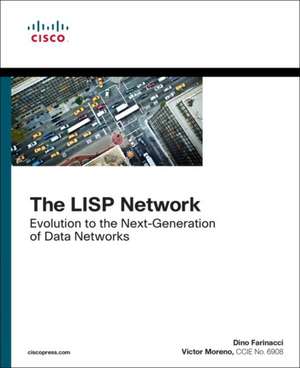
LISP Network, The: Networking Technology
Autor Dino Farinacci, Victor Morenoen Limba Engleză Paperback – 18 feb 2019
Structura progresivă: de la concept la implementare, transformă această lucrare într-o resursă tehnică esențială pentru înțelegerea modului în care identitatea dispozitivului poate fi separată de locația sa geografică. Publicată de Pearson Education, cartea The LISP Network oferă o perspectivă autoritară, fiind scrisă de Dino Farinacci, co-creator al protocolului, și Victor Moreno. Considerăm că valoarea acestui text rezidă în capacitatea de a explica un protocol complex, independent de familia de adrese, care poate încapsula orice protocol pentru a rula pe aproape orice rețea. Abordarea diferă de Smart Collaborative Identifier Network prin faptul că este mai puțin abstractă și mult mai aplicabilă în scenarii reale de producție. În timp ce alte lucrări se concentrează pe teorii viitoare ale internetului, The LISP Network se axează pe soluții imediate pentru virtualizarea la scară largă în WAN și centre de date multi-tenant. De asemenea, spre deosebire de LISP Network Deployment and Troubleshooting, care este centrat pe platformele Cisco, acest volum rămâne în mare parte neutru față de furnizor, oferind principii de arhitectură care pot fi adaptate în diverse medii hardware. Analizând cuprinsul, observăm o progresie logică: după stabilirea fundamentelor arhitecturale și a gestionării traficului unicast și multicast, autorii trec rapid la aplicații critice precum mobilitatea host-urilor și ingineria de trafic. Un aspect distinctiv este integrarea LISP cu Internet of Things și rețelele definite prin software (SDN), demonstrând versatilitatea protocolului în ecosistemele moderne de cloud computing. Finalul cărții, dedicat studiilor de caz și depanării, ancorează întreaga teorie în experiența practică a autorilor.

Preț: 351.49 lei
Preț vechi: 439.36 lei
-20%
Carte disponibilă
Livrare economică 14-28 noiembrie
Livrare express 03-07 noiembrie pentru 28.23 lei
Specificații
ISBN-10: 1587144719
Pagini: 192
Dimensiuni: 187 x 231 x 15 mm
Greutate: 0.33 kg
Editura: Pearson Education (US)
Colecția Networking Technology
Seria Networking Technology
V-ar putea interesa
-
 Computer Networks: A Systems ApproachLarry L. Peterson-41%Preț: 558.53 lei941.05 lei
 -
 -20%Preț: 267.82 lei334.78 lei
 -
 Segment Routing for Service Provider and Enterprise NetworksFlorian Deragisch-20%Preț: 492.95 lei616.18 lei
 -
 TCP/IP IllustratedKevin Fall-20%Preț: 403.13 lei503.92 lei
 -
 The Real Internet ArchitecturePamela Zave-20%Preț: 809.96 lei1012.44 lei
 -
 The Real Internet ArchitecturePamela Zave-20%Preț: 222.38 lei277.98 lei
 -
 -20%Preț: 249.78 lei312.23 lei
 -
 Networking All-In-One for DummiesDoug Lowe-20%Preț: 258.11 lei322.63 lei
 -
 -20%Preț: 432.49 lei540.61 lei
 -
 -20%Preț: 335.34 lei419.18 lei
 -
 LISP Network Deployment and TroubleshootingTarique Shakil-20%Preț: 363.44 lei454.29 lei
 -
 -20%Preț: 486.76 lei608.45 lei
 -
 -36%Preț: 284.35 lei440.95 lei
 -
 The Book of PF, 4th Edition: A No-Nonsense Guide to the OpenBSD FirewallPeter N.M. Hansteen-35%Preț: 282.67 lei437.64 lei
 -
 Advances in AI for Cloud, Edge, and Mobile Computing ApplicationsShrikaant Kulkarni-20%Preț: 1296.62 lei1620.78 lei
 -
 Packet Tracer for Young Intermediate AdminsDamian Strojek-20%Preț: 265.27 lei331.59 lei
 -
 Computer Networks in Packet Tracer for Intermediate UsersDamian Strojek-20%Preț: 265.31 lei331.65 lei
De ce să citești această carte
Recomandăm această carte inginerilor de rețea și arhitecților de sistem care au nevoie de o înțelegere profundă a protocolului LISP. Veți câștiga expertiza necesară pentru a implementa soluții de mobilitate a sarcinilor de lucru și virtualizare în centre de date moderne. Este un ghid tehnic indispensabil pentru cei care doresc să stăpânească scalabilitatea și flexibilitatea rețelelor de generație următoare, oferind răspunsuri concrete despre viitorul conectivității IP.
Despre autor
Dino Farinacci este o figură centrală în industria networking-ului, fiind recunoscut drept co-creator al protocolului LISP (Locator/ID Separation Protocol). Expertiza sa este dublată de cea a lui Victor Moreno, un specialist de top în dezvoltarea implementărilor LISP în cadrul Cisco. Împreună, autorii aduc o perspectivă unică asupra designului și evoluției standardelor de rețea, combinând viziunea arhitecturală cu rigoarea implementării practice. Contribuțiile lor la standardele Internet Engineering Task Force (IETF) fac din această lucrare o referință tehnică de prim rang pentru profesioniștii IT.
Descriere scurtă
In an era of ubiquitous clouds, virtualization, mobility, and the Internet of Things, information and resources must be accessible anytime, from anywhere. Connectivity to devices and workloads must be seamless even when people move, and their location must be fully independent of device identity. The Locator/ID Separation Protocol (LISP) makes all this possible.
The LISP Network is the first comprehensive, in-depth guide to LISP concepts, architecture, techniques, behavior, and applications. Co-authored by LISP co-creator Dino Farinacci and Victor Moreno-co-developer of the Cisco LISP implementation-it will help you identify the opportunities and benefits of deploying LISP in any data center, campus and branch access, WAN edge, or service provider core network.
This largely implementation-agnostic guide will be valuable to architects, engineers, consultants, technical sales professionals, and senior IT professionals in any largescale network environment. The authors show how LISP overcomes key problems in large-scale networking, thoroughly introduce its key applications, guide you through designing real-world solutions, and present detailed deployment case studies based on their pioneering experience.- Understand LISP's core principles, history, motivation, and applications- Explore LISP's technical architecture, components, mechanisms, and workflows- Use LISP to seamlessly deliver diverse network services and enable major advances in data center connectivity- Improve mobility, network segmentation, and policy management- Leverage software-defined WANs (SD-WANs) to efficiently move traffic from access to data center- Evolve access networks to provide pervasive, mega-scale, high-density modern connectivity - Integrate comprehensive security into the networking control and data plane, and learn how LISP infrastructure is protected against attacks- Enforce access control policies, connection integrity, confidentiality for data in flight, and end-point anonymity- Discover how LISP mobility mechanisms anticipate tomorrow's application use cases
Notă biografică
Dino Farinacci is a software engineer by trade and a technology visionary by passion, advancing the state of the art in computer networking. As one of the first Cisco Fellows, Dino holds more than 40 Internet and networking-related patents and has been a major IETF contributor for nearly 30 years with approximately 50 RFCs and Internet Drafts published. Dino is the founder of lispers.net, a nonprofit engineering organization, where he now focuses on design and deployment of LISP for IoT, cryptocurrency, and 5G mobile networks.
Dino is one of the original RFC co-authors of LISP, dating back to 2007, and has had the pleasure of writing two implementations of the protocol. He currently does consulting for large startup networking vendors and helps users deploy network designs using LISP and other architectures. If you can name an Internet protocol, there is a good chance Dino has designed and implemented it in widely deployed products. Over his career working at the NSA, CDC, 3Com, Procket, and Cisco, he has worked on dozens of operating systems, network protocols, and infrastructure systems.
Cuprins
- 1. LISP and the Future of Networking
- 2. LISP Architecture
- 3. LISP Unicast Handling Fundamentals
- 4. LISP Multicasting Fundamentals
- 5. Traffic Engineering and LISP
- 6. LISP Host Mobility
- 7. LISP Network Virtualization/Multi-tenancy
- 8. LISP and the Multi-homed Internet Edge
- 9. Programmability, Policy and LISP: Integration and Application
- 10. LISP and the Internet of Things
- 11. LISP Application Deployment, Configuration and Troubleshooting