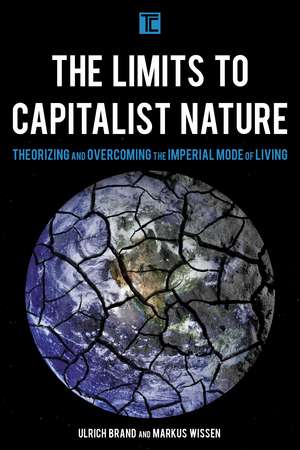
The Limits to Capitalist Nature: Theorizing and Overcoming the Imperial Mode of Living: Transforming Capitalism
Autor Ulrich Brand, Markus Wissenen Limba Engleză Paperback – 12 mar 2018






Preț: 282.67 lei
Preț vechi: 388.53 lei
-27%
Puncte Express: 424
Carte tipărită la comandă
Livrare economică 23 noiembrie-07 decembrie
Livrare prin curier în România Termenul estimat este afișat lângă disponibilitate.
Transport gratuit de la 400.00 lei Plată online sau ramburs, în funcție de opțiunile comenzii.
Retur gratuit în 14 zile Comandă securizată și suport în română.
Specificații
ISBN-13: 9781786601568
ISBN-10: 1786601567
Pagini: 152
Dimensiuni: 148 x 226 x 12 mm
Greutate: 0.24 kg
Editura: Bloomsbury Publishing
Colecția Rowman & Littlefield
Seria Transforming Capitalism
Locul publicării:New York, United States
ISBN-10: 1786601567
Pagini: 152
Dimensiuni: 148 x 226 x 12 mm
Greutate: 0.24 kg
Editura: Bloomsbury Publishing
Colecția Rowman & Littlefield
Seria Transforming Capitalism
Locul publicării:New York, United States
Cuprins
Chapter 1: Theorizing the Imperial Mode of Living: An Introduction
Chapter 2: The Crisis of Global Environmental Politics and the Imperial Mode of Living
Chapter 3: Crisis and Continuity of Capitalist Societal Nature Relations
Chapter 4: Strategies of a Green Economy, Contours of a Green Capitalism
Chapter 5: The Valorization and Financialization of Nature as Crisis Strategy
Chapter 6: Social-Ecological Transformation as the Horizon of a Practical Critique of the Imperial Mode of Living
Chapter 7: Towards the Democratization of Societal Nature Relations
Chapter 8: Overcoming the Imperial Mode of Living: Political and Strategic Implications
References
Index
Chapter 2: The Crisis of Global Environmental Politics and the Imperial Mode of Living
Chapter 3: Crisis and Continuity of Capitalist Societal Nature Relations
Chapter 4: Strategies of a Green Economy, Contours of a Green Capitalism
Chapter 5: The Valorization and Financialization of Nature as Crisis Strategy
Chapter 6: Social-Ecological Transformation as the Horizon of a Practical Critique of the Imperial Mode of Living
Chapter 7: Towards the Democratization of Societal Nature Relations
Chapter 8: Overcoming the Imperial Mode of Living: Political and Strategic Implications
References
Index
Recenzii
How and why does capitalism ceaselessly exploit the biophysical world yet remain resilient in the face of its manifest failures? Through their concept of the 'imperial mode of living' the authors show how the destructive forces of capitalism become, paradoxically, opportunities not only for political opposition but for capitalism itself. A battery of organisation, geographical and ideological manoeuvres allow the ecological limits to capitalism to be continuously overcome. Leveraging off these limits is the necessary work of capitalism's many opponents.
Brand and Wissen's remarkable synthesis of political sociology and political ecology tells how a hegemonic mode of consumption regulates society-nature relations under a newly emergent 'internationalised state'. If you want to know why global environmental crisis stems from 'the imperial way of living'; why financialization and the green economy stops its effective management; and why participatory socio-ecological transformation is urgent, then this is your book.
Brand and Wissen offer an innovative perspective on the limits of capitalist nature. The book is an important addition to the literature on the eco-social transformation of contemporary capitalism. Scholars, students and activists should read it.
This book has breakthrough appeal. It cuts through a thick layer of ideology around the crises of the societal relationships with nature in an age of climate change. Its innovative and precise core concept of 'the imperial mode of living' reveals the chief contradictions of daily life in neoliberalism and is a crucial contribution to current debates on the Capitalocene.
Everybody who wants to know why and how contemporary capitalist societies are so unsustainable, why a Great Transformation is such a big challenge, but also which alternative strategies do already exist, should read this book. It provides a powerful explanation as to why the current mode of production and living is socially unjust, ecologically disastrous and a major obstacle for an attractive future.
Brand and Wissen's remarkable synthesis of political sociology and political ecology tells how a hegemonic mode of consumption regulates society-nature relations under a newly emergent 'internationalised state'. If you want to know why global environmental crisis stems from 'the imperial way of living'; why financialization and the green economy stops its effective management; and why participatory socio-ecological transformation is urgent, then this is your book.
Brand and Wissen offer an innovative perspective on the limits of capitalist nature. The book is an important addition to the literature on the eco-social transformation of contemporary capitalism. Scholars, students and activists should read it.
This book has breakthrough appeal. It cuts through a thick layer of ideology around the crises of the societal relationships with nature in an age of climate change. Its innovative and precise core concept of 'the imperial mode of living' reveals the chief contradictions of daily life in neoliberalism and is a crucial contribution to current debates on the Capitalocene.
Everybody who wants to know why and how contemporary capitalist societies are so unsustainable, why a Great Transformation is such a big challenge, but also which alternative strategies do already exist, should read this book. It provides a powerful explanation as to why the current mode of production and living is socially unjust, ecologically disastrous and a major obstacle for an attractive future.