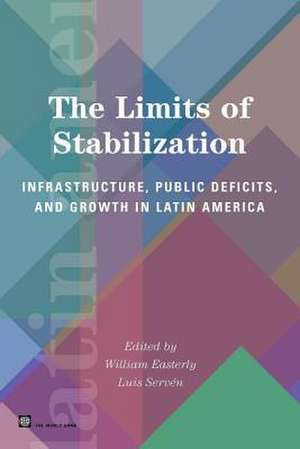
The Limits of Stabilization
Editat de William Easterly, Luis Servénen Limba Engleză Paperback – oct 2003
Preț: 257.74 lei
Puncte Express: 387
Carte tipărită la comandă
Livrare economică 05-19 decembrie
Livrare prin curier în România Termenul estimat este afișat lângă disponibilitate.
Transport gratuit de la 400.00 lei Plată online sau ramburs, în funcție de opțiunile comenzii.
Retur gratuit în 14 zile Comandă securizată și suport în română.
Specificații
ISBN-13: 9780821354896
ISBN-10: 0821354892
Pagini: 228
Ilustrații: 1
Dimensiuni: 151 x 228 x 20 mm
Greutate: 0.32 kg
Editura: World Bank Publications
ISBN-10: 0821354892
Pagini: 228
Ilustrații: 1
Dimensiuni: 151 x 228 x 20 mm
Greutate: 0.32 kg
Editura: World Bank Publications
V-ar putea interesa
-
 -16%Preț: 100.14 lei118.83 lei
 -
 -25%Preț: 179.79 lei239.32 lei
 -
 Business Regulation and Economic PerformanceNorman LoayzaPreț: 327.68 lei
 -
 The Public Debt ProblemP. Lemieux-15%Preț: 660.78 lei777.39 lei
 -
 Planning Japan's Economic FutureK. Sheridan-8%Preț: 661.23 lei718.73 lei
 -
 -8%Preț: 666.97 lei724.96 lei
 -
 International Financial ArchitectureC. Peláez-15%Preț: 650.44 lei765.22 lei
 -
 Area C and the Future of the Palestinian EconomyOrhan NiksicPreț: 194.33 lei
 -
 Preț: 244.44 lei
 -
 Puzzles of Economic GrowthLeszek BalcerowiczPreț: 333.30 lei
 -
 Preț: 290.83 lei
 -
 Fiscal and Welfare Impacts of Electricity Subsidies in Central AmericaMarco Antonio Hernández OréPreț: 264.56 lei
 -
 The Rise of Today's Rich and Super-RichRoy C. SmithPreț: 251.28 lei
 -
 -19%Preț: 479.14 lei591.53 lei
 -
 Preț: 178.44 lei
 -
 Business CyclesSumru G. AltugPreț: 456.74 lei
 -
 -18%Preț: 883.32 lei1077.21 lei
 -
 Growth with InequalityJinjun Xue-18%Preț: 838.24 lei1022.24 lei
Recenzii
"This fascinating book highlights a neglected cost of two decades of fiscal austerity in Latin America. The authors' careful analysis reveals that the decline in public investment in infrastructure may have been expensive not only for growth but for long-term fiscal solvency as well. Deserves to be read by every IMF economist (and many others besides)." —Dani Rodrik,John F. Kennedy School of Government, Harvard University
"The lessons from this research are likely to be valuable not only for developing countries but also for the European countries that are part of the Euro zone." —Sergio Rebelo,Kellogg School of Management, Northwestern University
Notă biografică
William Easterly is Senior Fellow at the Center for Global Development and the Institute for International Economics in Washington, DC. Luis Servén is Lead Specialist in the Office of the Chief Economist of the Latin America and Caribbean Region of the World Bank.
Textul de pe ultima copertă
“This fascinating book highlights a neglected cost of two decades of fiscal austerity in Latin America. The authors’ careful analysis reveals that the decline in public investment in infrastructure may have been expensive not only for growth but for long-term fiscal solvency as well. Deserves to be read by every IMF economist (and many others besides).” —Dani Rodrik,John F. Kennedy School of Government, Harvard University
“The lessons from this research are likely to be valuable not only for developing countries but also for the European countries that are part of the Euro zone.” —Sergio Rebelo,Kellogg School of Management, Northwestern University
“The lessons from this research are likely to be valuable not only for developing countries but also for the European countries that are part of the Euro zone.” —Sergio Rebelo,Kellogg School of Management, Northwestern University