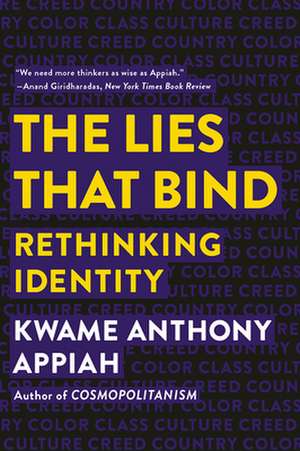
The Lies That Bind
Autor Kwame Anthony Appiahen Limba Engleză Paperback – 20 aug 2019
Într-o epocă marcată de polarizare extremă, ne întrebăm adesea ce anume ne definește cu adevărat și de ce etichetele pe care le purtăm par să ne despartă mai mult decât să ne unească. Observăm cum dezbaterea publică se blochează frecvent în jurul conceptelor de rasă, religie sau apartenență culturală, tratate ca adevăruri imuabile. În The Lies That Bind, Kwame Anthony Appiah ne invită la o regândire radicală a acestor piloni identitari, demonstrând că multe dintre certitudinile noastre sunt, de fapt, construcții istorice fragile sau „minciuni” necesare care ne guvernează existența. Recomandăm această lectură pentru modul curajos în care deconstruiește miturile suveranității naționale și ale purității culturale. Stilul lui Appiah este unul de o eleganță rară, împletind rigoarea filosofică cu narațiuni biografice fascinante — de la povestea unui copil african devenit filosof în Europa secolului al XVIII-lea, până la experiențele propriului său tată în lupta anticolonială. Pe aceeași linie cu volumul Identity de Henry Harris, care explorează conceptul din perspective multidisciplinare, lucrarea lui Appiah se distinge printr-o abordare mai personală și o ancorare profundă în istoria ideilor politice. Credem că valoarea acestui eseu rezidă în capacitatea de a ne arăta că, deși identitățile sunt adesea bazate pe erori științifice sau istorice, ele rămân esențiale pentru progresul moral. Față de lucrările sale anterioare, precum Cosmopolitanism, unde pleda pentru o etică globală, The Lies That Bind analizează mai îndeaproape mecanismele psihologice și sociale care ne fac să ne agățăm de grupuri specifice, oferind un ghid intelectual indispensabil pentru a înțelege cine suntem cu adevărat în secolul XXI.
Preț: 88.63 lei
Carte disponibilă
Livrare economică 11-25 noiembrie
Specificații
ISBN-10: 1631495976
Pagini: 272
Dimensiuni: 139 x 208 x 20 mm
Greutate: 0.23 kg
Editura: Liveright Publishing Corporation
V-ar putea interesa
-
 Setting Health-Care Priorities: What Ethical Theories Tell UsTorbjörn Tännsjö-21%Preț: 517.27 lei654.87 lei
 -
 In My Father's House: Africa in the Philosophy of CultureKwame Anthony Appiah-24%Preț: 186.68 lei245.00 lei
 -
 Thinking it Through: An Introduction to Contemporary PhilosophyKwame Anthony Appiah-24%Preț: 683.59 lei903.57 lei
 -
 Encyclopedia of Africa: Two-volume setHenry Louis Gates-31%Preț: 1733.86 lei2520.74 lei
 -
 -18%Preț: 1112.38 lei1356.55 lei
 -
 Preț: 404.57 lei
 -
 Compromise and Disagreement in Contemporary Political TheoryChristian RostbollPreț: 471.68 lei
 -
 CosmopolitanismKwame Anthony AppiahPreț: 92.78 lei
 -
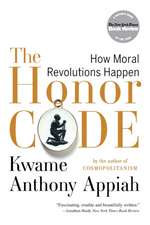 The Honor CodeKwame Anthony AppiahPreț: 87.17 lei
 -
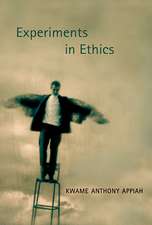 Experiments in EthicsKwame Anthony AppiahPreț: 164.54 lei
 -
 The Ethics of IdentityKwame Anthony AppiahPreț: 210.83 lei
 -
 Preț: 102.22 lei
 -
 On AugustineAlan RyanPreț: 80.56 lei
 -
 -15%Preț: 625.00 lei735.29 lei
 -
 Understanding Digital Ethics: Cases and ContextsJonathan BeeverPreț: 379.94 lei
 -
 Re-Uniting the StatesMatthew-John CalvinPreț: 111.14 lei
 -
 RealityWynand de BeerPreț: 147.80 lei
 -
 The Concept of AnxietySøren KierkegaardPreț: 97.94 lei
 -
 The Stone Reader: Modern Philosophy in 133 ArgumentsPeter CatapanoPreț: 258.37 lei
 -
 The Internet of UsMichael P LynchPreț: 93.02 lei
 -
 Modern Ethics in 77 ArgumentsPeter CatapanoPreț: 110.98 lei
 -
 Jean-Jacques Rousseau: A Collection of Short EssaysBen Wood JohnsonPreț: 62.24 lei
 -
 Preț: 141.27 lei
 -
 Der KosmopolitKwame Anthony AppiahPreț: 91.60 lei
De ce să citești această carte
Recomandăm această carte oricui dorește să înțeleagă rădăcinile conflictelor identitare moderne dincolo de lozincile politice. Cititorul va câștiga o perspectivă clară asupra modului în care clasa, rasa și religia ne modelează viața, învățând să navigheze complexitatea socială fără a cădea în capcana extremismului. Este un instrument esențial pentru profesioniștii din științe sociale și pentru orice spirit critic preocupat de viitorul coeziunii umane.
Despre autor
Kwame Anthony Appiah, președinte al PEN American Center și profesor la Universitatea Princeton, este unul dintre cei mai influenți gânditori contemporani asupra culturii și identității. Născut în Ghana și educat în Anglia, parcursul său multicultural îi oferă o perspectivă unică asupra temelor abordate. Este autorul unor lucrări de referință precum The Ethics of Identity și Cosmopolitanism, fiind recunoscut la nivel internațional pentru claritatea cu care analizează problemele etice complexe. Experiența sa vastă pe trei continente se reflectă în abordarea sa umanistă și în rigoarea cu care tratează subiectele sensibile ale societății actuale.
Descriere scurtă
Kwame Anthony Appiah's The Lies That Bind is an incandescent exploration of the nature and history of the identities that define us. It challenges our assumptions about how identities work. We all know there are conflicts between identities, but Appiah shows how identities are created by conflict. Religion, he demonstrates, gains power because it isn't primarily about belief. Our everyday notions of race are the detritus of discarded nineteenth-century science. Our cherished concept of the sovereign nation--of self-rule--is incoherent and unstable. Class systems can become entrenched by efforts to reform them. Even the very idea of Western culture is a shimmering mirage.
From Anton Wilhelm Amo, the eighteenth-century African child who miraculously became an eminent European philosopher before retiring back to Africa, to Italo Svevo, the literary marvel who changed citizenship without leaving home, to Appiah's own father, Joseph, an anticolonial firebrand who was ready to give his life for a nation that did not yet exist, Appiah interweaves keen-edged argument with vibrant narratives to expose the myths behind our collective identities.
These "mistaken identities," Appiah explains, can fuel some of our worst atrocities--from chattel slavery to genocide. And yet, he argues that social identities aren't something we can simply do away with. They can usher in moral progress and bring significance to our lives by connecting the small scale of our daily existence with larger movements, causes, and concerns.
Elaborating a bold and clarifying new theory of identity, The Lies That Bind is a ringing philosophical statement for the anxious, conflict-ridden twenty-first century. This book will transform the way we think about who--and what--"we" are.
Notă biografică
Recenzii
There is barely a word in his book I don't agree with
This book will help a lot of people think with far more clarity about some of the thorniest issues of our times. An inspiring and essential read.
Appiah's essays are exquisitely and painstakingly argued.
Erudite, personal, timely and deeply humane, this is a book for our time.
[Appiah is] one of the most brilliant philosophers in the English-speaking world. He is an intellectual hero of mine... a brilliant and beautiful thinker. He writes with élan and clarity, erudition and wit.
Not only does that elegant writer and transcendent thinker, Anthony Appiah, clarify the historical gaslighting around color and racial stereotype, he also forges radical new theories of identity as they apply to almost every conceivable aspect of self. The Lies That Bind forces you to rethink what tribe you actually belong to with regard to race and religion, geography and gender, class and sexuality. Sheer genius and a joy to read.
Appiah makes the controversial and difficult subject of identity lucid, edifying, and even fun. When it comes to the humane values that allow us to live with one another, he may be our most penetrating?and entertaining?major philosopher.
This wonderful book unravels a tapestry of suppositions about identity. Understanding what draws us together and what tears us apart lies at the core of democracy. This is a vital book, an antidote to violent nativism, and a key to success in the human experiment.
The terrible power of bad ideas is best resisted, as The Lies That Bind shows, by subjecting them to serious critical scrutiny. Identities central to contemporary cultures can be both historically grounded and utterly misconceived. There is so much to learn from Anthony Appiah's splendid book.
The Lies That Bind ranges even more widely in time and space than [Francis Fukuyama's] Identity... The point of this entertaining, meandering journey is that identities are less solid than is frequently thought.
The Lies That Bind is a wise and erudite introduction to this most vexed of subjects.
Excellent... Appiah hopes to inspire a rethinking of our restrictive and therefore divisive notions of who we are. But if that seems an impossible task, should the massive obstacles stop us from trying? [Appiah] brings to the task a number of insights and the mind of a realist... if the solution to the fracturing of our world remains elusive, this book at least helps us think clearly about the problem.
If you are going to read only one book on identity this year, Appiah's is the one
A topical study, particularly given today's societal divisions in the US and UK.
The Lies that Bind is a small volume of mighty power. In his lucid prose, Appiah elegantly dismantles the humbug, dogma, pseudo-science and propaganda that have long dogged our attempts to discuss 'identity,' and offers in their place a practical and philosophical tool-kit, as subtly radical in its aims as it is humane in application. From the illusions of 19th century ideas of biological destiny, to the late-capitalist logic of our contemporary 'cultural appropriation' debates, this book will help a lot of people think with far more clarity about some of the thorniest issues of our times. An inspiring and essential read.
Through this meditative journey, Appiah calls on us to buckle down to the difficult task of living with complexity -that is, the task of being modern. Erudite, personal, timely and deeply humane, this is a book for our time.
A provocative and brilliant intervention into the current discussion of the role identity plays in our society. We're doing it all wrong, as Appiah demonstrates with characteristic erudition, clear thinking, and elegant prose.
Descriere
We often think identity is personal. But the identities that shape the world, our struggles, and our hopes, are social ones, shared with countless others. Our sense of self is shaped by our family, but also by affiliations that spread out from there, like our nationality, culture, class, race and religion.Taking these broad categories as a starting point, Professor Appiah challenges our assumptions about how identity works. In eloquent and lively chapters, he weaves personal anecdote with historical, cultural and literary example to explore the entanglements within the stories we tell ourselves. We all know there are conflicts among identities; but Professor Appiah explores how identities are created by conflict. Identities are then crafted from confusions - confusions this book aims to help us sort through. Religion, Appiah shows us, isn't primarily about beliefs. The idea of national self-determination is incoherent. Our everyday racial thinking is an artefact of discarded science. Class is not a matter of upper and lower. And the very idea of Western culture is a misleading myth. We will see our situation more clearly if we start to question these mistaken identities. This is radical new thinking from a master in the subject and will change forever the way we think about ourselves and our communities.