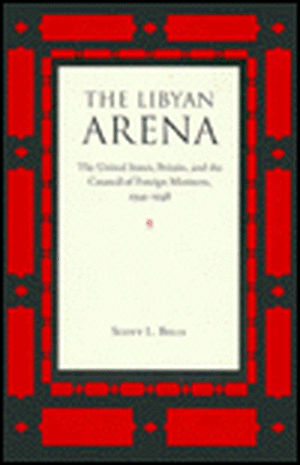
The Libyan Arena: The United States, Britain, and the Council of Foreign Ministers, 1945-1948: American Diplomatic History, cartea 0008
Autor Shirley Bills, Scott L. Billsen Limba Engleză Hardback – 28 feb 1995




Preț: 211.75 lei
Nou
Puncte Express: 318
Preț estimativ în valută:
37.47€ • 43.94$ • 32.91£
37.47€ • 43.94$ • 32.91£
Carte disponibilă
Livrare economică 19 ianuarie-02 februarie 26
Preluare comenzi: 021 569.72.76
Specificații
ISBN-13: 9780873385114
ISBN-10: 087338511X
Pagini: 209
Dimensiuni: 157 x 236 x 24 mm
Greutate: 0.5 kg
Ediția:New.
Editura: Kent State University Press
Seriile American Diplomatic History S., American Diplomatic History
ISBN-10: 087338511X
Pagini: 209
Dimensiuni: 157 x 236 x 24 mm
Greutate: 0.5 kg
Ediția:New.
Editura: Kent State University Press
Seriile American Diplomatic History S., American Diplomatic History
V-ar putea interesa
-
 GoebbelsPeter Longerich-18%Preț: 99.21 lei120.48 lei
 -
 The German WarNicholas Stargardt-27%Preț: 87.20 lei119.31 lei
 -
 Decolonization: A Very Short IntroductionDane Kennedy-22%Preț: 52.24 lei67.16 lei
 -
 KLNikolaus Wachsmann-25%Preț: 89.26 lei119.65 lei
 -
 The Long Sixties – America, 1955–1973CB StrainPreț: 273.03 lei
 -
 Red PlentyFrancis SpuffordPreț: 90.20 lei
 -
 Preț: 278.95 lei
 -
 The Invention of RussiaArkady Ostrovsky-18%Preț: 63.09 lei77.29 lei
 -
 Kent State/May 4: Echoes Through a DecadeShirley BillsPreț: 183.25 lei
 -
 Memoir of a Cold War SoldierRichard E MackPreț: 170.35 lei
 -
 Call Me Mike: A Political Biography of Michael V. DiSalleRichard G. ZimmermanPreț: 195.93 lei
 -
 Ohio and Its PeopleGeorge W. KnepperPreț: 292.80 lei
 -
 Preț: 341.29 lei
 -
 Fighting the Unbeatable FoeTom DiemerPreț: 196.97 lei
 -
 Growing Up with ClementeRichard PetersonPreț: 103.41 lei
 -
 Berlin 1936Oliver HilmesPreț: 146.14 lei
Textul de pe ultima copertă
Following the Second World War, the disposition of Italy's former colonies, Libya, Eritrea, and Somalia, became the responsibility of the Council of Foreign Ministers (CFM), a body of representatives from Britain, France, the Soviet Union, and the United States. The controversies that evolved within this coalition over the settlement of these dependencies played a significant role in shaping U.S.-British relations - particularly their partnership in the Middle East - as cold war tensions intensified. The Libyan Arena examines Anglo-American plans for North African decolonization and focuses specifically on the events preceding the UN discussions that led to the creation of the modern Libyan state. Based primarily on sources at the National Archives in Washington, D.C., and newly opened files at the Public Record Office in Kew, England, this study represents the most accurate and comprehensive account to date of the CFM's work in North Africa. Students of 20th-century U.S.-British diplomatic history, post-War II African and Middle Eastern history, transnational policymaking, decolonization, and the early cold war era will find much of interest here.