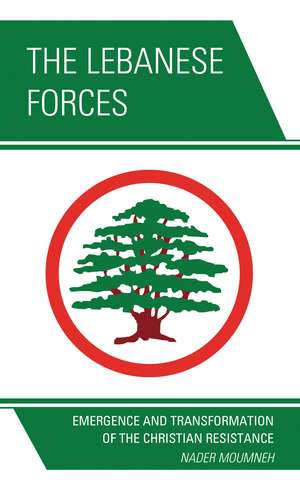
The Lebanese Forces: Emergence and Transformation of the Christian Resistance
Autor Nader Moumnehen Limba Engleză Paperback – 17 dec 2018
Mr. Moumneh drew upon his self-acquired persuasion tactics and negotiation strategies to earn the Lebanese Forces' trust and gain access to top secret, never-before published information. Since then, he has continually revised and expanded the manuscript to address the rapidly changing situation in Lebanon and the Middle East. The Lebanese Forces: Emergence and Transformation of the Christian Resistance has taken twenty-five years to produce and is unique in its own right. Mr. Moumneh's work is not a typical re-telling of the Lebanese crisis, rather it is a magnificent blend of skillful craftsmanship, an unprecedented wealth of painstakingly referenced chronological research and now declassified intelligence information.
Preț: 403.13 lei
Preț vechi: 584.93 lei
-31%
Puncte Express: 605
Carte tipărită la comandă
Livrare economică 03-17 decembrie
Livrare prin curier în România Termenul estimat este afișat lângă disponibilitate.
Transport gratuit pentru acest produs Plată online sau ramburs, în funcție de opțiunile comenzii.
Retur gratuit în 14 zile Comandă securizată și suport în română.
Specificații
ISBN-13: 9780761870883
ISBN-10: 0761870881
Pagini: 622
Ilustrații: 34 b/w photos;
Dimensiuni: 150 x 228 x 36 mm
Greutate: 0.95 kg
Editura: Bloomsbury Publishing
Colecția Hamilton Books
Locul publicării:New York, United States
ISBN-10: 0761870881
Pagini: 622
Ilustrații: 34 b/w photos;
Dimensiuni: 150 x 228 x 36 mm
Greutate: 0.95 kg
Editura: Bloomsbury Publishing
Colecția Hamilton Books
Locul publicării:New York, United States
Cuprins
Foreword
Preface
Acknowledgments
Part I
Chapter 1: Party System Development in Religiously Divided Lebanon
Chapter 2: The Kataeb Party in the Prewar Period
Chapter 3: The Palestinian Settlement in Lebanon and Its Effects on Christian Militancy
Part II
Chapter 4: The Creation of a Unified Command Council for the Christian Militias
Chapter 5: The Ascendancy of Bashir Gemayel
Chapter 6: Power Struggle within the Lebanese Forces
Chapter 7: The Rise to Prominence of Samir Geagea
Chapter 8: General Aoun's Futile Wars
Chapter 9: The Lebanese Forces in the Post-Taif Era
Part III
Chapter 10: The Syrian Diktat over Lebanon
Chapter 11: A Prelude to the Cedars Revolution
Chapter 12: The End of Syria's Military Hegemony over Lebanon
Chapter 13: The Return in Full Force of the Lebanese Forces
Chapter 14: Syria and Iran's Vain Attempts to Derail the Cedars Revolution
Chapter 15: Significant Victories for the March 14 Alliance in the Legislative and Municipal Elections
Chapter 16: The Battle over the S
Preface
Acknowledgments
Part I
Chapter 1: Party System Development in Religiously Divided Lebanon
Chapter 2: The Kataeb Party in the Prewar Period
Chapter 3: The Palestinian Settlement in Lebanon and Its Effects on Christian Militancy
Part II
Chapter 4: The Creation of a Unified Command Council for the Christian Militias
Chapter 5: The Ascendancy of Bashir Gemayel
Chapter 6: Power Struggle within the Lebanese Forces
Chapter 7: The Rise to Prominence of Samir Geagea
Chapter 8: General Aoun's Futile Wars
Chapter 9: The Lebanese Forces in the Post-Taif Era
Part III
Chapter 10: The Syrian Diktat over Lebanon
Chapter 11: A Prelude to the Cedars Revolution
Chapter 12: The End of Syria's Military Hegemony over Lebanon
Chapter 13: The Return in Full Force of the Lebanese Forces
Chapter 14: Syria and Iran's Vain Attempts to Derail the Cedars Revolution
Chapter 15: Significant Victories for the March 14 Alliance in the Legislative and Municipal Elections
Chapter 16: The Battle over the S
Recenzii
The history of the Lebanese Forces is an important and quite fascinating story. Insofar as Nader Moumneh's book is concerned, we can say that it constitutes an important first step on the way to portraying that history.
Lebanon came under attack from many subversive ideologies in the 1970s: Arabism, Baathism, Palestinianism, and Islamism. They threatened the country's unique nature and even its political existence. The Lebanese Forces (LF) arose in response, serving as a Christian resistance movement. Moumneh's lengthy, historical narrative-rigorously factual and objective-chronicles their story. . . . the author does not obscure the errors of the Christian resistance: The LF and army failed to merge; the Kataeb political party proved intolerant of rivals; and the idea of Lebanese federalism never became credible. Yet Moumneh still hopes that the day will come when Lebanon will be a modern, secular, and democratic country. His book offers a source for reflection on that hope.
Nader Moumneh, a native Lebanese, has written a comprehensive, sweeping, and detailed volume. . . .His unique perspective, familiarity, and empathy, has produced a thorough and vivid political history of the Lebanese Forces. The book's pages are full of much action, suspense, surprise, and intrigue. One can almost hear the gunfire and explosions behind the events the author relates . . .
Nader Moumneh has provided a first-rate historical record. Indeed, this work is a thriller in scholarship.
Mr. Moumneh's work is a long overdue analysis of the complex forces at work within the Christian resistance, their genesis in the ancient and indigenous people of the land, and their desire to maintain their existence in their small and threatened region while facing malign forces bent on their destruction. This comprehensive and exhaustively researched chronicle by Mr. Moumneh does not fail to point out the many missteps, mistakes, and failures of the Lebanese Forces and their leaders as well as their victories. Those who consider themselves well versed on the topic and history of modern Lebanon will learn a great deal reading this book. Both the expert and layman will find this masterpiece of Lebanese history exquisitely researched and documented.
Mr. Moumneh is not only the pioneer in unfolding and discovering the catalyst of what is now known as United Nations Security Council Resolution (UNSCR) 1559; he is also the curator and guardian of the realities of Lebanon's history that often get buried or, even worse, misconstrued. Moumneh's fervent research and diligent attention to detail regarding why and how UNSCR 1559 was formed, and the affirmative votes that instituted the revolutionary resolution, is what makes this book a must-read for all. The foundation for the free and fair electoral process within Lebanon and ultimately the country's sovereignty directly derive from the French- and American-backed resolution. Moumneh unveils why these outcomes were critical and how they became a reality.
Nader Moumneh provides an extensive analysis of Lebanese political party backgrounds, their absolute need to be affiliated to foreign powers, and their willingness to change allegiances in a never-ending quest for relevancy. The book is an exciting read with vivid displays of a frail and tenuous balance that is Lebanese politics and details the attempts by some to maintain the forward development of this precious and loveable nation of Lebanon.
A nation beset by terrorism, assassinations, murder, destruction, and secret manipulation of national and international authorities alike, inside the government of Lebanon lies a fertile bed where corruption breeds and festers, dismantling an otherwise harmonious and pluralist society.
The Lebanese diaspora masterminded United Nations Security Council Resolution 1559 through their endeavours with the World Lebanese Cultural Union and the World Council of the Cedars Revolution. The net result was awareness and actions by powerful Western bloc nations as well as other UN Security Council members to remove the Syrian occupation of Lebanon and remove terrorist organizations such as Hezbollah. The success and effectiveness of a determined Lebanese Diaspora has been absolutely remarkable.
I commend this book as a most enriching and captivating read to every loyal Lebanese throughout the world.
Canadian-Lebanese writer Nader Moumneh's 2018 book fills a useful niche in that it is a sympathetic and detailed overview of the main Lebanese Christian military-political formation born during the Lebanese Civil War, a formation that became a leading Lebanese nationalist political party after the war ended.
Nader Moumneh's lengthy, meticulously researched, and extremely accurate historical narrative chronicles the formation and evolution of the Kataeb Party from 1936 to 1975 and the emergence and transformation of the Lebanese Forces from 1976 to 2011. It is one of the rare scholarly works on the Christian resistance in Lebanon that is based on facts and data-based information without any emotional bias. . . . It is a seminal work, noteworthy for its meticulous adherence to historical accuracy, as well as its innovative portrayal of the perspectives of the sovereign Lebanese people. It seamlessly melds scholarly rigour with a refreshingly accessible and relatable narrative style.
Lebanon came under attack from many subversive ideologies in the 1970s: Arabism, Baathism, Palestinianism, and Islamism. They threatened the country's unique nature and even its political existence. The Lebanese Forces (LF) arose in response, serving as a Christian resistance movement. Moumneh's lengthy, historical narrative-rigorously factual and objective-chronicles their story. . . . the author does not obscure the errors of the Christian resistance: The LF and army failed to merge; the Kataeb political party proved intolerant of rivals; and the idea of Lebanese federalism never became credible. Yet Moumneh still hopes that the day will come when Lebanon will be a modern, secular, and democratic country. His book offers a source for reflection on that hope.
Nader Moumneh, a native Lebanese, has written a comprehensive, sweeping, and detailed volume. . . .His unique perspective, familiarity, and empathy, has produced a thorough and vivid political history of the Lebanese Forces. The book's pages are full of much action, suspense, surprise, and intrigue. One can almost hear the gunfire and explosions behind the events the author relates . . .
Nader Moumneh has provided a first-rate historical record. Indeed, this work is a thriller in scholarship.
Mr. Moumneh's work is a long overdue analysis of the complex forces at work within the Christian resistance, their genesis in the ancient and indigenous people of the land, and their desire to maintain their existence in their small and threatened region while facing malign forces bent on their destruction. This comprehensive and exhaustively researched chronicle by Mr. Moumneh does not fail to point out the many missteps, mistakes, and failures of the Lebanese Forces and their leaders as well as their victories. Those who consider themselves well versed on the topic and history of modern Lebanon will learn a great deal reading this book. Both the expert and layman will find this masterpiece of Lebanese history exquisitely researched and documented.
Mr. Moumneh is not only the pioneer in unfolding and discovering the catalyst of what is now known as United Nations Security Council Resolution (UNSCR) 1559; he is also the curator and guardian of the realities of Lebanon's history that often get buried or, even worse, misconstrued. Moumneh's fervent research and diligent attention to detail regarding why and how UNSCR 1559 was formed, and the affirmative votes that instituted the revolutionary resolution, is what makes this book a must-read for all. The foundation for the free and fair electoral process within Lebanon and ultimately the country's sovereignty directly derive from the French- and American-backed resolution. Moumneh unveils why these outcomes were critical and how they became a reality.
Nader Moumneh provides an extensive analysis of Lebanese political party backgrounds, their absolute need to be affiliated to foreign powers, and their willingness to change allegiances in a never-ending quest for relevancy. The book is an exciting read with vivid displays of a frail and tenuous balance that is Lebanese politics and details the attempts by some to maintain the forward development of this precious and loveable nation of Lebanon.
A nation beset by terrorism, assassinations, murder, destruction, and secret manipulation of national and international authorities alike, inside the government of Lebanon lies a fertile bed where corruption breeds and festers, dismantling an otherwise harmonious and pluralist society.
The Lebanese diaspora masterminded United Nations Security Council Resolution 1559 through their endeavours with the World Lebanese Cultural Union and the World Council of the Cedars Revolution. The net result was awareness and actions by powerful Western bloc nations as well as other UN Security Council members to remove the Syrian occupation of Lebanon and remove terrorist organizations such as Hezbollah. The success and effectiveness of a determined Lebanese Diaspora has been absolutely remarkable.
I commend this book as a most enriching and captivating read to every loyal Lebanese throughout the world.
Canadian-Lebanese writer Nader Moumneh's 2018 book fills a useful niche in that it is a sympathetic and detailed overview of the main Lebanese Christian military-political formation born during the Lebanese Civil War, a formation that became a leading Lebanese nationalist political party after the war ended.
Nader Moumneh's lengthy, meticulously researched, and extremely accurate historical narrative chronicles the formation and evolution of the Kataeb Party from 1936 to 1975 and the emergence and transformation of the Lebanese Forces from 1976 to 2011. It is one of the rare scholarly works on the Christian resistance in Lebanon that is based on facts and data-based information without any emotional bias. . . . It is a seminal work, noteworthy for its meticulous adherence to historical accuracy, as well as its innovative portrayal of the perspectives of the sovereign Lebanese people. It seamlessly melds scholarly rigour with a refreshingly accessible and relatable narrative style.