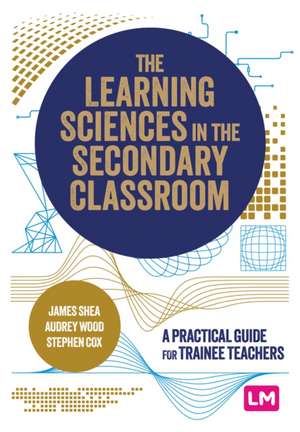
The Learning Sciences in the Secondary Classroom
Autor James Shea, Audrey Wood, Stephen Coxen Limba Engleză Paperback – 13 iun 2026
Preț: 217.97 lei
Puncte Express: 327
Carte disponibilă
Livrare economică 12-26 noiembrie
Livrare express 29 octombrie-04 noiembrie pentru 24.02 lei
Livrare prin curier în România Termenul estimat este afișat lângă disponibilitate.
Transport gratuit de la 400.00 lei Plată online sau ramburs, în funcție de opțiunile comenzii.
Retur gratuit în 14 zile Comandă securizată și suport în română.
Specificații
ISBN-13: 9781529687484
ISBN-10: 1529687489
Pagini: 170
Dimensiuni: 170 x 244 x 9 mm
Greutate: 0.28 kg
Editura: LEARNING MATTERS
ISBN-10: 1529687489
Pagini: 170
Dimensiuni: 170 x 244 x 9 mm
Greutate: 0.28 kg
Editura: LEARNING MATTERS
Notă biografică
Dr James Shea is Principal Lecturer and the Initial Teacher Education Portfolio Leader at the University of Bedfordshire, overseeing all undergraduate and postgraduate teacher education programs. His primary focus is on educating teachers and collaborating with partnership schools through research and teacher education. He is a highly awarded academic whose research expertise covers key areas in cognitive science, including retrieval practice and the use of cognitive load theory in teaching, as well as GCSE student revision strategies.
Cuprins
Part I
1. Introduction - Using the learning sciences in your teaching
2. The rise of the learning sciences in teaching
3. 3. The learning sciences - blended or isolated in the classroom today?
Part II - The Learning Sciences
4. Behaviourism
5. Cognitivism
6. Constructivism
7. Connectivism
Part III - The art of planning and teaching with learning sciences
8. Synthesising the learning sciences in the classroom and beyond as teachers
9. How the learning sciences influence curriculum design and sequencing
10. Adaptations of planning to diverse learner needs
11. How learning sciences affect assessment design and preparation for assessment
Part IV - The future of learning sciences
12. Reflections and speculation on the future of learning sciences in teaching
1. Introduction - Using the learning sciences in your teaching
2. The rise of the learning sciences in teaching
3. 3. The learning sciences - blended or isolated in the classroom today?
Part II - The Learning Sciences
4. Behaviourism
5. Cognitivism
6. Constructivism
7. Connectivism
Part III - The art of planning and teaching with learning sciences
8. Synthesising the learning sciences in the classroom and beyond as teachers
9. How the learning sciences influence curriculum design and sequencing
10. Adaptations of planning to diverse learner needs
11. How learning sciences affect assessment design and preparation for assessment
Part IV - The future of learning sciences
12. Reflections and speculation on the future of learning sciences in teaching