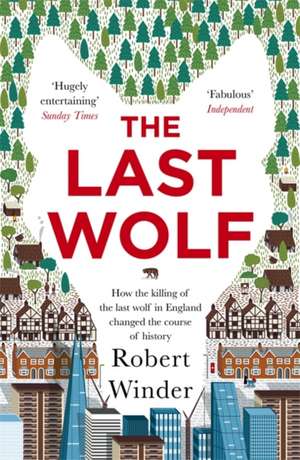
The Last Wolf: The Hidden Springs of Englishness
Autor Robert Winderen Limba Engleză Paperback – 3 mai 2018
In Bloody Foreigners Robert Winder told the rich story of immigration to Britain. Now, in The Last Wolf, he spins an English tale. Travelling the country, he looks for its hidden springs not in royal pageantry or politics, but in landscape and history.
Medieval monks with their flocks of sheep . . . cathedrals built by wool . . . the first shipment of coal to leave Newcastle . . . marital contests on a village green . . . mock-Tudor supermarkets - the story is studded with these and other English things.
And it starts by looking at a very important thing England did not have: wolves.
Preț: 81.10 lei
Preț vechi: 108.79 lei
-25%
Puncte Express: 122
Carte disponibilă
Livrare economică 07-21 noiembrie
Livrare express 24-30 octombrie pentru 54.81 lei
Livrare prin curier în România Termenul estimat este afișat lângă disponibilitate.
Transport gratuit de la 400.00 lei Plată online sau ramburs, în funcție de opțiunile comenzii.
Retur gratuit în 14 zile Comandă securizată și suport în română.
Specificații
ISBN-13: 9780349141862
ISBN-10: 034914186X
Pagini: 480
Ilustrații: 25 integrated black and white pictures
Dimensiuni: 126 x 198 x 32 mm
Greutate: 0.37 kg
Editura: Little Brown
Colecția Abacus
Locul publicării:London, United Kingdom
ISBN-10: 034914186X
Pagini: 480
Ilustrații: 25 integrated black and white pictures
Dimensiuni: 126 x 198 x 32 mm
Greutate: 0.37 kg
Editura: Little Brown
Colecția Abacus
Locul publicării:London, United Kingdom
V-ar putea interesa
-
 Attrition: Fighting the First World WarWilliam Philpott-26%Preț: 73.97 lei99.78 lei
 -
 -25%Preț: 81.16 lei108.82 lei
 -
 Bloody Foreigners: The Story of Immigration to BritainRobert Winder-25%Preț: 82.81 lei109.79 lei
 -
 Primitive RebelsEric Hobsbawm-27%Preț: 68.43 lei93.34 lei
 -
 Preț: 168.12 lei
 -
 DarwinMatthew StephenPreț: 280.64 lei
 -
![Historical Sketch of the Town of Pawtucket [RI]](https://i2.books-express.ro/bt/9780788421273/historical-sketch-of-the-town-of-pawtucket-ri.jpg) Historical Sketch of the Town of Pawtucket [RI]Massena GoodrichPreț: 134.39 lei
Historical Sketch of the Town of Pawtucket [RI]Massena GoodrichPreț: 134.39 lei -
 Preț: 282.58 lei
 -
 Marshman!Kendon L ClarkPreț: 198.07 lei
 -
 SharkbaitGuy S. ClarkPreț: 164.39 lei
 -
 The Little Wonder: The Remarkable History of WisdenRobert Winder-33%Preț: 156.34 lei233.84 lei
 -
 -40%Preț: 65.91 lei109.86 lei
 -
 -27%Preț: 67.92 lei92.87 lei
 -
 Viceroys: The Creation of the BritishChristopher Lee-25%Preț: 92.47 lei123.21 lei
 -
 -26%Preț: 78.79 lei106.64 lei
 -
 -24%Preț: 84.12 lei110.00 lei
 -
 Half-Time: The Glorious Summer of 1934Robert Winder-33%Preț: 92.19 lei138.43 lei
 -
 A Line in the SandJoseph M. Nixon B. A.Preț: 251.90 lei
 -
 Letters from Death RowErin Taylor DanielsPreț: 144.18 lei
 -
 William Allen WhiteJack Wayne TraylorPreț: 79.43 lei
 -
 Kunskapens tiderAnnika SandénPreț: 117.48 lei
Recenzii
'A fascinating attempt to find the sources of Englishness . . . Well-crafted, reflective and quite personal, The Last Wolf is also original and deeply researched' Robert McCrum, Guardian
What sort of a place is England? And who are the English? As the United Kingdom turns away from its European neighbours and begins to look increasingly disunited at home, it is becoming necessary to ask what England has that is singular and its own. In The Last Wolf, Robert Winder spins an English tale. Travelling the country, he looks for its hidden springs not in royal pageantry or politics, but in landscape and history.
'Winder is at his best when tracing how one thing became another. His excellent description of the rise of Lancashire's enormous cotton industry triggers a discussion of the slave trade and English morality . . . fascinating twists and turns' The Times
'[Winder] weaves a fabulous tale of wolves and sheep, water and coal, rain and agriculture, industry and architecture, pinpointing qualities that grew out of our landscape' Independent i
Spirited, provocative, wise, hugely entertaining
Winder, who in 2004 wrote a compelling book about immigration called Bloody Foreigners, expertly navigates his subject without mentioning Brexit. Yet it has a pertinent lesson for some of the more excitable Brexiteers-we have never been an island nation
A fascinating attempt to find the sources of Englishness . . . Well-crafted, reflective and quite personal, The Last
Wolf is also original and deeply researched
A glorious romp through more than eight centuries, told with humour and charm, with the same themes recurring over the ages. Highly recommended
Winder is at his best when tracing how one thing became another. His excellent description of the rise of Lancashire's enormous cotton industry triggers a discussion of the slave trade and English morality . . . fascinating twists and turns
A provocative and lively look at what has made the English who they are
The Last Wolf is an engaging ramble through the wool towns and open ranges of medieval England
[Winder] weaves a fabulous tale of wolves and sheep, water and coal, rain and agriculture, industry and architecture, pinpointing qualities that grew out of our landscape
An entertainingly discursive anatomy of the English character
This is digestible, friendly, whimsical history: Winder is clearly allergic to boring history books and makes it his business not to write one
I will return to its insights again and again
A truly brilliant account of the happy accidents of climate and geography that are the real source of our national identity. It is compulsively readable and packed full of information, anecdote and wit
What sort of a place is England? And who are the English? As the United Kingdom turns away from its European neighbours and begins to look increasingly disunited at home, it is becoming necessary to ask what England has that is singular and its own. In The Last Wolf, Robert Winder spins an English tale. Travelling the country, he looks for its hidden springs not in royal pageantry or politics, but in landscape and history.
'Winder is at his best when tracing how one thing became another. His excellent description of the rise of Lancashire's enormous cotton industry triggers a discussion of the slave trade and English morality . . . fascinating twists and turns' The Times
'[Winder] weaves a fabulous tale of wolves and sheep, water and coal, rain and agriculture, industry and architecture, pinpointing qualities that grew out of our landscape' Independent i
Spirited, provocative, wise, hugely entertaining
Winder, who in 2004 wrote a compelling book about immigration called Bloody Foreigners, expertly navigates his subject without mentioning Brexit. Yet it has a pertinent lesson for some of the more excitable Brexiteers-we have never been an island nation
A fascinating attempt to find the sources of Englishness . . . Well-crafted, reflective and quite personal, The Last
Wolf is also original and deeply researched
A glorious romp through more than eight centuries, told with humour and charm, with the same themes recurring over the ages. Highly recommended
Winder is at his best when tracing how one thing became another. His excellent description of the rise of Lancashire's enormous cotton industry triggers a discussion of the slave trade and English morality . . . fascinating twists and turns
A provocative and lively look at what has made the English who they are
The Last Wolf is an engaging ramble through the wool towns and open ranges of medieval England
[Winder] weaves a fabulous tale of wolves and sheep, water and coal, rain and agriculture, industry and architecture, pinpointing qualities that grew out of our landscape
An entertainingly discursive anatomy of the English character
This is digestible, friendly, whimsical history: Winder is clearly allergic to boring history books and makes it his business not to write one
I will return to its insights again and again
A truly brilliant account of the happy accidents of climate and geography that are the real source of our national identity. It is compulsively readable and packed full of information, anecdote and wit