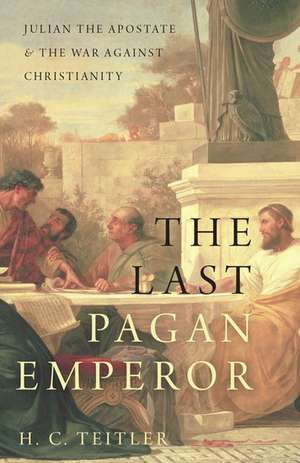
The Last Pagan Emperor: Julian the Apostate and the War against Christianity: OXFORD UNIV PR
Autor H.C. Teitleren Limba Engleză Hardback – 20 apr 2017
Din seria OXFORD UNIV PR
- 11%
 Preț: 556.22 lei
 -
 Preț: 229.40 lei
 - 20%
 Preț: 125.26 lei
 - 31%
 Preț: 693.75 lei
 - 28%
 Preț: 378.98 lei
 - 31%
 Preț: 927.11 lei
 - 14%
 Preț: 709.10 lei
 - 23%
 Preț: 368.20 lei
 - 19%
 Preț: 388.40 lei
 - 35%
 Preț: 538.59 lei
 - 15%
 Preț: 404.13 lei
 - 21%
 Preț: 239.44 lei
 - 12%
 Preț: 260.34 lei
 - 20%
 Preț: 252.50 lei
 - 24%
 Preț: 180.59 lei
 - 6%
 Preț: 296.53 lei
 - 9%
 Preț: 353.39 lei
 - 32%
 Preț: 532.88 lei
 - 28%
 Preț: 368.78 lei
 - 20%
 Preț: 258.01 lei
 - 33%
 Preț: 854.69 lei
 - 18%
 Preț: 314.11 lei
 - 28%
 Preț: 425.50 lei
 - 23%
 Preț: 582.13 lei
 - 28%
 Preț: 347.35 lei
 - 28%
 Preț: 371.67 lei
 - 31%
 Preț: 888.91 lei
 - 20%
 Preț: 268.31 lei
 - 31%
 Preț: 980.33 lei
 - 14%
 Preț: 809.53 lei
 - 30%
 Preț: 404.35 lei
 -
 Preț: 283.29 lei
 - 30%
 Preț: 429.87 lei
 - 19%
 Preț: 346.23 lei
 - 22%
 Preț: 356.05 lei
 - 31%
 Preț: 726.45 lei
 - 19%
 Preț: 347.19 lei
 - 31%
 Preț: 602.19 lei
 -
 Preț: 382.08 lei
 -
 Preț: 361.18 lei
 - 31%
 Preț: 661.29 lei
 - 20%
 Preț: 298.58 lei
 - 31%
 Preț: 709.10 lei
 - 19%
 Preț: 369.21 lei
 - 23%
 Preț: 221.33 lei
 - 30%
 Preț: 436.17 lei
 - 24%
 Preț: 141.95 lei
 - 21%
 Preț: 340.85 lei
 - 20%
 Preț: 268.20 lei
Preț: 296.03 lei
Preț vechi: 340.10 lei
-13%
Puncte Express: 444
Carte tipărită la comandă
Livrare economică 20 noiembrie-01 decembrie
Livrare prin curier în România Termenul estimat este afișat lângă disponibilitate.
Transport gratuit de la 400.00 lei Plată online sau ramburs, în funcție de opțiunile comenzii.
Retur gratuit în 14 zile Comandă securizată și suport în română.
Specificații
ISBN-13: 9780190626501
ISBN-10: 019062650X
Pagini: 312
Dimensiuni: 142 x 211 x 31 mm
Greutate: 0.43 kg
Editura: Oxford University Press
Colecția OUP USA
Seria OXFORD UNIV PR
Locul publicării:New York, United States
ISBN-10: 019062650X
Pagini: 312
Dimensiuni: 142 x 211 x 31 mm
Greutate: 0.43 kg
Editura: Oxford University Press
Colecția OUP USA
Seria OXFORD UNIV PR
Locul publicării:New York, United States
V-ar putea interesa
-
 Student Study Guide to The Ancient Greek WorldJennifer T. Roberts-23%Preț: 72.52 lei94.61 lei
 -
 -31%Preț: 691.03 lei1005.52 lei
 -
 Explaining the Cosmos: Creation and Cultural Interaction in Late-Antique GazaMichael W. Champion-31%Preț: 661.29 lei960.33 lei
 -
 -31%Preț: 694.63 lei1007.69 lei
 -
 Choruses, Ancient and ModernJoshua Billings-31%Preț: 856.83 lei1241.81 lei
 -
 Niketas Choniates: A Historiographical StudyAlicia Simpson-31%Preț: 729.76 lei1056.15 lei
 -
 God, Space, and City in the Roman ImaginationRichard Jenkyns-21%Preț: 478.52 lei604.26 lei
 -
 -31%Preț: 905.24 lei1311.86 lei
 -
 The Reach of RomeAlberto AngelaPreț: 164.29 lei
 -
 Preț: 431.05 lei
 -
 -9%Preț: 981.98 lei1079.10 lei
Recenzii
An impeccably scholarly work. It establishes in great detail, and with a certain dry humor, the fact that most of the martyrdoms said to have been undergone by Christians during the reign of the apostate emperor were mere fairy tales invented by Christians of a later age.
The book is written in an easy-to-read prose that will please students and scholars alike, whether familiar or not with the characters and texts treated. Almost fifty pages of notes, sixty-six of bibliography, and a useful index close the book. ... In summary, the book is a major contribution to the late antique debate of the conflict between paganism and Christianity as it engages in topics which until not so long ago were nearly undeniable
The author's explication of the troublesome ancient sources (such as Christian apologetics and letters) particularly impresses. This book [explains] everything clearly and pleasantly without requiring specialized knowledge. An excellent introduction to this period and its personalities. ... Summing Up: Highly recommended. All levels/libraries.
It is about time someone put the myth of Julian the Persecutor to rest. Teitler does it with style, authority, and some well-placed humor. There is an enormous amount of erudition packed into these pages, yet they unfold at a measured, almost leisurely pace. The result is a study that is both highly informative and highly accessible. It is that rare combination of a lively and readable text with thorough documentation.
In the reign of Julian religious tensions ran high. Teitler reveals how the flashpoints these created were magnified and distorted in their retelling by later Christian authors. From this book emerges a much clearer picture of late antiquity's most enigmatic emperor.
Teitler offers a compelling, vivid, and readable portrait of the life and legacy of the emperor Julian. He traces Julian's path from Christianity to paganism, explains the careful measures the emperor took to shift the religious landscape of the Roman world, and shows how Christian contemporaries unfairly redefined Julian as a persecuting tyrant. This book provides an exciting new way to understand the mind of Rome's last pagan emperor as well as the world that shaped our modern views of Julian's unique legacy.
Teitler has pulled off the trick of exculpating Julian of anti-Christian pogroms in a fully evidenced and highly accessible text -- a page-turner, in fact. He does not, of course, suggest that there were not attacks on Christians -- simply that there was no Julianic programme of religious cleansing. Indeed, we see Julian upbraiding those who would indulge in torture and execution on the grounds that the worst you could do is deny a would-be saint martyrdom ... The reviewer has no hesitation in recommending this book to all readers
The book is written in an easy-to-read prose that will please students and scholars alike, whether familiar or not with the characters and texts treated. Almost fifty pages of notes, sixty-six of bibliography, and a useful index close the book. ... In summary, the book is a major contribution to the late antique debate of the conflict between paganism and Christianity as it engages in topics which until not so long ago were nearly undeniable
The author's explication of the troublesome ancient sources (such as Christian apologetics and letters) particularly impresses. This book [explains] everything clearly and pleasantly without requiring specialized knowledge. An excellent introduction to this period and its personalities. ... Summing Up: Highly recommended. All levels/libraries.
It is about time someone put the myth of Julian the Persecutor to rest. Teitler does it with style, authority, and some well-placed humor. There is an enormous amount of erudition packed into these pages, yet they unfold at a measured, almost leisurely pace. The result is a study that is both highly informative and highly accessible. It is that rare combination of a lively and readable text with thorough documentation.
In the reign of Julian religious tensions ran high. Teitler reveals how the flashpoints these created were magnified and distorted in their retelling by later Christian authors. From this book emerges a much clearer picture of late antiquity's most enigmatic emperor.
Teitler offers a compelling, vivid, and readable portrait of the life and legacy of the emperor Julian. He traces Julian's path from Christianity to paganism, explains the careful measures the emperor took to shift the religious landscape of the Roman world, and shows how Christian contemporaries unfairly redefined Julian as a persecuting tyrant. This book provides an exciting new way to understand the mind of Rome's last pagan emperor as well as the world that shaped our modern views of Julian's unique legacy.
Teitler has pulled off the trick of exculpating Julian of anti-Christian pogroms in a fully evidenced and highly accessible text -- a page-turner, in fact. He does not, of course, suggest that there were not attacks on Christians -- simply that there was no Julianic programme of religious cleansing. Indeed, we see Julian upbraiding those who would indulge in torture and execution on the grounds that the worst you could do is deny a would-be saint martyrdom ... The reviewer has no hesitation in recommending this book to all readers
Notă biografică
H.C. Teitler, born in Surabaya in the Dutch East Indies--now Indonesia--and raised in Den Helder and Amsterdam in the Netherlands, studied Classics at the University of Amsterdam. He served as Assistant Professor of Ancient History at Utrecht University from 1975 until his retirement in 2002.
Cuprins
- List of Abbreviations
- Map of the Near East in the Time of Julian
- Introduction
- I Julian's Apostasy
- II Constantine and the Christians
- III A Fleeting Cloud?
- IV George of Cappadocia
- V Artemius
- VI Pagan Temples and Christian Churches
- VII Sacrifices to the Gods
- VIII Julian's School Edict: a Form of Persecution?
- IX Basil of Ancyra
- X Idols and Psalm-Singing
- XI Julian and his Uncle Julianus
- XII Caesarea and Gaza
- XIII Eugenius and Macarius
- XIV The Banner of the Cross
- XV Chrysostom and Julian
- XVI To the End and Beyond
- XVII Elophius
- XVIII Praise and Blame
- Chronological Outline
- Bibliography
- Index