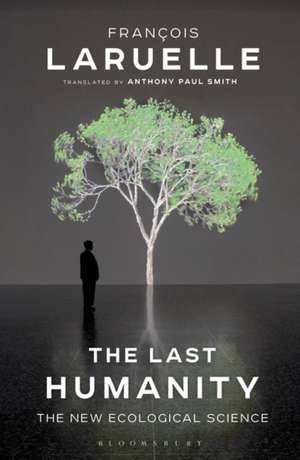
The Last Humanity
Autor Francois Laruelleen Limba Engleză Paperback – 12 noi 2020
Preț: 174.57 lei
Preț vechi: 214.67 lei
-19% Nou
Puncte Express: 262
Preț estimativ în valută:
30.89€ • 36.22$ • 27.13£
30.89€ • 36.22$ • 27.13£
Carte disponibilă
Livrare economică 22 ianuarie-05 februarie
Livrare express 07-13 ianuarie pentru 59.75 lei
Preluare comenzi: 021 569.72.76
Specificații
ISBN-13: 9781350008236
ISBN-10: 1350008230
Pagini: 184
Dimensiuni: 129 x 198 x 10 mm
Greutate: 0.2 kg
Editura: BLOOMSBURY ACADEMIC
Locul publicării:London, United Kingdom
ISBN-10: 1350008230
Pagini: 184
Dimensiuni: 129 x 198 x 10 mm
Greutate: 0.2 kg
Editura: BLOOMSBURY ACADEMIC
Locul publicării:London, United Kingdom
Caracteristici
This is the first English translation of The Last Humanity and will be of real interest to those studying philosophies of ecology and post-humanism, both of which are increasingly important in contemporary theory
Notă biografică
François Laruelle is a French philosopher, formerly of the Collège international de philosophie and the University of Paris X: Nanterre, France.
Cuprins
Foreword Introduction Chapter 1: In Search of a Messianic Ecology Chapter 2: Philosophy's Degrowth for a Generic Ecology Chapter 3: The House of Philosophy Is in Ruins Chapter 4: The Antinomy of Ecology and Philosophy Chapter 5: The Unification of the Lived-without-Life and Being-in-the-Last-Humanity Chapter 6: Ecology as Quantum of the Messianic Lived Conclusion: Ethics Between Ecology and Messianity
Recenzii
François Laruelle's The Last Humanity is a unique, ambitious, and provocative adventure in ecological thinking. It offers one of the most original, realist, and dare I say deconstructive ecological encounters to date.
Laruelle's non-philosophical ecology represents an uncompromising challenge to existing ecological thought and, in this brilliantly accomplished translation, makes a provocative and landmark contribution to contemporary eco-critical debate. Laruelle aims at nothing less than a total reconfiguration of the ethical relations between the human, the animal, and biological life more generally and he succeeds in ways that we have hitherto been unable to imagine.
Laruelle's non-philosophical ecology represents an uncompromising challenge to existing ecological thought and, in this brilliantly accomplished translation, makes a provocative and landmark contribution to contemporary eco-critical debate. Laruelle aims at nothing less than a total reconfiguration of the ethical relations between the human, the animal, and biological life more generally and he succeeds in ways that we have hitherto been unable to imagine.