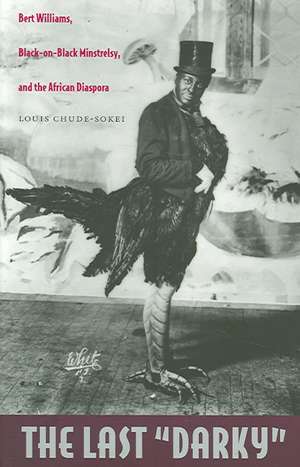
The Last Darky
Autor Louis Chude-Sokeien Limba Engleză Paperback – 16 ian 2006
Ne-a atras atenția modul în care Louis Chude-Sokei deconstruiește în capitolul „Black Minstrel, Black Modernism” o perioadă adesea ignorată a istoriei culturale: utilizarea machiajului de tip „blackface” nu ca act de rasism internalizat, ci ca instrument complex de negociere a identității. Putem afirma că lucrarea de față îl recuperează pe Bert Williams, un artist de origine bahamiană, dintr-o zonă a ambiguității istorice, plasându-l în centrul modernismului negru global. Autorul argumentează convingător că spectacolele de tip minstrelsy ale lui Williams au servit ca spațiu de explorare pentru tensiunile dintre imigranții negri din Caraibe și comunitatea afro-americană din New York. Structura volumului ghidează cititorul de la migrația simbolică a măștii rasiale către o teorie a interculturalității. Merită menționat modul în care textul integrează discursurile despre asimilare și militantism ale unor figuri precum Marcus Garvey sau W. E. B. Du Bois în contextul economiei globale a divertismentului. [The Last "Darky"] (book) funcționează ca o alternativă teoretică solidă la Dancing In The Dark de Caryl Phillips pentru cursurile de studii etnice sau istoria spectacolului; în timp ce Phillips oferă o perspectivă narativă asupra vieții lui Williams, Chude-Sokei aduce avantajul unei analize academice riguroase asupra modului în care identitatea diasporică a influențat Renașterea din Harlem. În contextul operei sale, această lucrare precede preocupările din The Sound of Culture privind tehnologia și rasa, concentrându-se aici pe „tehnologia” măștii și a performanței scenice.
Preț: 251.70 lei
Carte tipărită la comandă
Livrare economică 02-16 decembrie
Specificații
ISBN-10: 082233643X
Pagini: 288
Dimensiuni: 154 x 236 x 24 mm
Greutate: 0.42 kg
Editura: Duke University Press
V-ar putea interesa
-
 -30%Preț: 393.55 lei560.43 lei
 -
 Preț: 301.90 lei
 -
 The Sound of CultureLouis Chude-SokeiPreț: 209.86 lei
 -
 Child of the FireKirsten BuickPreț: 170.87 lei
 -
 Afro AsiaFred HoPreț: 269.25 lei
 -
 Slaves to FashionMonica L Miller-23%Preț: 678.94 lei881.74 lei
 -
 The Intimate UniversityNancy AbelmannPreț: 218.46 lei
 -
 Black Arts WestDaniel WidenerPreț: 186.79 lei
 -
 "We Must Be Up and Doing": A Reader in Early African American FeminismsTeresa C. Zackodnik-17%Preț: 361.01 lei435.45 lei
 -
 Charles Johnson: The Novelist as PhilosopherMarc C. ConnerPreț: 262.71 lei
 -
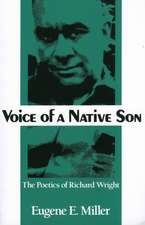 Voice of a Native Son: The Poetics of Richard WrightEugene E. MillerPreț: 192.40 lei
 -
 Preț: 262.71 lei
 -
 Preț: 143.90 lei
 -
 Kamikaze of SongsMianne A. AdufutsePreț: 50.84 lei
 -
 Son Preference: Sex Selection, Gender and Culture in South AsiaNavtej K. Purewal-18%Preț: 1112.48 lei1356.68 lei
 -
 -19%Preț: 558.66 lei689.71 lei
De ce să citești această carte
Este o resursă esențială pentru cercetătorii din domeniul studiilor etnice și culturale care doresc să înțeleagă complexitatea identității negre dincolo de granițele naționale. Cititorul câștigă o perspectivă nouă asupra modului în care stereotipurile rasiale au fost reasimilate și folosite ca formă de rezistență și modernism. Este recomandată celor care au studiat Race and New Modernisms și caută un studiu de caz aprofundat despre tensiunile interne ale diasporei africane.
Despre autor
Louis Chude-Sokei este profesor asociat de literatură la Universitatea din California, Santa Cruz. Opera sa este profund marcată de temele deplasării culturale și ale identității transnaționale, elemente vizibile și în volumul său de memorii Floating in a Most Peculiar Way, unde descrie parcursul său din Biafra către Jamaica și Statele Unite. Interesul său academic se situează la intersecția dintre rasă, tehnologie și istoria spectacolului, transformându-l într-o voce de referință în studiile despre modernismul diasporei africane și influența globală a culturii negre.
Recenzii
--D.B. Wilmeth, "Choice"
"[A] book that offers much to understandings of black-on-black minstrelsy and its histories in the U.S. and throughout the African diaspora."
--Jodi Brooks, "Screening the Past"
"[A] much needed and long overdue text that outlines the history of minstrelsy, the performance of 'Blackness' and the significance of the African American guise on the global stage."
--Marti Newland, "Souls"
"Louis Chude-Sokei's "The Last "Darky"" offers a provocative study interweaving performance studies, postcolonial theory, and critical race theory to examine the black-on-black minstrelsy of Bert Williams . . . . [His] contributions offer exciting possibilities for further research on black modernism, and the unrealized significance of Williams and other West Indians of the black diaspora.":
--Adrienne C. Macki, "Theatre Journal"
“Louis Chude-Sokei’s innovative study not only brings overdue attention to Bert Williams. It deepens our understanding of black modernity and redirects the study of minstrelsy as well. A rich, wide-ranging book, it is filled with resonant insights and brilliant collocations.”—Nathaniel Mackey, author of "Paracritical Hinge"
“With theoretical verve and archival aplomb, Louis Chude-Sokei explores an open secret that we too often have preferred to ignore: the central role of black minstrelsy in the origins of the Harlem Renaissance. Starting with the simple fact of Bert Williams’s Caribbean origins, he finds the multiple layers of masquerade in any performance of ‘race.’ A timely, often profound portrait of the dynamics of intraracial difference in diaspora.”—Brent Hayes Edwards, author of "The Practice of Diaspora "
"Louis Chude-Sokei's innovative study not only brings overdue attention to Bert Williams. It deepens our understanding of black modernity and redirects the study of minstrelsy as well. A rich, wide-ranging book, it is filled with resonant insights and brilliant collocations."--Nathaniel Mackey, author of Paracritical Hinge "With theoretical verve and archival aplomb, Louis Chude-Sokei explores an open secret that we too often have preferred to ignore: the central role of black minstrelsy in the origins of the Harlem Renaissance. Starting with the simple fact of Bert Williams's Caribbean origins, he finds the multiple layers of masquerade in any performance of 'race.' A timely, often profound portrait of the dynamics of intraracial difference in diaspora."--Brent Hayes Edwards, author of The Practice of Diaspora "Louis Chude-Sokei's The Last "Darky" offers a provocative study interweaving performance studies, postcolonial theory, and critical race theory to examine the black-on-black minstrelsy of Bert Williams... [His] contributions offer exciting possibilities for further research on black modernism, and the unrealized significance of Williams and other West Indians of the black diaspora."--Adrienne C. Macki, Theatre Journal
Textul de pe ultima copertă
Descriere
Cuprins
1. Black Minstrel, Black Modernism 17
2. Migrations of a Mask 46
3. Theorizing Black-on-Black Cross-Culturality 82
4. The Global Economy of Minstrelsy 114
5. In Dahomy 161
6. Claude McKay’s Calypso 207
Notes 249
Bibliography 263
Index 272