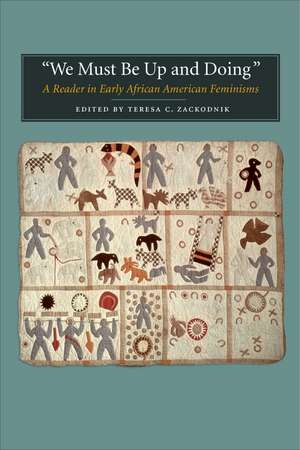
"We Must Be Up and Doing": A Reader in Early African American Feminisms
Editat de Teresa C. Zackodniken Limba Engleză Paperback – 11 mar 2010
Going beyond a focus on the “greats” of black feminism to include lesser known figures, “We Must Be Up and Doing” offers a broad and contextualized look at the critical mass early black feminism achieved by including a variety of genres, such as the spiritual autobiography, the platform speech, periodical articles, pamphlets, fiction, and excerpts from convention and conference proceedings.
Preț: 361.01 lei
Preț vechi: 435.45 lei
-17%
Puncte Express: 542
Carte disponibilă
Livrare economică 11-25 noiembrie
Livrare express 27-31 octombrie pentru 118.94 lei
Livrare prin curier în România Termenul estimat este afișat lângă disponibilitate.
Transport gratuit de la 400.00 lei Plată online sau ramburs, în funcție de opțiunile comenzii.
Retur gratuit în 14 zile Comandă securizată și suport în română.
Specificații
ISBN-13: 9781551119175
ISBN-10: 155111917X
Pagini: 402
Dimensiuni: 152 x 229 x 13 mm
Greutate: 0.58 kg
Editura: BROADVIEW PR
Colecția Broadview Press
Locul publicării:Peterborough, Canada
ISBN-10: 155111917X
Pagini: 402
Dimensiuni: 152 x 229 x 13 mm
Greutate: 0.58 kg
Editura: BROADVIEW PR
Colecția Broadview Press
Locul publicării:Peterborough, Canada
V-ar putea interesa
-
 -18%Preț: 211.65 lei257.51 lei
 -
 August Wilson and Black AestheticsS. ShannonPreț: 287.86 lei
 -
 Preț: 385.28 lei
 -
 Living FanonF. FanonPreț: 401.25 lei
 -
 Preț: 247.70 lei
 -
 Law and Society in VietnamMark SidelPreț: 307.39 lei
 -
 Freedom Struggles – African Americans and World War IAdriane Lentz–smithPreț: 233.95 lei
 -
 The Fisher KingPaule MarshallPreț: 94.34 lei
 -
 Preț: 208.79 lei
Recenzii
African American women have been “up and doing” for their communities for as long as they have been in the United States, and their ability to resist the institution of slavery was central to the survival of African Americans. This anthology gives readers access to African American feminist thought in its foundational period by drawing together key documents from the late 1820s through the 1920s.
Going beyond a focus on the “greats” of black feminism to include lesser known figures, “We Must Be Up and Doing” offers a broad and contextualized look at the critical mass early black feminism achieved by including a variety of genres, such as the spiritual autobiography, the platform speech, periodical articles, pamphlets, fiction, and excerpts from convention and conference proceedings.
“From a rich but generally unknown tradition of African American women’s political and social writing, Teresa C. Zackodnik has chosen judiciously to bring us a volume that is both instructive and interesting. ‘We Must Be Up and Doing’ takes its rightful place in the twenty-first-century renaissance of Black Women’s Studies that bridges dangerous gaps between theory and practice, town and gown, us and them.” — Frances Smith Foster, Emory University
“This is a very important book, not least of all for its inclusion of nineteenth-century women preachers named as and among early black feminists. Teresa C. Zackodnik does an excellent job of situating their reform efforts in the appropriate contexts of white women’s abolitionism, black male Protestantism’s religious missions, and US religious revivalism more broadly. I continue to be amazed by the difficult terrain early black feminists had to traverse, and more so by the ground they did cover despite the difficulty. As Zackodnik ably demonstrates, these women showed a dexterity and flexibility, a nimbleness of vision and thought without compromising conviction or goal, that few others were required to exert.” — Joycelyn Moody, University of Texas at San Antonio
“‘We Must be Up and Doing’ will be of immense value to anyone interested in American literary and cultural history, and it will be an essential book for anyone interested in the history and diversity of African American feminist thought. Superbly edited and annotated by Teresa C. Zackodnik, this collection makes available many previously inaccessible orations and essays that place the better known feminist statements, also included here, in useful context. Like only a handful of other publication ventures over the past few decades, ‘We Must be Up and Doing’ will encourage, aid, and direct scholarship on the subject for years to come.” — John Ernest, West Virginia University
Going beyond a focus on the “greats” of black feminism to include lesser known figures, “We Must Be Up and Doing” offers a broad and contextualized look at the critical mass early black feminism achieved by including a variety of genres, such as the spiritual autobiography, the platform speech, periodical articles, pamphlets, fiction, and excerpts from convention and conference proceedings.
“From a rich but generally unknown tradition of African American women’s political and social writing, Teresa C. Zackodnik has chosen judiciously to bring us a volume that is both instructive and interesting. ‘We Must Be Up and Doing’ takes its rightful place in the twenty-first-century renaissance of Black Women’s Studies that bridges dangerous gaps between theory and practice, town and gown, us and them.” — Frances Smith Foster, Emory University
“This is a very important book, not least of all for its inclusion of nineteenth-century women preachers named as and among early black feminists. Teresa C. Zackodnik does an excellent job of situating their reform efforts in the appropriate contexts of white women’s abolitionism, black male Protestantism’s religious missions, and US religious revivalism more broadly. I continue to be amazed by the difficult terrain early black feminists had to traverse, and more so by the ground they did cover despite the difficulty. As Zackodnik ably demonstrates, these women showed a dexterity and flexibility, a nimbleness of vision and thought without compromising conviction or goal, that few others were required to exert.” — Joycelyn Moody, University of Texas at San Antonio
“‘We Must be Up and Doing’ will be of immense value to anyone interested in American literary and cultural history, and it will be an essential book for anyone interested in the history and diversity of African American feminist thought. Superbly edited and annotated by Teresa C. Zackodnik, this collection makes available many previously inaccessible orations and essays that place the better known feminist statements, also included here, in useful context. Like only a handful of other publication ventures over the past few decades, ‘We Must be Up and Doing’ will encourage, aid, and direct scholarship on the subject for years to come.” — John Ernest, West Virginia University
Cuprins
Acknowledgements
List of Photographs
Introduction
CHAPTER 1
Roots of Reform and Early African American Feminism
WOMEN AND THE CHURCH
Maria W. Stewart, “Cause for Encouragement” (1832)
Jarena Lee, Excerpts from The Life and Religious Experiences of Jarena Lee, a Coloured Lady, Giving an Account of her Call to Preach the Gospel (1836)
Zilpha Elaw, Excerpts from Memoirs of the Life, Religious Experiences, Ministerial Travels and Labours of Mrs. Zilpha Elaw, An American Female of Colour: Together with Some Account of the Great Religious Revivals in America (1846)
Julia Foote, Excerpts from A Brand Plucked From the Fire. An Autobiographical Sketch (1879)
FEMALE BENEVOLENT AND LITERARY SOCIETIES
Maria W. Stewart, “An Address Delivered Before the Afric-AmericanFemale Intelligence Society of Boston” (1832)
Sarah Mapps Douglass, “Mental Feasts” (1832)
Anonymous, “Address to the Female Literary Association ofPhiladelphia, On their First Anniversary: By a Member” (1832)
ABOLITION
Sarah Forten [“Magawisca”], “The Abuse of Liberty” (1831)
Sarah Mapps Douglass [“Zillah”], “A Mother’s Love” (1832)
Lucy Stanton, “A Plea for the Oppressed” (1850)
Frances Ellen Watkins Harper, “The Colored People in America,”Poems on Miscellaneous Subjects (1854)
Frances Ellen Watkins Harper, “Could we trace the record of everyhuman heart …” (1857)
Sojourner Truth, “Pro-Slavery in Indiana” (1858)
Sarah Parker Remond, Three Lectures (1859)
1. “Lecture on American Slavery by a Colored Lady”
2. “A Second Lecture by Miss Remond”
3. “The Lecture at the Lion Hotel”
Sarah Parker Remond, “Miss Remond in Manchester” (1859)
CHAPTER 2
Feminist Black Nationalism
EMIGRATION AND COLONIZATION
Sojourner Truth, “Lecture by Sojourner Truth” (1853)
Mary Ann Shadd Cary, “The Humbug of Reform” (1854)
Mary Ann Shadd Cary, “A Voice of Thanks” (1861)
Frances Ellen Watkins Harper, “Mrs. Frances E. Watkins Harper on the War and the President’s Colonization Scheme” (1862)
Elizabeth J. Jennings, “Thoughts on Colonization” (1862)
EDUCATION
Maria W. Stewart, “Mrs. Steward’s Essays” (1832)
Frances Ellen Watkins Harper, “Letter from Miss Watkins” (1859)
Katie S. Campbell, “Our Educational Interests” (1873)
Anna Julia Cooper, “The Higher Education of Women” (1891)
Nannie Helen Burroughs, “Industrial Education — Will it Solve the Negro Problem” (1904)
Fannie Barrier Williams, “Industrial Education — Will it Solve the Negro Problem” (1904)
Josephine B. Bruce, “What Has Education Done for Colored Women” (1904)
LABOR AND EMPLOYMENT
Maria W. Stewart, “Lecture Delivered at the Franklin Hall” (1832)
Lucy Parsons, “Mrs. Parson’s Lecture [I am an anarchist … ]” (1886)
Nannie Helen Burroughs, “The Colored Woman and Her Relationto the Domestic Problem” (1902)
Mary Church Terrell, “What it Means to Be Colored in the Capital ofthe United States” (1907)
Addie Hunton, “Employment of Colored Women in Chicago” (1911)
A Negro Nurse, “More Slavery at the South” (1912)
MIGRATION
Gertrude Mossell [Mrs. N.F. Mossell], “Our Woman’s Department … A Word of Counsel” (1886)
Victoria Earle Matthews, “Some of the Dangers Confronting Southern Girls in the North” (1898)
Fannie Barrier Williams, “Social Bonds in the ‘Black Belt’ of Chicago” (1905)
CHAPTER 3
Lynching
Frances Ellen Watkins Harper, “Duty to Dependent Races” (1891)
Ida B. Wells, Southern Horrors: Lynch Law in All Its Phases (1892)
Ida B. Wells [Barnett], “The Negro’s Case in Equity” (1900)
Mary Church Terrell, “Lynching from a Negro’s Point of View” (1904)
The Anti-Lynching Crusaders, “The Anti-Lynching Crusaders” (1922)
CHAPTER 4
Defending Black Womanhood and the Black Women’s Club Movement
DEFENSE OF BLACK WOMANHOOD
Fannie Barrier Williams, “The Intellectual Progress of the Colored Women of the United States Since the Emancipation Proclamation”(1894)
Josephine St. Pierre Ruffin, “A Charge to be Refuted” (1895)
Lucy Craft Laney, “The Burden of the Educated Colored Woman” (1899)
Addie Hunton, “Negro Womanhood Defended” (1904)
CLUB MOVEMENT
Mary Church Terrell, “The Duty of the National Association of Colored Women to the Race” (1900)
Margaret Murray Washington, “The Gain in the Life of Negro Women” (1904)
Josephine Silone-Yates, “The National Association of Colored Women” (1904)
CHAPTER 5
Woman’s Rights, Suffrage, Temperance
WOMAN’S RIGHTS
Sojourner Truth, “Woman’s Rights Convention” (1851)
Sojourner Truth, “Woman’s Rights Convention. Meeting at the Broadway Tabernacle” (1853)
Harriet Beecher Stowe, “Sojourner Truth, The Libyan Sibyl” (1863)
Frances D. Gage, “Sojourner Truth” (1863)
Frances Ellen Watkins Harper, “We Are All Bound Up Together” (1866)
SUFFRAGE
Sojourner Truth, “Female Suffrage” (1867)
Naomi Talbert, “A Colored Woman’s Voice” (1869)
Mary Ann Shadd Cary, “Speech to Judiciary Committee Re: The Right of Women to Vote” (1874)
Mary E. (“Meb”) Britton, “Woman’s Suffrage. A Potent Agency in Public Reforms” (1887)
Anna Julia Cooper, “Woman versus the Indian” (1892)
Frances Ellen Watkins Harper, “Woman’s Political Future” (1894)
Adella Hunt Logan, “Woman Suffrage” (1905)
Mary Church Terrell, “Woman Suffrage and the 15th Amendment” (1915)
TEMPERANCE
Frances Ellen Watkins Harper, “The Woman’s Christian Temperance Union and the Colored Woman” (1888)
Ida B. Wells, “All things considered … ” (1891)
Carrie W. Clifford, “Love’s Way (A Christmas Story)” (1905)
References and Further Readings
Index of Names
List of Photographs
Introduction
CHAPTER 1
Roots of Reform and Early African American Feminism
WOMEN AND THE CHURCH
Maria W. Stewart, “Cause for Encouragement” (1832)
Jarena Lee, Excerpts from The Life and Religious Experiences of Jarena Lee, a Coloured Lady, Giving an Account of her Call to Preach the Gospel (1836)
Zilpha Elaw, Excerpts from Memoirs of the Life, Religious Experiences, Ministerial Travels and Labours of Mrs. Zilpha Elaw, An American Female of Colour: Together with Some Account of the Great Religious Revivals in America (1846)
Julia Foote, Excerpts from A Brand Plucked From the Fire. An Autobiographical Sketch (1879)
FEMALE BENEVOLENT AND LITERARY SOCIETIES
Maria W. Stewart, “An Address Delivered Before the Afric-AmericanFemale Intelligence Society of Boston” (1832)
Sarah Mapps Douglass, “Mental Feasts” (1832)
Anonymous, “Address to the Female Literary Association ofPhiladelphia, On their First Anniversary: By a Member” (1832)
ABOLITION
Sarah Forten [“Magawisca”], “The Abuse of Liberty” (1831)
Sarah Mapps Douglass [“Zillah”], “A Mother’s Love” (1832)
Lucy Stanton, “A Plea for the Oppressed” (1850)
Frances Ellen Watkins Harper, “The Colored People in America,”Poems on Miscellaneous Subjects (1854)
Frances Ellen Watkins Harper, “Could we trace the record of everyhuman heart …” (1857)
Sojourner Truth, “Pro-Slavery in Indiana” (1858)
Sarah Parker Remond, Three Lectures (1859)
1. “Lecture on American Slavery by a Colored Lady”
2. “A Second Lecture by Miss Remond”
3. “The Lecture at the Lion Hotel”
Sarah Parker Remond, “Miss Remond in Manchester” (1859)
CHAPTER 2
Feminist Black Nationalism
EMIGRATION AND COLONIZATION
Sojourner Truth, “Lecture by Sojourner Truth” (1853)
Mary Ann Shadd Cary, “The Humbug of Reform” (1854)
Mary Ann Shadd Cary, “A Voice of Thanks” (1861)
Frances Ellen Watkins Harper, “Mrs. Frances E. Watkins Harper on the War and the President’s Colonization Scheme” (1862)
Elizabeth J. Jennings, “Thoughts on Colonization” (1862)
EDUCATION
Maria W. Stewart, “Mrs. Steward’s Essays” (1832)
Frances Ellen Watkins Harper, “Letter from Miss Watkins” (1859)
Katie S. Campbell, “Our Educational Interests” (1873)
Anna Julia Cooper, “The Higher Education of Women” (1891)
Nannie Helen Burroughs, “Industrial Education — Will it Solve the Negro Problem” (1904)
Fannie Barrier Williams, “Industrial Education — Will it Solve the Negro Problem” (1904)
Josephine B. Bruce, “What Has Education Done for Colored Women” (1904)
LABOR AND EMPLOYMENT
Maria W. Stewart, “Lecture Delivered at the Franklin Hall” (1832)
Lucy Parsons, “Mrs. Parson’s Lecture [I am an anarchist … ]” (1886)
Nannie Helen Burroughs, “The Colored Woman and Her Relationto the Domestic Problem” (1902)
Mary Church Terrell, “What it Means to Be Colored in the Capital ofthe United States” (1907)
Addie Hunton, “Employment of Colored Women in Chicago” (1911)
A Negro Nurse, “More Slavery at the South” (1912)
MIGRATION
Gertrude Mossell [Mrs. N.F. Mossell], “Our Woman’s Department … A Word of Counsel” (1886)
Victoria Earle Matthews, “Some of the Dangers Confronting Southern Girls in the North” (1898)
Fannie Barrier Williams, “Social Bonds in the ‘Black Belt’ of Chicago” (1905)
CHAPTER 3
Lynching
Frances Ellen Watkins Harper, “Duty to Dependent Races” (1891)
Ida B. Wells, Southern Horrors: Lynch Law in All Its Phases (1892)
Ida B. Wells [Barnett], “The Negro’s Case in Equity” (1900)
Mary Church Terrell, “Lynching from a Negro’s Point of View” (1904)
The Anti-Lynching Crusaders, “The Anti-Lynching Crusaders” (1922)
CHAPTER 4
Defending Black Womanhood and the Black Women’s Club Movement
DEFENSE OF BLACK WOMANHOOD
Fannie Barrier Williams, “The Intellectual Progress of the Colored Women of the United States Since the Emancipation Proclamation”(1894)
Josephine St. Pierre Ruffin, “A Charge to be Refuted” (1895)
Lucy Craft Laney, “The Burden of the Educated Colored Woman” (1899)
Addie Hunton, “Negro Womanhood Defended” (1904)
CLUB MOVEMENT
Mary Church Terrell, “The Duty of the National Association of Colored Women to the Race” (1900)
Margaret Murray Washington, “The Gain in the Life of Negro Women” (1904)
Josephine Silone-Yates, “The National Association of Colored Women” (1904)
CHAPTER 5
Woman’s Rights, Suffrage, Temperance
WOMAN’S RIGHTS
Sojourner Truth, “Woman’s Rights Convention” (1851)
Sojourner Truth, “Woman’s Rights Convention. Meeting at the Broadway Tabernacle” (1853)
Harriet Beecher Stowe, “Sojourner Truth, The Libyan Sibyl” (1863)
Frances D. Gage, “Sojourner Truth” (1863)
Frances Ellen Watkins Harper, “We Are All Bound Up Together” (1866)
SUFFRAGE
Sojourner Truth, “Female Suffrage” (1867)
Naomi Talbert, “A Colored Woman’s Voice” (1869)
Mary Ann Shadd Cary, “Speech to Judiciary Committee Re: The Right of Women to Vote” (1874)
Mary E. (“Meb”) Britton, “Woman’s Suffrage. A Potent Agency in Public Reforms” (1887)
Anna Julia Cooper, “Woman versus the Indian” (1892)
Frances Ellen Watkins Harper, “Woman’s Political Future” (1894)
Adella Hunt Logan, “Woman Suffrage” (1905)
Mary Church Terrell, “Woman Suffrage and the 15th Amendment” (1915)
TEMPERANCE
Frances Ellen Watkins Harper, “The Woman’s Christian Temperance Union and the Colored Woman” (1888)
Ida B. Wells, “All things considered … ” (1891)
Carrie W. Clifford, “Love’s Way (A Christmas Story)” (1905)
References and Further Readings
Index of Names