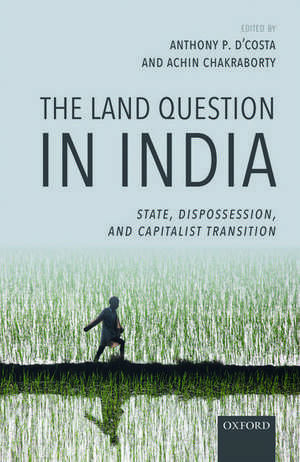
The Land Question in India: State, Dispossession, and Capitalist Transition
Editat de Anthony P. D'Costa, Achin Chakrabortyen Limba Engleză Hardback – 13 apr 2017
După parcurgerea acestui volum, cititorul va fi capabil să decripteze mecanismele complexe prin care statul indian facilitează tranziția către capitalism prin deposedarea sistematică de terenuri. Suntem de părere că această lucrare reîncadrează „chestiunea funciară” nu doar ca o simplă etapă în transformarea agriculturii, ci ca un punct central de conflict între capitalul privat, interesele statului și comunitățile marginalizate. Găsim în această carte o analiză riguroasă a modului în care pământul este extras din circuitul agricol pentru a susține strategii de acumulare în imobiliare și industrie, proces susținut de date empirice solide, incluzând 36 de tabele și 4 figuri.
Descoperim aici o perspectivă distinctă asupra comunităților adivasi, a căror rezistență nu este motivată de profit, ci de protejarea unei economii morale independente de piață. Abordarea diferă de Dispossession without Development de Michael Levien prin faptul că este mai puțin abstractă și mai mult aplicabilă, oferind studii de caz regionale care ilustrează diversitatea proceselor de achiziție și implicațiile lor etico-juridice specifice Indiei contemporane. În timp ce alte lucrări se concentrează pe proteste, acest volum editat de Anthony P. D'Costa și Achin Chakraborty analizează structurile instituționale care permit transformarea pământului în marfă.
Această lucrare se poziționează ca un pilon de analiză politică și economică în vasta operă a lui Anthony P. D'Costa. Dacă în Globalization and Economic Nationalism in Asia acesta explora rolul intervenționist al statului în economie, în volumul de față aplică acea teorie pe o resursă finită și disputată: terenul. Față de studiile sale anterioare despre mobilitatea talentelor în International Mobility, Global Capitalism, and Changing Structures of Accumulation, aici accentul cade pe imobilitatea forțată a populațiilor rurale prin politici de expropriere, oferind o imagine completă a dinamicii dezvoltării asiatice.
Preț: 678.17 lei
Preț vechi: 1021.78 lei
-34%
Carte tipărită la comandă
Livrare economică 12-23 iunie
Specificații
ISBN-10: 0198792441
Pagini: 358
Ilustrații: 4 Figures and 36 Tables
Dimensiuni: 180 x 241 x 28 mm
Greutate: 0.66 kg
Editura: OUP OXFORD
Colecția OUP Oxford
Locul publicării:Oxford, United Kingdom
V-ar putea interesa
-
 -8%Preț: 353.75 lei383.82 lei
 -
 The Selected Works of George J. Benston, Volume 2: Accounting and FinanceJames D. Rosenfeld-11%Preț: 442.67 lei497.38 lei
 -
 Oil for Food: The Global Food Crisis and the Middle EastEckart Woertz-13%Preț: 384.28 lei443.90 lei
 -
 After-Development Dynamics: South Korea's Contemporary Engagement with AsiaAnthony P. D'Costa-33%Preț: 757.10 lei1136.86 lei
 -
 Globalization and Economic Nationalism in AsiaAnthony P. D'Costa-14%Preț: 842.19 lei979.29 lei
 -
 Population in the Human Sciences: Concepts, Models, EvidencePhilip Kreager-33%Preț: 678.08 lei1007.23 lei
 -
 The Oxford Handbook of the Economics of the Biopharmaceutical IndustryPatricia M. Danzon-34%Preț: 990.39 lei1496.44 lei
 -
 The Rise of Mutual Funds: An Insider's ViewMatthew P. FinkPreț: 236.93 lei
 -
 -29%Preț: 1011.78 lei1425.08 lei
 -
 -18%Preț: 1069.26 lei1303.97 lei
 -
 PROJECT MANAGEMENT FOR DUMMIES 2ND UK PONick GrahamPreț: 75.88 lei
 -
 -15%Preț: 403.10 lei474.23 lei
 -
 India in the Global Software IndustryAnthony P D'Costa-15%Preț: 620.73 lei730.27 lei
 -
 The End of JobsTaylor PearsonPreț: 84.06 lei
 -
 Preț: 96.39 lei
 -
 Responsible & ProfitableSveinung JørgensenPreț: 312.29 lei
 -
 -18%Preț: 1068.74 lei1303.34 lei
De ce să citești această carte
Această carte se adresează economiștilor, sociologilor și specialiștilor în politici publice care doresc să înțeleagă realitatea brutală a dezvoltării economice în India. Cititorul câștigă o înțelegere profundă a modului în care legislația funciară este utilizată ca instrument de acumulare a capitalului. Este un instrument esențial pentru oricine studiază conflictele dintre modernizarea industrială și drepturile comunităților indigene asupra resurselor naturale.
Despre autor
Anthony P. D'Costa este profesor de studii indiene și director de cercetare la Asia Research Centre, Copenhagen Business School. Expertiza sa vastă acoperă industriile globale de oțel, auto și IT, cu un accent deosebit pe restructurarea industrială și globalizare. În contextul lucrării de față, experiența sa în analizarea naționalismului economic asiatic și a experiențelor de dezvoltare din India și China îi permite să coordoneze o analiză critică asupra tranziției capitaliste. A publicat lucrări fundamentale despre economia spațială și mobilitatea internațională, fiind o voce autoritară în studiile de economie politică contemporană.
Descriere
Recenzii
The distribution of landownership, tenancy arrangements, and the marketable surplus of agricultural products have long been considered key elements in understanding the trajectory of development in low-income countries. This view is challenged, however, in this important new book. The contributors argue that land is central to economic and political change and the distribution of income and wealth in India, but it is no longer central to agricultural development. The book thus raises important issues about structural change and economic transition in India. It deserves to be widely read.
Collectively, the authors of these diverse case studies provide thoughtful perspectives, incisive insights and empirical analyses of perhaps the most vital single dimension of development processes and policies in the contemporary Indian neo-liberal accumulation regime: control over land. The studies convincingly triangulate the modus operandi of the logic and forms of dispossession and predation by capital, rightly emphasising the crucial catalyzing framework provided by instrumental legal and political interventions by the state acting as a de facto proxy for capital at various levels of the economy and polity. The editors are to be thanked for bringing together this significant intellectual intervention which will be welcomed both by the specialist researcher as well as the engaged lay reader.