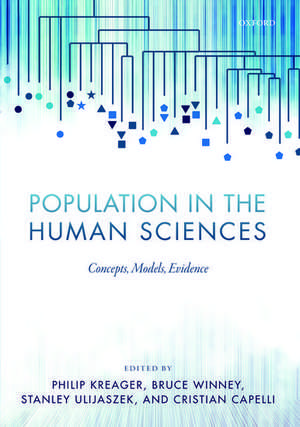
Population in the Human Sciences: Concepts, Models, Evidence
Editat de Philip Kreager, Bruce Winney, Stanley Ulijaszek, Cristian Capellien Limba Engleză Hardback – 5 mar 2015
Preț: 757.19 lei
Preț vechi: 1080.87 lei
-30%
Puncte Express: 1136
Carte tipărită la comandă
Livrare economică 27 noiembrie-02 decembrie
Livrare prin curier în România Termenul estimat este afișat lângă disponibilitate.
Transport gratuit pentru acest produs Plată online sau ramburs, în funcție de opțiunile comenzii.
Retur gratuit în 14 zile Comandă securizată și suport în română.
Specificații
ISBN-13: 9780199688203
ISBN-10: 0199688206
Pagini: 628
Ilustrații: 96 Figures and 58 Tables
Dimensiuni: 182 x 253 x 40 mm
Greutate: 1.25 kg
Editura: OUP OXFORD
Colecția OUP Oxford
Locul publicării:Oxford, United Kingdom
ISBN-10: 0199688206
Pagini: 628
Ilustrații: 96 Figures and 58 Tables
Dimensiuni: 182 x 253 x 40 mm
Greutate: 1.25 kg
Editura: OUP OXFORD
Colecția OUP Oxford
Locul publicării:Oxford, United Kingdom
V-ar putea interesa
-
 -29%Preț: 342.04 lei482.69 lei
 -
 An Essay on the Principle of Population and Other WritingsThomas MalthusPreț: 78.38 lei
 -
 Raising Children: Emerging Needs, Modern Risks, and Social ResponsesJill Duerr Berrick-14%Preț: 106.12 lei123.23 lei
 -
 City LightsE. Barbara Phillips-27%Preț: 1029.88 lei1410.79 lei
 -
 Population Change in CanadaRoderic Beaujot-6%Preț: 340.45 lei362.84 lei
 -
 India: The State of Population 2007Alok Ranjan ChaurasiaPreț: 145.69 lei
 -
 The Demographic Transition: Stages, Patterns, and Economic ImplicationsJean-Claude Chesnais-33%Preț: 1825.28 lei2717.19 lei
 -
 -30%Preț: 843.83 lei1206.79 lei
 -
 -31%Preț: 695.80 lei1008.40 lei
 -
 Cities and Sovereignty – Identity Politics in Urban SpacesDiane E. DavisPreț: 215.14 lei
 -
 Buenos Aires: 400 YearsStanley R. RossPreț: 195.74 lei
 -
 No Shame in My GameKatherine S. NewmanPreț: 127.69 lei
 -
 History of Future CitiesDaniel BrookPreț: 188.40 lei
 -
 Population and SocietyGregg Lee CarterPreț: 175.86 lei
 -
 Life on the BrinkPhilip CafaroPreț: 269.46 lei
 -
 Obesity, Eating Disorders and the MediaKarin Eli-18%Preț: 1250.55 lei1525.06 lei
 -
 Human Variation: From the Laboratory to the FieldC.G. Nicholas Mascie-Taylor-18%Preț: 1778.04 lei2168.34 lei
 -
 Uprooting Urban AmericaHorace R. HallPreț: 397.20 lei
 -
 No Matter How Loud I ShoutEdward HumesPreț: 110.51 lei
 -
 Population 10 BillionProfessor Danny Dorling-25%Preț: 75.84 lei101.76 lei
 -
 Fertility, Conjuncture, DifferencePhilip Kreager-23%Preț: 765.64 lei994.34 lei
Recenzii
Ultimately, philosophically inclined readers and historians of science may get the most out of this book, as it offers a panoramic view of the of human sciences.
Notă biografică
Philip Kreager is an anthropological demographer and historian of population thought and analysis. He is Senior Research Fellow in Human Sciences, Somerville College; Director, Fertility and Reproductive Studies Group, School of Anthropology; Lecturer and Tutor in Population, Institute of Human Sciences; and Senior Research Fellow, Institute of Population Ageing, Oxford University. He currently co-directs an exploratory anthropological and demographic study of problems of malaria treatment in the eastern archipelago of Indonesia. During 1999-2007 he directed Ageing in Indonesia, a multi-site longitudinal study of ageing in three Indonesian Communities, supported by the Welcome Trust. This work has led to continuing collaboration with the University of Indonesia, where he is Honorary Professor. Dr Kreager has a primary interest in the history of population thought, particularly as a common ground of theory and analysis linking the biological and social sciences.
Cuprins
- PART I. Population in the Human Sciences: An Introduction
- Introduction
- PART II. What is a Population?
- 1: Philip Kreager: Population and the Making of the Human Sciences: An Historical Outline
- 2: Walter Bodmer and Bruce Winney: Population Genetics: The Study of the Genetic Structure of Human Populations
- 3: Daniel John Lawson: Populations in Statistical Genetic Modelling and Inference
- 4: Kenneth W. Wachter: Population Heterogeneity in the Spotlight of Biodemography
- PART III. Rethinking Intra- and Inter-Population Dynamics
- 5: John Odling-Smee: Niche Construction in Human Evolution and Demography
- 6: Simon Szreter: Populations for Studying the Causes of Britain's Fertility Decline: Communication Communities
- 7: Hans-Peter Kohler, Stéphane Helleringer, Jere R. Behrman, and Susan C. Watkins: The Social and the Sexual: Networks in Contemporary Demographic Research
- 8: Jennifer A. Johnson-Hanks: Populations are Composed One Event at a Time
- PART IV. Mechanisms of Local Level Variation and Change of State
- 9: Elisabeth Schröder-Butterfill: Networks, Strata, and Ageing: Towards a Compositional Demography of Vulnerability
- 10: Graeme Hugo: Constructing Migration in Southeast Asia: Conceptual, Empirical, and Policy Issues
- 11: Melissa J. Brown: Collective Identities, Shifting Population Membership, and Niche Construction Theory: Implications from Taiwanese and Chinese Empirical Evidence
- 12: Hillard Kaplan, Paul L. Hooper, Jonathan Stieglitz, and Michael Gurven: The Causal Relationship between Fertility and Infant Mortality: Prospective Analyses of a Population in Transition
- PART V. Constructing Populations in the Long Term
- 13: Francesc Calafell and David Comas: Genetics and the Reconstruction of African Population History
- 14: Sarah Elton and Jason Dunn: Species, Populations, and Groups in Hominin Evolution
- 15: Mikolaj Szoltysek: Residence Patterns and the Human-Ecological Setting in Historical Eastern Europe: A Challenge of Compositional (Re)analysis
- 16: Mark Elvin: Linking Late-Imperial and Early Modern Population Dynamics in the Lower Yangzi Valley: An Analysis of Xiaoji Township
- PART VI. Identifying Sub-Populations for Disease Treatment and Control
- 17: Chris Spencer: From Populations to Clines in Modern Statistical Genetics
- 18: Simon Gregson and Tim Hallett: Population Structure and Public Health Research on HIV Control in Sub-Saharan Africa
- 19: Stephen Kunitz: Interventions in Context
- 20: Klim McPherson: Hormones and Disease: Contested Knowledge of Exogenous Hormones in the Evaluation of Oral Contraceptives and Hormone Replacement Therapy