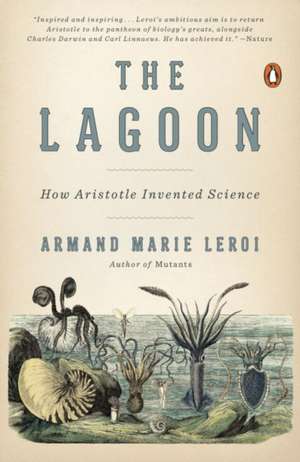
The Lagoon
Autor Armand Marie Leroien Limba Engleză Paperback – 8 dec 2015
Remarcăm în The Lagoon o abordare curajoasă care scoate la lumină o fațetă mai puțin explorată a lui Aristotel: cea de pionier al biologiei. Deși istoria îl reține ca autor al textelor despre metafizică sau poetică, Armand Marie Leroi demonstrează că un sfert din opera sa a fost dedicată lumii naturale. Spre deosebire de edițiile clasice precum The History of Animals, acest volum nu este doar o traducere sau un comentariu arid, ci o călătorie fizică și intelectuală. Leroi merge pe urmele Filosofului în insula Lesbos, observând aceleași specii de melci, bureți și păsări pe care acesta le-a disecat și catalogat acum două milenii. Cititorii familiarizați cu Aristotle's Philosophy of Biology de James G. Lennox vor aprecia modul în care Leroi umanizează rigoarea academică prin observație de teren și analiză critică. Autorul nu se sfiește să puncteze erorile lui Aristotel, dar subliniază cum intuițiile acestuia au prefigurat concepte moderne de dezvoltare și evoluție. Această lucrare continuă preocuparea lui Leroi pentru variația biologică și formarea corpului uman, teme explorate anterior în volumul său premiat, Mutants (cunoscut și ca Tanz der Gene). Apreciem în mod deosebit structura narativă care împletește biologia evoluționistă contemporană cu istoria ideilor, oferind o perspectivă proaspătă asupra modului în care știința occidentală a moștenit structura logică a observației aristoteliene. Este o explorare a modului în care curiozitatea brută, sprijinită de munci colective ale pescarilor și vânătorilor antici, a pus bazele taxonomiei și anatomiei comparative.
Preț: 160.97 lei
Carte disponibilă
Livrare economică 16-30 noiembrie
Specificații
ISBN-10: 0143127985
Pagini: 514
Dimensiuni: 140 x 214 x 28 mm
Greutate: 0.53 kg
Editura: Penguin Publishing Group
V-ar putea interesa
-
 Being ShelleyAnn WroePreț: 119.05 lei
 -
 UnrecountedW. G. SebaldPreț: 91.71 lei
 -
 A Place in the CountryW. G. Sebald-31%Preț: 59.13 lei85.85 lei
 -
 AristotleJohn Sellars-27%Preț: 56.71 lei77.49 lei
 -
 Dominion: The Making of the Western MindTom Holland-23%Preț: 85.01 lei110.59 lei
 -
 On the Natural History of DestructionW. G. SebaldPreț: 118.26 lei
 -
 Selected Poems of Salvador EspriuSalvador EspriuPreț: 107.94 lei
 -
 AristotleAristotlePreț: 193.55 lei
 -
 History of Animals, Volume IAristotlePreț: 228.42 lei
 -
 VertigoW. G. SebaldPreț: 97.30 lei
 -
 As Night FallsAvner WishnitzerPreț: 327.68 lei
 -
 On the Generation of AnimalsAristotlePreț: 40.86 lei
 -
 System of ViennaGert JonkePreț: 68.89 lei
 -
 Arriving in AvignonDaniel RobberechtsPreț: 75.94 lei
 -
 The Siege in the RoomMiquel BaucaPreț: 125.59 lei
 -
 My Beautiful BusJacques JouetPreț: 66.49 lei
 -
 No World ConcertoA. G. PortaPreț: 99.81 lei
 -
 -21%Preț: 158.42 lei201.22 lei
 -
 Orpheus: The Song of LifeAnn Wroe-18%Preț: 99.91 lei122.57 lei
 -
 Preț: 164.90 lei
De ce să citești această carte
Recomandăm această carte oricărui pasionat de istoria ideilor care dorește să înțeleagă rădăcinile științei moderne. The Lagoon transformă un personaj istoric adesea perceput ca abstract într-un cercetător pasionat și meticulos. Veți descoperi cum observațiile despre inima umană sau comportamentul animalelor din antichitate rămân relevante și cum biologia actuală încă folosește limbajul conceptual creat de Aristotel pe malul lagunei din Lesbos.
Despre autor
Armand Marie Leroi este un renumit biolog evoluționist și profesor la Imperial College London. Cercetările sale se concentrează pe mecanismele de dezvoltare la nematode, însă recunoașterea publică a venit odată cu scrierile sale de popularizare a științei. Volumul său Mutants a câștigat prestigiosul Guardian First Book Award, fiind tradus în numeroase limbi. Prin The Lagoon, Leroi își folosește expertiza academică pentru a reevalua antichitatea, fiind distins anterior și cu medalia „Scientist for the New Century” de către Royal Institution of Great Britain.
Descriere scurtă
Both a travelogue and a study of the origins of science, "The Lagoon" shows how an ancient thinker still has much to teach us today. Aristotle s philosophy looms large over the history of Western thought, but the subject he most loved was biology. He wrote vast treatises on animals, dissecting them, classifying them, recording how they lived, fed, and bred. He founded a science. It can even be said that he founded science itself.
In this luminous book, acclaimed biologist Armand Marie Leroi recovers Aristotle s science. He explores Aristotle s observations, his deep ideas, his inspired guesses and the things he got wildly wrong. Leroi visits the Aegean island where Aristotle plumbed the secrets of the living world in all its beauty. Modern science still bears the stamp of its founder. "The Lagoon" reveals that Aristotle was not only the first biologist, but also one of the greatest."
Descriere
In the Eastern Aegean lies an island of forested hills and olive groves, with streams, marshes and a lagoon that nearly cuts the land in two. It was here, over two thousand years ago, that Aristotle came to work.
Aristotle was the greatest philosopher of all time. Author of the Poetics, Politics and Metaphysics, his work looms over the history of Western thought. But he was also a biologist - the first.
Aristotle explored the mysteries of the natural world. With the help of fishermen, hunters and farmers, he catalogued the animals in his world, dissected them, observed their behaviours and recorded how they lived, fed, and bred. In his great zoological treatise, Historia animalium, he described the mating habits of herons, the sexual incontinence of girls, the stomachs of snails, the sensitivity of sponges, the flippers of seals, the sounds of cicadas, the destructiveness of starfish, the dumbness of the deaf, the flatulence of elephants and the structure of the human heart. And then, in another dozen books, he explained it all.
In The Lagoon, acclaimed biologist Armand Marie Leroi recovers Aristotle's science. He goes to Lesbos to see the creatures that Aristotle saw, where he saw them, and explores the Philosopher's deep ideas and inspired guesses - as well as the things that he got wildly wrong. Leroi shows how Aristotle's science is deeply intertwined with his philosophical system and how modern science even now bears the imprint of its inventor.
Recenzii
Leroi clearly adores Greece and he uses his detailed local knowledge to splendid effect, evocatively re-creating the experiences of the peripatetic philosopher . Leroi is absolutely right to say that even those sections of Aristotle's work we no longer believe to be correct have affected the knowledge that we have today
In this lush, epic and hugely enjoyable book, biologist Armand Marie Leroi explores the idea that it was another ancient Greek giant whose shoulders we may all stand upon . Leroi is a beautiful writer and it's been too long, a decade, since his last outstanding book
Brilliant . Not just a charismatic book, but one that places Aristotle in a freshly Aegean context . Above all, Leroi shows, science today trawls through reams of data for patterns and explanations, in precisely Aristotle's manner
Leroi takes us through Aristotle's work, finding hints of modern thinking everywhere . The Lagoon bubbles with enthusiasm for its subject, making an absolutely gripping read out of what might have seemed the most unlikely material
Compelling, sometimes contentious, and always thought-provoking . It celebrates what is most admirable in the Aristotelian tradition: its appreciation of what is actually there
How Aristotle nearly beat Darwin to a theory of evolution. Brilliant
In the History of Animals "[Aristotle] speaks of the reproduction of lice, the mating habits of herons, the sexual incontinence of girls, the stomachs of snails, the sensitivity of starfish, the dumbness of the deaf, the flatulence of elephants and the structure of the human heart: his book contains 130,000 words and 9,000 empirical claims". Leroi's own uncompromising investigation gives us a flavour of his subject's indefatigable explorations . Leroi does not upstage Aristotle's descriptions with modern anatomical illustrations, though his attractively illustrated discussions draw on much scholarship that has been expended on editing and interpreting Aristotle's ideas about nature . Leroi's scholarship is impeccable and consistently generous . Only an expert biologist with broad cultural sympathies and a deep feeling for history could have created such a compelling reappraisal of Aristotle's place in the history of science. What's in a name, indeed; in marshalling the facts and ideas that support Aristotle's scientific credentials in exuberant detail, Leroi must be accounted the king
Beautifully written
Remarkable