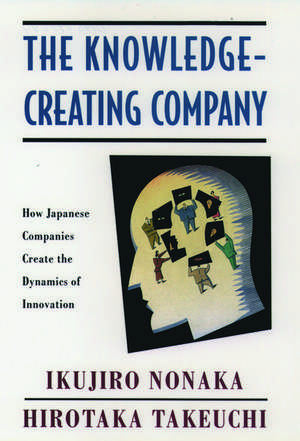
The Knowledge-Creating Company: How Japanese Companies Create the Dynamics of Innovation
Autor Ikujiro Nonaka, Hirotaka Takeuchien Limba Engleză Hardback – 7 sep 1995
Preț: 254.13 lei
Puncte Express: 381
Carte în stoc
Livrare din stoc 21 octombrie
Livrare prin curier în România Termenul estimat este afișat lângă disponibilitate.
Transport gratuit de la 400.00 lei Plată online sau ramburs, în funcție de opțiunile comenzii.
Retur gratuit în 14 zile Comandă securizată și suport în română.
Specificații
ISBN-13: 9780195092691
ISBN-10: 0195092694
Pagini: 304
Ilustrații: line figures, tables
Dimensiuni: 236 x 163 x 28 mm
Greutate: 0.62 kg
Ediția:1
Editura: Oxford University Press
Colecția OUP USA
Locul publicării:New York, United States
ISBN-10: 0195092694
Pagini: 304
Ilustrații: line figures, tables
Dimensiuni: 236 x 163 x 28 mm
Greutate: 0.62 kg
Ediția:1
Editura: Oxford University Press
Colecția OUP USA
Locul publicării:New York, United States
V-ar putea interesa
-
 -17%Preț: 192.26 lei230.54 lei
 -
 The Infinite AlphabetCésar A. HidalgoPreț: 191.23 lei
 -
 The Anatomy of Japanese BusinessKazuo SatoPreț: 469.07 lei
 -
 The ArcherPaulo CoelhoPreț: 125.35 lei
 -
 The ArcherPaulo CoelhoPreț: 119.38 lei
 -
 Good to GreatJim Collins-24%Preț: 146.96 lei192.27 lei
 -
 A Brief History of TimeStephen Hawking-19%Preț: 64.40 lei79.13 lei
 -
 Preț: 231.49 lei
 -
 Fish Can't See WaterKai HammerichPreț: 187.26 lei
 -
 How to Create InnovationStefan F. DieffenbacherPreț: 262.87 lei
 -
 The New Nature of BusinessAndre HoffmannPreț: 116.02 lei
 -
 Systematic Reviews in the Social SciencesHelen RobertsPreț: 445.68 lei
 -
 Charles Dickens: Five Novels: Letherbound. Ediţie de colecţieCharles Dickens-26%Preț: 262.05 lei352.29 lei
 -
 Cultural KaizenPaul W. III SwaneyPreț: 70.80 lei
 -
 Kaizen Kreativity (OOPS!)Tom DepaoliPreț: 158.75 lei
 -
 Japanese Business Culture and PracticesJon P. AlstonPreț: 82.37 lei
 -
 Art of Basic Oil PaintingMarcia BaldwinPreț: 129.37 lei
 -
 Preț: 104.03 lei
 -
 -16%Preț: 144.39 lei172.06 lei
 -
 200 Words to Help You Talk about ArtBen Street-26%Preț: 52.28 lei71.04 lei
 -
 Do RecruitKhalilah Olokunola-38%Preț: 57.72 lei92.42 lei
 -
 Strategic Management and Innovation StrategiesTakabumi Hayashi-18%Preț: 887.97 lei1082.88 lei
 -
 K¿s¿-ryoku: Conceptualizing CapabilityNoboru Konno-18%Preț: 1039.23 lei1267.35 lei
Recenzii
When the authors detail specific examples of knowledge creation, the reader's interest awakens.
Nonaka and Tekuchi demonstrate for the reader how it is possible to transfer tacit knowledge into explicit, which in turn is used to create new knowledge.
Nonaka is indispensable.
Nonaka and Takeuchi have written an academic study that summarises their theories and presents case studies illustrative to a western audience ... a guide to practitioners, based on materials for workshops and consultancy by the authors.
Provides a perceptive and very relevant analysis of how Japanese companies go about creating new knowledge organizationally ... One of the most valuable new books I have covered ... for some time.
The book, an esoteric mixture of philosophy and practical guidance, has been a business bestseller in the US.
Nonaka and Tekuchi demonstrate for the reader how it is possible to transfer tacit knowledge into explicit, which in turn is used to create new knowledge.
Nonaka is indispensable.
Nonaka and Takeuchi have written an academic study that summarises their theories and presents case studies illustrative to a western audience ... a guide to practitioners, based on materials for workshops and consultancy by the authors.
Provides a perceptive and very relevant analysis of how Japanese companies go about creating new knowledge organizationally ... One of the most valuable new books I have covered ... for some time.
The book, an esoteric mixture of philosophy and practical guidance, has been a business bestseller in the US.
Notă biografică
Ikujiro Nonaka and Hirotaka Takeuchi are both Professors of Management at the Institute of Business Research, Hitosubashi University.