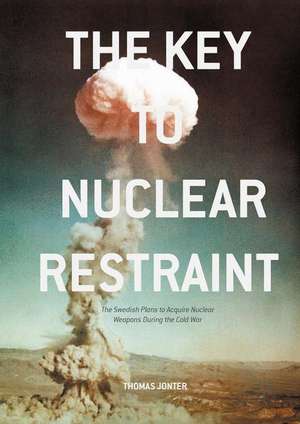
The Key to Nuclear Restraint
Autor Thomas Jonteren Limba Engleză Hardback – 13 mai 2016
Preț: 566.94 lei
Preț vechi: 666.99 lei
-15%
Puncte Express: 850
Carte tipărită la comandă
Livrare economică 09-23 iunie
Specificații
ISBN-13: 9781137581129
ISBN-10: 1137581123
Pagini: 308
Ilustrații: XIV, 293 p.
Dimensiuni: 153 x 216 x 22 mm
Greutate: 0.51 kg
Ediția:1st ed. 2016
Editura: Palgrave MacMillan
Locul publicării:London, United Kingdom
ISBN-10: 1137581123
Pagini: 308
Ilustrații: XIV, 293 p.
Dimensiuni: 153 x 216 x 22 mm
Greutate: 0.51 kg
Ediția:1st ed. 2016
Editura: Palgrave MacMillan
Locul publicării:London, United Kingdom
V-ar putea interesa
-
 -11%Preț: 420.49 lei472.46 lei
 -
 Everyday Life in Fascist Venice, 1929-40K. FerrisPreț: 377.24 lei
 -
 Serbia and the Serbs in World War TwoSabrina P RametPreț: 383.76 lei
 -
 Preț: 376.36 lei
 -
 Preț: 377.74 lei
 -
 Making Sense of AnarchismDavide TurcatoPreț: 379.14 lei
 -
 The Rise of Economic Societies in the Eighteenth CenturyK. StapelbroekPreț: 384.70 lei
 -
 Life and Society in Byzantine CappadociaEric Cooper-15%Preț: 677.54 lei797.11 lei
 -
 Preț: 378.19 lei
 -
 -19%Preț: 337.07 lei416.95 lei
 -
 A Brief History of the English ReformationMr Derek Wilson-27%Preț: 74.98 lei103.09 lei
 -
 Liverpool FC Match of My LifeLeo MoynihanPreț: 57.22 lei
 -
 Wolves Match of My LifeSimon LowePreț: 62.81 lei
 -
 Stoke City Match of My LifeSimon LowePreț: 65.46 lei
Cuprins
Introduction. - 1.The ideas to initiate a nuclear weapons program started to grow. - 2. The development of a latent capability of producing nuclear weapons, 1945–59. - 3. The United States and Sweden’s plans to acquire nuclear weapons, 1945-62. - 4. The political debate: 1954–60. - 5. Abandoning the nuclear weapons plans: 1961–75. - 6. Conclusions
Notă biografică
Thomas Jonter is Director of Stockholm University Graduate School of International Studies, Sweden, and Professor of International Relations at the Department of Economic History. He has been visiting scholar at Stockholm International Peace Research Institute (SIPRI), Stanford University, and Cornell University. Professor Jonter is also chair of Swedish Pugwash and served as advisor to the Swedish delegation to the 2015 Review Conference to the Treaty on the Non-proliferation of Nuclear Weapons, at the United Nations in New York.
Textul de pe ultima copertă
Why have some nations acquired nuclear weapons while others have refrained from doing so? Most research related to this question has focused on states that have built nuclear weapons, yet little attention has been devoted to countries that have chosen nuclear restraint. This book analyzes Swedish plans to acquire nuclear weapons during the Cold War. Sweden was very close to putting a bomb together in 1960s but, for a number of reasons illuminated in this book, decision makers abandoned those plans and subsequently rose to become one of the most recognized players in the international game of disarmament. Thanks to the recent declassification of essential documentation in Sweden and United States, it is now possible to assemble a comprehensive analysis of the Swedish nuclear weapons program based on primary sources. This book presents that analysis, a unique perspective owing to the fact that nuclear development is a highly secretive activity in most countries – with non-existent orlimited access to state archives.