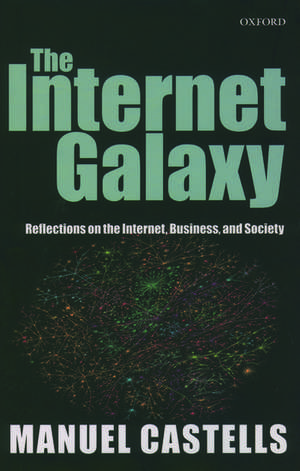
The Internet Galaxy: Reflections on the Internet, Business, and Society: Clarendon Lectures in Management Studies
Autor Manuel Castellsen Limba Engleză Hardback – 18 oct 2001





Preț: 385.06 lei
Preț vechi: 485.48 lei
-21%
Puncte Express: 578
Carte tipărită la comandă
Livrare economică 03-09 decembrie
Livrare prin curier în România Termenul estimat este afișat lângă disponibilitate.
Transport gratuit de la 400.00 lei Plată online sau ramburs, în funcție de opțiunile comenzii.
Retur gratuit în 14 zile Comandă securizată și suport în română.
Specificații
ISBN-13: 9780199241538
ISBN-10: 0199241538
Pagini: 304
Ilustrații: 2 maps
Dimensiuni: 146 x 224 x 21 mm
Greutate: 0.55 kg
Editura: OUP OXFORD
Colecția OUP Oxford
Seria Clarendon Lectures in Management Studies
Locul publicării:Oxford, United Kingdom
ISBN-10: 0199241538
Pagini: 304
Ilustrații: 2 maps
Dimensiuni: 146 x 224 x 21 mm
Greutate: 0.55 kg
Editura: OUP OXFORD
Colecția OUP Oxford
Seria Clarendon Lectures in Management Studies
Locul publicării:Oxford, United Kingdom
V-ar putea interesa
-
 Digital Nomads: In Search of Meaningful Work in the New EconomyRachael A. WoldoffPreț: 251.03 lei
 -
 -15%Preț: 89.16 lei104.63 lei
 -
 Work: A Very Short IntroductionStephen Fineman-20%Preț: 56.65 lei70.82 lei
 -
 Preț: 436.80 lei
 -
 Preț: 414.57 lei
 -
 -18%Preț: 1119.36 lei1365.07 lei
 -
 WorkLars SvendsenPreț: 318.38 lei
 -
 A Definitive Guide to Behavioural SafetyTim Marsh-9%Preț: 787.87 lei865.79 lei
 -
 Age in the Workplace: Challenges and OpportunitiesDonald TruxilloPreț: 351.06 lei
 -
 The Routledge Companion to Critical Management StudiesAnshuman Prasad-15%Preț: 439.39 lei516.93 lei
 -
 Work in a Metro: Intense, Flexible, InsecureAnuradha Kalhan-18%Preț: 1266.67 lei1544.72 lei
 -
 -18%Preț: 1154.01 lei1407.32 lei
 -
 -18%Preț: 1127.52 lei1375.01 lei
 -
 Strategizing Management Accounting: Liberal Origins and Neoliberal TrendsChandana Alawattage-18%Preț: 1130.52 lei1378.69 lei
 -
 Men at Work: Labour, Masculinities, DevelopmentCecile JacksonPreț: 311.83 lei
 -
 Just One More Hand: Life in the Casino EconomyEllen MutariPreț: 233.53 lei
 -
 Undoing Work, Rethinking Community – A Critique of the Social Function of WorkJames A. ChamberlainPreț: 195.33 lei
 -
 Theorizing the Sharing EconomyIndre Maurer-23%Preț: 749.23 lei973.03 lei
 -
 Notes from a Beijing CoffeeshopJon Geldart-13%Preț: 77.02 lei88.86 lei
 -
 Go Slow and CurvyDehyun SohnPreț: 401.98 lei
 -
 Further Training for Older Workers: A Solution for an Ageing Labour Force?Hilal Zboralski-Avidan-23%Preț: 475.65 lei617.72 lei
Recenzii
Attempting an academic survey of the internet is an heroic task ... Manuel Castells is better placed than most to attempt such an undertaking, and pulls it off with verve and clarity.
Authoritative guide to the origins of the internet, how it is affecting every area of human life, and its business applications.
This small but complete volume is a critical introduction to internet-related theories, while doubling as a simplified reader on his own ideas. The book should help to spread his influence beyond the faithful.
The Internet Galaxy is the best attempt by a big thinker to grapple with the net's long-term implications for our society.
The Internet is shaping society and in turn being shaped by society. It takes a scholar of Manuel Castells's range to do justice to this phenomenon. His book is learned without being pompous, and insightful without being impenetrable. If we ever get a discipline of Internet studies, this will be one of its founding texts.
Manuel Castells has proved once again that he has an unmatched synoptic capacity to make sense of the complexities of a networked world, and here writes with clarity and insight about everything from the history of the technology to the subcultures that have done so much to shape it.
Thoroughly researched and truly global in scope. Castells provides balanced covergae of e-business and the new economy: the politics of the Internet, including privacy and freedom: and the geography of the Internet. Highly recommended for academic libraries.
[An] excellent, readable, nontechnical summary of the history, social implications and likely future of Internet business.
Castells is probably the world's most highly regarded commentator on the information age and new economic order.
Adam Smith explained how capitalism worked, and Karl Marx explained why it didn't. Now the social and economic relations of the Information Age have been captured by Manuel Castells.
A readable, articulate and persuasive account of why the internet's most powerful impacts on the shape of business, politics and society may be yet to come. Castells is the nearest thing the internet has to a founding philosopher.
Authoritative guide to the origins of the internet, how it is affecting every area of human life, and its business applications.
This small but complete volume is a critical introduction to internet-related theories, while doubling as a simplified reader on his own ideas. The book should help to spread his influence beyond the faithful.
The Internet Galaxy is the best attempt by a big thinker to grapple with the net's long-term implications for our society.
The Internet is shaping society and in turn being shaped by society. It takes a scholar of Manuel Castells's range to do justice to this phenomenon. His book is learned without being pompous, and insightful without being impenetrable. If we ever get a discipline of Internet studies, this will be one of its founding texts.
Manuel Castells has proved once again that he has an unmatched synoptic capacity to make sense of the complexities of a networked world, and here writes with clarity and insight about everything from the history of the technology to the subcultures that have done so much to shape it.
Thoroughly researched and truly global in scope. Castells provides balanced covergae of e-business and the new economy: the politics of the Internet, including privacy and freedom: and the geography of the Internet. Highly recommended for academic libraries.
[An] excellent, readable, nontechnical summary of the history, social implications and likely future of Internet business.
Castells is probably the world's most highly regarded commentator on the information age and new economic order.
Adam Smith explained how capitalism worked, and Karl Marx explained why it didn't. Now the social and economic relations of the Information Age have been captured by Manuel Castells.
A readable, articulate and persuasive account of why the internet's most powerful impacts on the shape of business, politics and society may be yet to come. Castells is the nearest thing the internet has to a founding philosopher.
Notă biografică
Manuel Castells, born in Spain in 1942, is Professor of Planning and Professor of Sociology at the University of California, Berkeley where he was appointed in 1979. Previously he taught for twelve years at the University of Paris. He has also been a visiting professor in fifteen universities in Europe, North America, Asia, and Latin America. He has published twenty-one books, including the trilogy The Information Age: Economy, Society, and Culture (1996-2000), translated into fourteen languages. He has been a member of the European Commission's Expert Group on the Information Society, of the Advisory Committee to the United Nations Secretary General on Information and Communication Technology, and of the Advisory Committee to the President of South Africa on Information Technology and Development. He is a member of the European Academy.