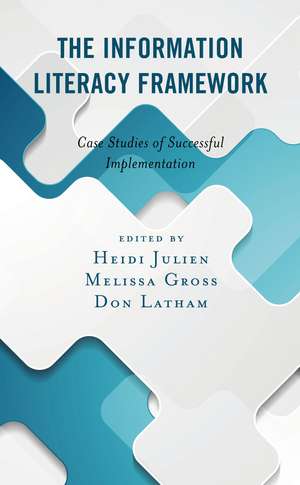
The Information Literacy Framework: Case Studies of Successful Implementation: Association for Library and Information Science Education
Editat de Heidi Julien, Melissa Gross, Don Lathamen Limba Engleză Hardback – 7 feb 2020


Preț: 660.59 lei
Preț vechi: 1005.78 lei
-34%
Puncte Express: 991
Carte tipărită la comandă
Livrare economică 28 noiembrie-12 decembrie
Livrare prin curier în România Termenul estimat este afișat lângă disponibilitate.
Transport gratuit pentru acest produs Plată online sau ramburs, în funcție de opțiunile comenzii.
Retur gratuit în 14 zile Comandă securizată și suport în română.
Specificații
ISBN-13: 9781538121436
ISBN-10: 1538121433
Pagini: 312
Ilustrații: 20 b/w photos; 21 tables; 2 textboxes
Dimensiuni: 154 x 232 x 24 mm
Greutate: 0.6 kg
Editura: Bloomsbury Publishing
Colecția Rowman & Littlefield
Seria Association for Library and Information Science Education
Locul publicării:New York, United States
ISBN-10: 1538121433
Pagini: 312
Ilustrații: 20 b/w photos; 21 tables; 2 textboxes
Dimensiuni: 154 x 232 x 24 mm
Greutate: 0.6 kg
Editura: Bloomsbury Publishing
Colecția Rowman & Littlefield
Seria Association for Library and Information Science Education
Locul publicării:New York, United States
Cuprins
Table of Contents
List of Figures
Foreword
Preface
Part I. Preparing to use the Framework
Chapter 1. Strategies for Mapping Information Literacy Threshold Concepts to Course Objectives in Political Science
Mohamed Berray
Chapter 2. Faculty Workshops: Incorporating the Framework and Embedding Information Literacy in Undergraduate Courses
Melissa Harden and Anna Michelle Martinez-Montavon
Chapter 3. Are They There Yet? Determining Student Mastery of Learning Outcomes Based on the ACRL Framework
Holly Hendrigan, Keshav Makunda, and Diana Cukierman
Chapter 4. Finding Expertise in Your Own Backyard: Creating Communities of Practice to Support Learning about the Framework
Kim Pittman, Amy Mars, and Trent Brager
Chapter 5. From Standards to Threshold Concepts, Knowledge Practices, and Learner Dispositions: Rethinking Formal Information Literacy Instruction in Higher Education
Leslie M. Ross
Chapter 6. An Idea That Sells Itself: The Framework as a Partnership Guide and Faculty Marketing Tool
Sarah Steele, Steve Bahnaman, Brooke Taxakis, Ron Epps, and Elizabeth Dobbins
Part II. Case studies of instruction using the Framework
Chapter 7. Teaching the Framework Using an Online Tutorial
Leanna Fry Balci and Peter J. Rich
Chapter 8. Designing a First-Year Foundation Program around the Framework
Brianna B. Buljung
Chapter 9. The Framework as Pedagogical Tool: Teaching Source Integration
Gina Calia-Lotz
Chapter 10. Redesigning a Credit Bearing Course using the ACRL Information Literacy Framework
Kelly Diamond and Alyssa Wright
Chapter 11. The Framework and the Context: Refocusing Information Literacy at a Caribbean University
Paulette A. Kerr and Jessica C. Lewis
Chapter 12. The Librarian's Journey Begins: Finding Pedagogical Authority and Creativity in the ACRL Framework
Liza Oldham
Part III. Educating for the Framework
Chapter 13. Flexible Frameworks, New Paradigms: Examining Beliefs about the ACRL Framework to Grow Teaching Practice
Andrea Baer
Chapter 14. Chandler-Gilbert Community College Case Study
Mary Beth Burgoyne and Kim Chuppa-Cornell
Chapter 15. Exploring Metaliterate Learning through the Frames of Information Literacy
Thomas P. Mackey
Chapter 16. Extending the Framework for the Benefit of Praxis: A Strategic Literacy-Based Approach to Diversity Education (SLADE)
Bharat Mehra and Keren Dali
Chapter 17. Teaching Future Librarian Educators Using the ACRL Framework: A New Graduate-Level iSchool Teaching Certificate
Carla Stoffle, Nicole Pagowsky, and Yvonne Mery
Chapter 18. Rethinking the Reference and Instruction Curriculum Using the Integrated Threshold Concept Knowledge Framework
Susan Rathbun-Grubb
About the Contributors
About the Editors
List of Figures
Foreword
Preface
Part I. Preparing to use the Framework
Chapter 1. Strategies for Mapping Information Literacy Threshold Concepts to Course Objectives in Political Science
Mohamed Berray
Chapter 2. Faculty Workshops: Incorporating the Framework and Embedding Information Literacy in Undergraduate Courses
Melissa Harden and Anna Michelle Martinez-Montavon
Chapter 3. Are They There Yet? Determining Student Mastery of Learning Outcomes Based on the ACRL Framework
Holly Hendrigan, Keshav Makunda, and Diana Cukierman
Chapter 4. Finding Expertise in Your Own Backyard: Creating Communities of Practice to Support Learning about the Framework
Kim Pittman, Amy Mars, and Trent Brager
Chapter 5. From Standards to Threshold Concepts, Knowledge Practices, and Learner Dispositions: Rethinking Formal Information Literacy Instruction in Higher Education
Leslie M. Ross
Chapter 6. An Idea That Sells Itself: The Framework as a Partnership Guide and Faculty Marketing Tool
Sarah Steele, Steve Bahnaman, Brooke Taxakis, Ron Epps, and Elizabeth Dobbins
Part II. Case studies of instruction using the Framework
Chapter 7. Teaching the Framework Using an Online Tutorial
Leanna Fry Balci and Peter J. Rich
Chapter 8. Designing a First-Year Foundation Program around the Framework
Brianna B. Buljung
Chapter 9. The Framework as Pedagogical Tool: Teaching Source Integration
Gina Calia-Lotz
Chapter 10. Redesigning a Credit Bearing Course using the ACRL Information Literacy Framework
Kelly Diamond and Alyssa Wright
Chapter 11. The Framework and the Context: Refocusing Information Literacy at a Caribbean University
Paulette A. Kerr and Jessica C. Lewis
Chapter 12. The Librarian's Journey Begins: Finding Pedagogical Authority and Creativity in the ACRL Framework
Liza Oldham
Part III. Educating for the Framework
Chapter 13. Flexible Frameworks, New Paradigms: Examining Beliefs about the ACRL Framework to Grow Teaching Practice
Andrea Baer
Chapter 14. Chandler-Gilbert Community College Case Study
Mary Beth Burgoyne and Kim Chuppa-Cornell
Chapter 15. Exploring Metaliterate Learning through the Frames of Information Literacy
Thomas P. Mackey
Chapter 16. Extending the Framework for the Benefit of Praxis: A Strategic Literacy-Based Approach to Diversity Education (SLADE)
Bharat Mehra and Keren Dali
Chapter 17. Teaching Future Librarian Educators Using the ACRL Framework: A New Graduate-Level iSchool Teaching Certificate
Carla Stoffle, Nicole Pagowsky, and Yvonne Mery
Chapter 18. Rethinking the Reference and Instruction Curriculum Using the Integrated Threshold Concept Knowledge Framework
Susan Rathbun-Grubb
About the Contributors
About the Editors
Recenzii
This book is recommended for academic libraries and library schools. Approaching the 5th year since its adoption, the Framework has been around long enough for the library profession to have developed norms and best practices around its implementation and is a helpful catalog of many of these practices and is a useful resource to librarians teaching information literacy.
The Information Literacy Framework: Case Studies of Successful Implementation is a collection of 18 case studies , carefully chosen by accomplished members of the field, that contribute to the literature on how stakeholders can use the ACRL Framework to enhance student learning. This book will be of interest to anyone who has a role in teaching information literacy and it contributes to the literature by presenting effective examples of how practitioners have adopted the ACRL Framework.
The Framework for Information Literacy for Higher Education (Framework),put forth by the Association of College and Research Libraries (ACRL),can be either challenging to integrate or easily molded to conform to specific disciplines in teaching. In three sections, contributors offer unambiguous and concise approaches on how to overcome barriers and interpret and engage with the Framework. The first part explores essential preparation tools for using the Framework, such as curriculum mapping and collective professional development workshops. The next section presents exploratory case studies of the Framework being applied in various teaching environments, accompanied by astute reflections on redesigning an online tutorial, organizing a first-year-experience program, and using the Framework as a pedagogical tool in information literacy instruction. The final section discusses virtual course offerings for information literacy instructors, the expansion of "metaliterate" learning processes, and an online professional development certification in teaching. Most helpful are the diverse scenarios presented throughout illustrating how to support the Framework in more traditional learning environments, such as workshops, online class professional development, or a pedagogical component in library school. This is recommended reading for all librarians, at any level and within any library environment, and for other educators in information literacy instruction. Summing Up: Recommended. Graduate students, faculty, and professionals.
The editors are expert researchers in information literacy, who have applied their research expertise to create the most useful collection of case studies describing the challenges and opportunities associated with the implementation of the ACRL Framework for Information Literacy for Higher Education. The insightful examples from different perspectives provide new ways of interpreting, utilizing, and leveraging the Framework to engage students and faculty in information literacy instruction.
The Information Literacy Framework: Case Studies of Successful Implementation is a collection of 18 case studies , carefully chosen by accomplished members of the field, that contribute to the literature on how stakeholders can use the ACRL Framework to enhance student learning. This book will be of interest to anyone who has a role in teaching information literacy and it contributes to the literature by presenting effective examples of how practitioners have adopted the ACRL Framework.
The Framework for Information Literacy for Higher Education (Framework),put forth by the Association of College and Research Libraries (ACRL),can be either challenging to integrate or easily molded to conform to specific disciplines in teaching. In three sections, contributors offer unambiguous and concise approaches on how to overcome barriers and interpret and engage with the Framework. The first part explores essential preparation tools for using the Framework, such as curriculum mapping and collective professional development workshops. The next section presents exploratory case studies of the Framework being applied in various teaching environments, accompanied by astute reflections on redesigning an online tutorial, organizing a first-year-experience program, and using the Framework as a pedagogical tool in information literacy instruction. The final section discusses virtual course offerings for information literacy instructors, the expansion of "metaliterate" learning processes, and an online professional development certification in teaching. Most helpful are the diverse scenarios presented throughout illustrating how to support the Framework in more traditional learning environments, such as workshops, online class professional development, or a pedagogical component in library school. This is recommended reading for all librarians, at any level and within any library environment, and for other educators in information literacy instruction. Summing Up: Recommended. Graduate students, faculty, and professionals.
The editors are expert researchers in information literacy, who have applied their research expertise to create the most useful collection of case studies describing the challenges and opportunities associated with the implementation of the ACRL Framework for Information Literacy for Higher Education. The insightful examples from different perspectives provide new ways of interpreting, utilizing, and leveraging the Framework to engage students and faculty in information literacy instruction.