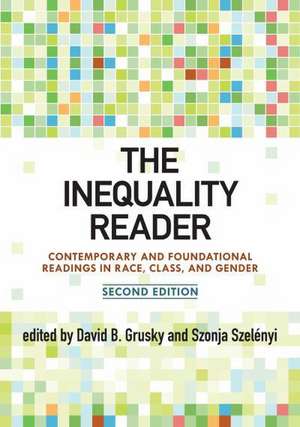
The Inequality Reader: Contemporary and Foundational Readings in Race, Class, and Gender
Autor David Grusky, Szonja Szelényien Limba Engleză Paperback – 15 mar 2011
Preț: 658.15 lei
Preț vechi: 774.30 lei
-15%
Puncte Express: 987
Carte tipărită la comandă
Livrare economică 04-18 decembrie
Livrare express 30 octombrie-05 noiembrie pentru 61.51 lei
Livrare prin curier în România Termenul estimat este afișat lângă disponibilitate.
Transport gratuit pentru acest produs Plată online sau ramburs, în funcție de opțiunile comenzii.
Retur gratuit în 14 zile Comandă securizată și suport în română.
Specificații
ISBN-13: 9780813344843
ISBN-10: 0813344840
Pagini: 784
Ilustrații: 100+ tables, figures, cgarts, graphs
Dimensiuni: 156 x 234 x 48 mm
Greutate: 1.04 kg
Ediția:Second Edition,
Editura: Taylor & Francis
Colecția Routledge
Locul publicării:Oxford, United Kingdom
ISBN-10: 0813344840
Pagini: 784
Ilustrații: 100+ tables, figures, cgarts, graphs
Dimensiuni: 156 x 234 x 48 mm
Greutate: 1.04 kg
Ediția:Second Edition,
Editura: Taylor & Francis
Colecția Routledge
Locul publicării:Oxford, United Kingdom
Cuprins
- Part I: Introduction - 1 David B. Grusky The Stories About Inequality That We Love to Tell - Part II: Does Inequality Serve a Purpose? - 2 Kingsley Davis and Wilbert E. Moore Some Principles of Stratification 3 Claude S. Fischer, Michael Hout, Mart
Descriere
Editors Grusky and Szelenyi, have assembled the most important classic and contemporary readings about how poverty and inequality are generated and how they might be reduced. This second edition provides new materials on anti-poverty policies as well as new qualitative readings that make the scholarship more alive, more accessible, and more relevant.