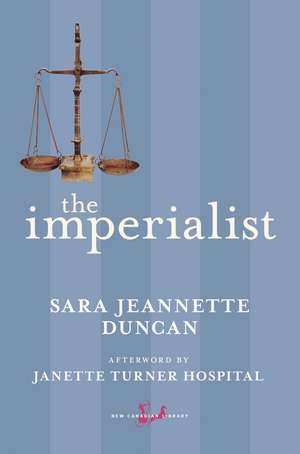
The Imperialist
Autor Sara Jeannette Duncanen Limba Engleză Paperback – dec 2008
Sympathetic, humorous, and wonderfully detailed, The Imperialist is an astute analysis of the paradoxes of Canadian nationhood, as relevant today as when the novel was first published in 1904.
From the Paperback edition.
| Toate formatele și edițiile | Preț | Express |
|---|---|---|
| Paperback (5) | 114.64 lei 3-5 săpt. | +59.20 lei 7-11 zile |
| BROADVIEW PR – 15 iun 2005 | 180.36 lei 3-5 săpt. | +59.20 lei 7-11 zile |
| CREATESPACE – | 114.64 lei 3-5 săpt. | |
| Alpha Editions – 12 mai 2018 | 146.91 lei 3-5 săpt. | |
| Book Jungle – 3 noi 2009 | 172.07 lei 6-8 săpt. | |
| TREDITION CLASSICS – 31 oct 2011 | 181.26 lei 6-8 săpt. |
Preț: 118.24 lei
Puncte Express: 177
Preț estimativ în valută:
20.90€ • 24.59$ • 18.24£
20.90€ • 24.59$ • 18.24£
Carte indisponibilă temporar
Doresc să fiu notificat când acest titlu va fi disponibil:
Se trimite...
Specificații
ISBN-13: 9780771096297
ISBN-10: 0771096291
Pagini: 376
Dimensiuni: 127 x 196 x 23 mm
Greutate: 0.36 kg
Editura: McClelland & Stewart
ISBN-10: 0771096291
Pagini: 376
Dimensiuni: 127 x 196 x 23 mm
Greutate: 0.36 kg
Editura: McClelland & Stewart
V-ar putea interesa
-
 From Man to Man or Perhaps Only—Olive Schreiner-18%Preț: 63.89 lei77.60 lei
 -
 Culture and AnarchyMatthew Arnold-21%Preț: 54.03 lei68.25 lei
 -
 A Passage to IndiaE. M. Forster-19%Preț: 56.84 lei69.77 lei
 -
 Empire: Number 4 in seriesGore Vidal-27%Preț: 84.88 lei116.95 lei
 -
 Heart of DarknessJoseph Conrad-21%Preț: 21.50 lei27.22 lei
 -
 The Picture of Dorian GrayOscar WildePreț: 33.29 lei
 -
 Preț: 351.76 lei
 -
 Sunshine Sketches of a Little TownStephen LeacockPreț: 70.00 lei
 -
 The History of Emily MontagueFrances BrookePreț: 179.45 lei
 -
 Set in AuthoritySara Jeannette Duncan-17%Preț: 235.50 lei284.17 lei
 -
 The Country of the Pointed FirsSarah Orne JewettPreț: 34.57 lei
 -
 The Girl PrinceDanell Jones-16%Preț: 134.67 lei161.26 lei
 -
 EdenglassieMelissa LucashenkoPreț: 76.21 lei
 -
 One Day, Everyone Will Have Always Been Against ThisOmar El AkkadPreț: 116.23 lei
 -
 MiddlemarchGeorge EliotPreț: 24.60 lei
 -
 Take Three CanadiansGail HughesPreț: 78.80 lei
 -
 Preț: 146.23 lei
 -
 The Importance of Being EarnestOscar WildePreț: 31.83 lei
 -
 Preț: 31.77 lei
Notă biografică
Sara Jeannette Duncan was born in Brantford, Ontario, in 1861. She attended the Toronto Normal School, then left teaching for a career in journalism. She worked as an editorial writer and book reviewer for the Washington Post, then wrote for the Toronto Globe under the name of “Garth Grafton,” and contributed a column to whose founder was Goldwin Smith. She was also parliamentary correspondent in Ottawa for the Montreal Star.
In 1888 Duncan set off on a round-the-world trip as correspondent for the New York World and the Montreal Star. In Calcutta she met her future husband, Everard Cotes, an Englishman serving there as curator of the Indian Museum. They married two years later. Duncan lived in India for twenty-five years, with extended stays abroad in London and frequent trips to Canada.
A prolific and popular writer of fiction, Duncan set nearly half of her novels in India. The Imperialist (1904), generally considered her finest, is her only novel set in Canada. During and after World War One she devoted much of her time to playwrighting.
In 1922 Duncan and her husband retired to England.
Sara Jeannette Duncan died in Ashtead, Surrey, England in 1922.
From the Paperback edition.
In 1888 Duncan set off on a round-the-world trip as correspondent for the New York World and the Montreal Star. In Calcutta she met her future husband, Everard Cotes, an Englishman serving there as curator of the Indian Museum. They married two years later. Duncan lived in India for twenty-five years, with extended stays abroad in London and frequent trips to Canada.
A prolific and popular writer of fiction, Duncan set nearly half of her novels in India. The Imperialist (1904), generally considered her finest, is her only novel set in Canada. During and after World War One she devoted much of her time to playwrighting.
In 1922 Duncan and her husband retired to England.
Sara Jeannette Duncan died in Ashtead, Surrey, England in 1922.
From the Paperback edition.
Recenzii
Set in the fictional Ontario town of Elgin at the beginning of the twentieth century, this 1904 novel was in its own time addressed largely to British readers. It has since become a Canadian classic, beloved for its ironic and dryly humorous portrait of small-town life. But The Imperialist is also a fascinating representation of race, gender, and nationalism in Britain’s “settler colonies.” This Broadview edition provides a wealth of contextual material invaluable to understanding the novel’s historical context, and particularly the debate, central to the story, over Edwardian Canada’s role in the British Empire.
This edition includes a critical introduction and, in the appendices, excerpts from Sara Jeannette Duncan’s journalism and autobiographical sketches (including an essay on “North American Indians”), speeches by Canadian and British politicians, political cartoons, and recipes for the dishes served at the novel’s social gatherings. Contemporary reviews of the novel from British, Canadian, and American periodicals are also included.
“Despite its literary excellence, The Imperialist can be a challenging book. The thoughtful notation and well-chosen appendices of this edition do much to overcome the distance created by the passage of a century that saw dramatic changes in ideas and social expectations. Misao Dean enables us to appreciate Sara Jeannette Duncan as a sophisticated woman who adhered to some values of her day and contested others, and to admire her courage in writing a realistic novel about highly-charged political issues whose legacy affects us today.” — Carole Gerson, Simon Fraser University
This edition includes a critical introduction and, in the appendices, excerpts from Sara Jeannette Duncan’s journalism and autobiographical sketches (including an essay on “North American Indians”), speeches by Canadian and British politicians, political cartoons, and recipes for the dishes served at the novel’s social gatherings. Contemporary reviews of the novel from British, Canadian, and American periodicals are also included.
“Despite its literary excellence, The Imperialist can be a challenging book. The thoughtful notation and well-chosen appendices of this edition do much to overcome the distance created by the passage of a century that saw dramatic changes in ideas and social expectations. Misao Dean enables us to appreciate Sara Jeannette Duncan as a sophisticated woman who adhered to some values of her day and contested others, and to admire her courage in writing a realistic novel about highly-charged political issues whose legacy affects us today.” — Carole Gerson, Simon Fraser University
Descriere
Descriere de la o altă ediție sau format:
Set in the fictional Ontario town of Elgin at the beginning of the twentieth century, this 1904 novel was in its own time addressed largely to British readers. It has since become a Canadian classic, beloved for its ironic and dryly humorous portrait of small-town life. But The Imperialist is also a fascinating representation of race, gender, and nationalism in Britain’s “settler colonies.” This Broadview edition provides a wealth of contextual material invaluable to understanding the novel’s historical context, and particularly the debate, central to the story, over Edwardian Canada’s role in the British Empire.
This edition includes a critical introduction and, in the appendices, excerpts from Sara Jeannette Duncan’s journalism and autobiographical sketches (including an essay on “North American Indians”), speeches by Canadian and British politicians, political cartoons, and recipes for the dishes served at the novel’s social gatherings. Contemporary reviews of the novel from British, Canadian, and American periodicals are also included.
Set in the fictional Ontario town of Elgin at the beginning of the twentieth century, this 1904 novel was in its own time addressed largely to British readers. It has since become a Canadian classic, beloved for its ironic and dryly humorous portrait of small-town life. But The Imperialist is also a fascinating representation of race, gender, and nationalism in Britain’s “settler colonies.” This Broadview edition provides a wealth of contextual material invaluable to understanding the novel’s historical context, and particularly the debate, central to the story, over Edwardian Canada’s role in the British Empire.
This edition includes a critical introduction and, in the appendices, excerpts from Sara Jeannette Duncan’s journalism and autobiographical sketches (including an essay on “North American Indians”), speeches by Canadian and British politicians, political cartoons, and recipes for the dishes served at the novel’s social gatherings. Contemporary reviews of the novel from British, Canadian, and American periodicals are also included.
Cuprins
Acknowledgements
Introduction
Sara Jeannette Duncan: A Brief Chronology
A Note on the Text
The Imperialist
Appendix A: Personal and Domestic Contexts
Introduction
Sara Jeannette Duncan: A Brief Chronology
A Note on the Text
The Imperialist
Appendix A: Personal and Domestic Contexts
- Sara Jeannette Duncan, “[North American Indians].” The Globe (29 July 1885)
- Sara Jeannette Duncan, “[The Old-Time Heroine].” The Week (28 October 1886)
- A Selection of Duncan’s Letters concerning The Imperialist
- From Sara Jeannette Duncan, “[Growing Golden-rod in Simla].” The Crow’s Nest (1901)
- Recipes from The Canadian Home Cook Book (1887)
- Twenty-fourth of May Celebration. The Brantford Expositor (22 May 1884)
- “A Pertinent Question.” Diogenes (19 June 1869)
- “The Effect of the National Policy” (c. 1891)
- Sara Jeannette Duncan, “Imperial Sentiment in Canada.” Indian Daily News (7 October 1896)
- From Goldwin Smith, “Commercial Union.” Canada and the Canadian Question (1891)
- From Joseph Chamberlain, “Trade and The Empire.” Imperial Union and Tariff Reform: Speeches Delivered from May 15th to Nov. 4 1903 (1903)
- “Hon. Geo. E. Foster Answers Sir Wilfrid Laurier” (1904)
- Unsigned. “Canada and Imperial Policy.” New York Times (5 March 1904)
- Unsigned. Times Literary Supplement (22 April 1904)
- Unsigned. The Spectator (23 April 1904)
- Mary K. Ford, “The Novel of the Month: Mrs. Cotes’ The Imperialist.” Current Literature (April 1904)
- J[ean] G[raham], Saturday Night (4 June 1904)
- Unsigned. Daily News [Toronto] (4 June 1904)
- E. Hoyt, The Lamp (July 1904)
- Unsigned. Canadian Magazine (July 1904)
- Unsigned. The Globe [Toronto] (13 August 1904)