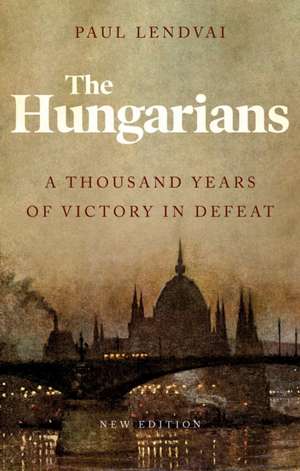
The Hungarians
Autor Paul Lendvaien Limba Engleză Paperback – 21 ian 2021
În cadrul programelor de studii europene și istorie central-europeană, The Hungarians se poziționează ca o lucrare fundamentală pentru înțelegerea unei națiuni definită prin izolare lingvistică și reziliență politică. Observăm în această monografie o tentativă reușită de a demitiza istoria maghiară, trecând dincolo de clișeele medievale ale „barbarilor” pentru a expune rolul Ungariei de apărător al creștinătății occidentale în fața tătarilor, turcilor și ulterior, a regimurilor totalitare. Paul Lendvai construiește un tablou complex al supraviețuirii unui stat-națiune care a traversat catastrofe succesive, menținându-și identitatea într-un mediu adesea ostil. Remarcăm stilul narativ ce îmbină rigoarea cercetării de arhivă cu vivacitatea jurnalismului de înaltă clasă. Autorul nu evită subiectele sensibile, analizând impactul profund al Tratatului de la Trianon asupra psihicului colectiv maghiar sau tensiunile dintre tendințele progresiste și naționalismul izolaționist. Ca alternativă la A Concise History of Hungary de Miklós Molnár pentru cursurile de istorie politică, lucrarea lui Lendvai aduce avantajul unei perspective subiective dar documentate, concentrându-se mai mult pe „sentimentul apartenenței” decât pe cronologia aridă. În contextul operei sale, această carte reprezintă pilonul istoric pe care se sprijină analizele sale politice contemporane, precum Orban. Dacă în lucrările recente autorul investighează mecanismele puterii actuale, în The Hungarians găsim rădăcinile culturale și traumele istorice care explică dinamica actuală a societății maghiare. Este o lectură fluidă, punctată de anecdote despre genii și impostori, ce explică modul în care o regiune izolată a produs o densitate remarcabilă de oameni de știință și artiști de talie mondială.
Preț: 123.86 lei
Preț vechi: 143.86 lei
-14%
Carte disponibilă
Livrare economică 02-16 noiembrie
Livrare express 17-23 octombrie pentru 64.58 lei
Specificații
ISBN-10: 1787383369
Pagini: 632
Dimensiuni: 141 x 213 x 48 mm
Greutate: 0.75 kg
Editura: C Hurst & Co Publishers Ltd
V-ar putea interesa
-
 Soviet-American Relations, 1917-1920, Volume IGeorge Frost KennanPreț: 522.80 lei
 -
 Utopia/DystopiaMichael D. GordinPreț: 215.33 lei
 -
 Preț: 295.65 lei
 -
 Civilizations of Ancient IraqBenjamin R. FosterPreț: 196.08 lei
 -
 The Princeton History of Modern IrelandRichard BourkePreț: 473.97 lei
 -
 Foragers, Farmers, and Fossil FuelsIan MorrisPreț: 238.15 lei
 -
 A Volunteer Nurse on the Western FrontOlive DentPreț: 115.42 lei
 -
 -24%Preț: 95.10 lei125.19 lei
 -
 Citizen Emperor: Napoleon in Power 1799-1815Philip Dwyer-40%Preț: 139.74 lei231.36 lei
 -
 -26%Preț: 75.07 lei101.24 lei
 -
 Lady Catherine and the Real Downton AbbeyThe Countess Of Carnarvon-26%Preț: 69.49 lei93.81 lei
 -
 Last King in IndiaRosie Llewellyn-JonesPreț: 279.26 lei
De ce să citești această carte
Această carte este esențială pentru oricine dorește să înțeleagă specificul Europei Centrale și rădăcinile identității maghiare. Cititorul va obține o perspectivă clară asupra modului în care traumele istorice, precum Trianonul, modelează și astăzi politica regională. Recomandăm volumul pentru echilibrul rar între erudiția academică și stilul jurnalistic captivant, fiind o resursă valoroasă pentru studenții de la relații internaționale sau pasionații de istorie politică.
Despre autor
Paul Lendvai este unul dintre cei mai respectați comentatori politici specializați în Europa Centrală și de Est. Cu o carieră impresionantă de 22 de ani ca corespondent pentru Financial Times și ulterior ca redactor-șef al corporației austriece de radiodifuziune ORF, Lendvai aduce o perspectivă unică asupra regiunii. Având experiența personală a exilului (a părăsit Ungaria după revoluția din 1956), el analizează istoria și politica maghiară cu o obiectivitate critică, dar și cu o înțelegere profundă a nuanțelor culturale. Expertiza sa este recunoscută internațional, fiind un observator fin al tranziției de la comunism la democrație și al derivei autoritare contemporane.
Notă biografică
Textul de pe ultima copertă
"This brief narrative of Hungarian history, elegantly translated into English, is written with verve, humor, profound insights, and just the right degree of cynicism. It well explains the dilemma of a respectable old state squeezed between more powerful neighbors, the contradictions between individual genius and repeated national failure, and the recurring tragic conflicts between the defense of nationhood and messianic nationalism. It is supplemented with fascinating essays on, for instance, the complexities of Jewish and German assimilation into the Hungarian nation."--Istvan Deak, Columbia University
"When Paul Lendvai, the indefatigable observer of Eastern Europe, writes a book, he has in general something exciting to relate. . . . Lendvai's book is a well-constructed mixture of historical facts, political judgments, and cultural anecdotes."--Der Spiegel
"Lendvai has written a standard-setting work, always at the highest level of historical research yet so eminently readable, so entertaining--only a journalist out of passion with profound knowledge of history is able to write in this way. . . . Lendvai's presentation of the thousand years of Hungarian history in Europe is not only comprehensive, it is also just."--Frankfurter Allgemeine Zeitung"
Descriere
"The Hungarians" is the most comprehensive, clear-sighted, and absorbing history ever of a legendarily proud and passionate but lonely people. Much of Europe once knew them as "child-devouring cannibals" and "bloodthirsty Huns." But it wasn't long before the Hungarians became steadfast defenders of the Christian West and fought heroic freedom struggles against the Tatars (1241), the Turks (16-18th centuries), and, among others, the Russians (1848-49 and 1956). Paul Lendvai tells the fascinating story of how the Hungarians, despite a string of catastrophes and their linguistic and cultural isolation, have survived as a nation-state for more than 1,000 years.
Lendvai, who fled Hungary in 1957, traces Hungarian politics, culture, economics, and emotions from the Magyars' dramatic entry into the Carpathian Basin in 896 to the brink of the post-Cold War era. Hungarians are ever pondering what being Hungarian means and where they came from. Yet, argues Lendvai, Hungarian national identity is not only about ancestry or language but also an emotional sense of belonging. Hungary's famous poet-patriot, Sándor Petofi, was of Slovak descent, and Franz Liszt felt deeply Hungarian though he spoke only a few words of Hungarian. Through colorful anecdotes of heroes and traitors, victors and victims, geniuses and imposters, based in part on original archival research, Lendvai conveys the multifaceted interplay, on the grand stage of Hungarian history, of progressivism and economic modernization versus intolerance and narrow-minded nationalism.
He movingly describes the national trauma inflicted by the transfer of the historic Hungarian heartland of Transylvania to Romania under the terms of the Treaty of Trianon in 1920--a trauma that the passing of years has by no means lessened. The horrors of Nazi and Soviet Communist domination were no less appalling, as Lendvai's restrained account makes clear, but are now part of history.
An unforgettable blend of eminent readability, vibrant humor, and meticulous scholarship, The Hungarians is a book without taboos or prejudices that at the same time offers an authoritative key to understanding how and why this isolated corner of Europe produced such a galaxy of great scientists, artists, and entrepreneurs.