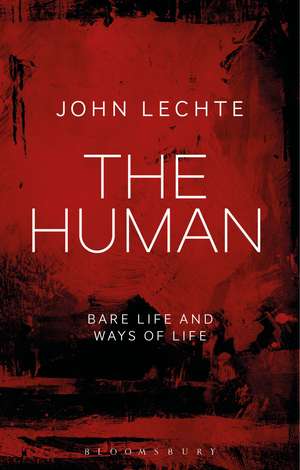
The Human: Bare Life and Ways of Life
Autor John Lechteen Limba Engleză Hardback – 14 iun 2018
Stateless people, those who do not have a political community, such as asylum seekers and refugees, are no less human. However the European tradition, represented most clearly in Hannah Arendt's thinking of the opposition between the oikos, as the satisfaction of basic needs, and the polis, as the realm of freedom and glory, proposes the opposite of this. Arendt's famous phrase, 'the right to have rights', means that freedom and full human potential can only be realised in the context of civil society; in short, that only citizens can be fully human. Because Arendt's view is so influential, yet often not acknowledged, it is necessary to undertake a full investigation of the nature and meaning of the human to establish that it is not reducible to the citizen, but is always characterised by a 'way of life' - life mediated by language. The human is never reducible to 'bare life' - a life with no other significance than physical survival.
The implications of 'bare life' are investigated through important themes in relation to the human, such as: freedom and necessity, the animal, animality as nature, inclusion and exclusion in politics, the sacred, death and dying, technics and nature, the Same and the Other, the everyday as extraordinary. Journeying through Agamben, Arendt, Bataille, Derrida, Hegel, Heidegger, Husserl, Levinas, Schelling, Simondon, and Stiegler, this is a profound search to reveal the truly human.
Preț: 785.95 lei
Preț vechi: 1167.14 lei
-33%
Puncte Express: 1179
Carte tipărită la comandă
Livrare economică 27 noiembrie-11 decembrie
Livrare prin curier în România Termenul estimat este afișat lângă disponibilitate.
Transport gratuit pentru acest produs Plată online sau ramburs, în funcție de opțiunile comenzii.
Retur gratuit în 14 zile Comandă securizată și suport în română.
Specificații
ISBN-13: 9781350028135
ISBN-10: 1350028134
Pagini: 272
Dimensiuni: 156 x 234 x 19 mm
Greutate: 0.56 kg
Editura: Bloomsbury Publishing
Colecția Bloomsbury Academic
Locul publicării:London, United Kingdom
ISBN-10: 1350028134
Pagini: 272
Dimensiuni: 156 x 234 x 19 mm
Greutate: 0.56 kg
Editura: Bloomsbury Publishing
Colecția Bloomsbury Academic
Locul publicării:London, United Kingdom
Cuprins
Introduction
1. The Condition of Being Human
2. The Theory of the Polis and the Political in Western Philosophy: Implications for the Human
3. How the Ordinary is Extraordinary: Arendt and Heidegger on the Polis
4. Approaching the Human and Freedom
5. The Human and the Animal: Bare Life and Transcendence
6. The Human and the Sacred in Bataille's Writing
7. The Human and/at the Moment of Death: Index and Image
8. The Human as Technics, Technicity, Technology and 'Way of Life'
9. Levinas on the Absolute Other as the Human
10. Life as Way of Life - As Acting
Bibliography
Index
1. The Condition of Being Human
2. The Theory of the Polis and the Political in Western Philosophy: Implications for the Human
3. How the Ordinary is Extraordinary: Arendt and Heidegger on the Polis
4. Approaching the Human and Freedom
5. The Human and the Animal: Bare Life and Transcendence
6. The Human and the Sacred in Bataille's Writing
7. The Human and/at the Moment of Death: Index and Image
8. The Human as Technics, Technicity, Technology and 'Way of Life'
9. Levinas on the Absolute Other as the Human
10. Life as Way of Life - As Acting
Bibliography
Index
Recenzii
How can it be possible - as we so often see - for human life to be excluded, exploited, oppressed and, ultimately, destroyed in the very name of humanity? This is the crucial question that Lechte tackles in this philosophical tour de force.
The domains of politics, ethics, economics, law and rights are all founded on the idea of the human and are meant to serve this end. Yet, this idea of humanity conceals a distinction, which has been with us since the Greeks, between human life as mere biological necessity, and human life as a 'way of life' - a division that allows certain ways of living to be denigrated. Lechte's bold and penetrating analysis forces us to question this assumption and, in doing so, disrupts the familiar categories of the Western political and philosophical tradition. Taking up from where Agamben left off, Lechte proposes a radical new understanding of the human as transcendent, as that which cannot be reduced to bare life. In doing so, he presents a fundamental challenge to the economic and political rationalities that today aim to objectify and control us.
I enthusiastically recommend John Lechte's The Human. Beginning with Hannah Arendt's experience of being a refugee, reduced to bare life and fleeing for her life, Lechte calls into question her claim that only a political life offers a remedy to reducing humans to bare life, and focuses on the transcendence of the human and the ways in which this transcendence is connected to various forms of life, political and otherwise.
A new way of thinking critically about the conception of freedom.
The domains of politics, ethics, economics, law and rights are all founded on the idea of the human and are meant to serve this end. Yet, this idea of humanity conceals a distinction, which has been with us since the Greeks, between human life as mere biological necessity, and human life as a 'way of life' - a division that allows certain ways of living to be denigrated. Lechte's bold and penetrating analysis forces us to question this assumption and, in doing so, disrupts the familiar categories of the Western political and philosophical tradition. Taking up from where Agamben left off, Lechte proposes a radical new understanding of the human as transcendent, as that which cannot be reduced to bare life. In doing so, he presents a fundamental challenge to the economic and political rationalities that today aim to objectify and control us.
I enthusiastically recommend John Lechte's The Human. Beginning with Hannah Arendt's experience of being a refugee, reduced to bare life and fleeing for her life, Lechte calls into question her claim that only a political life offers a remedy to reducing humans to bare life, and focuses on the transcendence of the human and the ways in which this transcendence is connected to various forms of life, political and otherwise.
A new way of thinking critically about the conception of freedom.