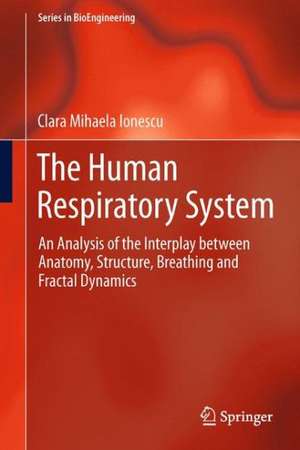
The Human Respiratory System
Autor Clara Mihaela Ionescuen Limba Engleză Hardback – 19 sep 2013
The text reveals the latest trends in modelling and identification of human respiratory parameters with a view to developing diagnosis and monitoring technologies. Of special interest is the notion of fractal structure which is indicative of the large-scale biological efficiency of the pulmonary system. The related idea of fractal dimension represents the adaptations in fractal structure caused by environmental factors, notably including disease. These basics are linked to model the dynamical patterns of breathing as a whole.
The ideas presented in the book are validated using real data generated from healthy subjects and respiratory patients and rest on non-invasive measurement methods.
The Human Respiratory System will be of interest to applied mathematicians studying the modelling of biological systems, to clinicians with interests outside the traditional borders of medicine, and to engineers working with technologies of either direct medical significance or for mitigating changes in the respiratory system caused by, for example, high-altitude or deep-sea environments.
Preț: 1038.57 lei
Preț vechi: 1266.55 lei
-18%
Puncte Express: 1558
Carte tipărită la comandă
Livrare economică 05-19 decembrie
Livrare prin curier în România Termenul estimat este afișat lângă disponibilitate.
Transport gratuit pentru acest produs Plată online sau ramburs, în funcție de opțiunile comenzii.
Retur gratuit în 14 zile Comandă securizată și suport în română.
Specificații
ISBN-13: 9781447153870
ISBN-10: 1447153871
Pagini: 244
Ilustrații: XXV, 217 p. 148 illus., 129 illus. in color.
Dimensiuni: 160 x 241 x 18 mm
Greutate: 0.48 kg
Ediția:2013
Editura: Springer
Locul publicării:London, United Kingdom
ISBN-10: 1447153871
Pagini: 244
Ilustrații: XXV, 217 p. 148 illus., 129 illus. in color.
Dimensiuni: 160 x 241 x 18 mm
Greutate: 0.48 kg
Ediția:2013
Editura: Springer
Locul publicării:London, United Kingdom
V-ar putea interesa
-
 -14%Preț: 795.44 lei924.93 lei
-
 Proton and Carbon Ion TherapyC-M Charlie Ma-5%Preț: 1455.37 lei1531.97 lei
-
 -18%Preț: 1311.52 lei1599.41 lei
-
 Biomedical Signal and Image ProcessingKayvan Najarian-5%Preț: 1352.86 lei1424.06 lei
-
 Assistive Technology for Blindness and Low VisionRoberto Manduchi-5%Preț: 1468.30 lei1545.58 lei
-
 A Laboratory Course in Tissue EngineeringMelissa Kurtis Micou-15%Preț: 606.52 lei713.54 lei
-
 -5%Preț: 1719.42 lei1809.92 lei
-
 INTRODUCTION TO BIOCERAMICS, AN (2ND ED)Hench Larry L-15%Preț: 562.85 lei662.17 lei
-
 -5%Preț: 750.15 lei789.63 lei
Public țintă
ResearchCuprins
Introduction.- The Human Respiratory System.- Respiratory Impedance.- Modelling the Respiratory Tract by Means of Electrical Analogy.- Mathematical Basis for Modelling.- Modelling the Respiratory Tract by Means of Mechanical Analogy.- Frequency Domain: Parametric Model Selection.- Time Domain: Fractal Dimension.- Nonlinear Effects in Measurement of Respiratory Impedance.- Conclusion.- Appendices: Mathematical Basis of Fractional Calculus; Overview of Forced Oscillation Technique Devices.
Notă biografică
Cosmin Copot is a post-doctoral researcher at Antwerp University. He received his PhD from Gh. Asachi University, Iasi, Romania in 2011.
Clara Ionescu is a tenured professor at Ghent University; she earned her doctorate (in applied sciences: biomedical engineering).
Cristina Muresan obtained her PhD in automatic control from the Technical University of Cluj-Napoca, Romania in 2011 and is now a professor in the same university.
The authors are all established scholars and have complementary expertise. They are recognized internationally in their field of expertise and are actively involved in the control engineering community as scientific event organizers (conferences, special sessions, invited tracks, special journal issues, etc.). They are members of various IEEE and IFAC technical committees. The authors have numerous papers and citations in Web of Science and are co-authors of technical patents.
Textul de pe ultima copertă
The Human Respiratory System combines emerging ideas from biology and mathematics to show the reader how to produce models for the development of biomedical engineering applications associated with the lungs and airways. Mathematically mature but in its infancy as far as engineering uses are concerned, fractional calculus is the basis of the methods chosen for system analysis and modelling. This reflects two decades’ worth of conceptual development which is now suitable for bringing to bear in biomedical engineering.
The text reveals the latest trends in modelling and identification of human respiratory parameters with a view to developing diagnosis and monitoring technologies. Of special interest is the notion of fractal structure which is indicative of the large-scale biological efficiency of the pulmonary system. The related idea of fractal dimension represents the adaptations in fractal structure caused by environmental factors, notably including disease. These basics are linked to model the dynamical patterns of breathing as a whole.
The ideas presented in the book are validated using real data generated from healthy subjects and respiratory patients and rest on non-invasive measurement methods.
The Human Respiratory System will be of interest to applied mathematicians studying the modelling of biological systems, to clinicians with interests outside the traditional borders of medicine, and to engineers working with technologies of either direct medical significance or for mitigating changes in the respiratory system caused by, for example, high-altitude or deep-sea environments.
Caracteristici
Relates the ideas of fractal structure and fractal dimension to the dynamical pattern of breathing A significant step forward in modelling, identification and evaluation of the respiratory system in healthy and breathing-impaired subjects Packed with patient-based data offering real-world validation of the ideas described Includes supplementary material: sn.pub/extras