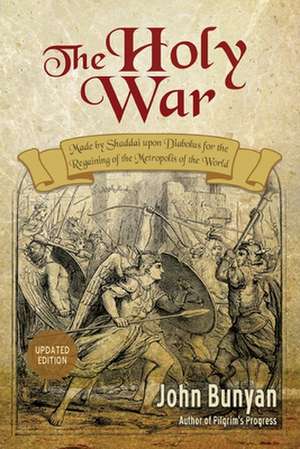
The Holy War
Autor John Bunyanen Limba Engleză Paperback – mar 2017
Bonus Content: The Life of John Bunyan, by William Brock
For we wrestle not against flesh and blood, but against principalities, against powers, against the lords of this age, rulers of this darkness, against spiritual wickedness in the heavens. (Ephesians 6:12)
What if you were able to see your life from a spiritual perspective and see the actual reality of the verse above? How does our enemy, Diabolus, plan and carry out his attacks? How do his demons help, and what are their objectives? Why and how must we petition Emmanuel to get His attention and help in this great, holy war?
Written four years after The Pilgrim's Progress, John Bunyan followed up with this second allegorical classic, which has touched hearts and minds of readers for generations. The epicenter of this book is the town of Mansoul, its people (such as Conscience, Self-Denial, and Do-Right), and its gates (Eye-gate, Ear-gate, Mouth-gate, Nose-gate, and Feel-gate). The attack by Diabolus and his demons, all of whom have appropriate names, is carefully planned and executed. As still happens to men today, Mansoul fell hard. Emmanuel is of course willing to help, but can only do so on special, seemingly strict terms. As you watch this intense battle unfold, you'll be emboldened to fight with new vigilance, to guard the gates with tenacity, and to rely on Emmanuel's sovereignty like never before.
It should be noted that John Bunyan focused not so much on biblical sequence or even perfect accuracy in every aspect. Instead, he honed in specifically on the spiritual battle being waged for each individual soul, filling in other details as needed to create the scenes. In this edition, we updated the text to clarify the meaning of each scene and inserted Bible verses in key areas to bring to light the depth and spiritual meaning of this powerful allegory.
About the Author
John Bunyan was born in November 1628, in Elstow, England. A celebrated English minister and preacher, he wrote The Pilgrim's Progress (1678), the book that was the most characteristic expression of the Puritan religious outlook. His other works include doctrinal and controversial writings; a spiritual autobiography, Grace Abounding (1666); and the allegory, The Holy War (1682).
Preț: 148.63 lei
Puncte Express: 223
Carte disponibilă
Livrare economică 17 noiembrie-01 decembrie
Livrare prin curier în România Termenul estimat este afișat lângă disponibilitate.
Transport gratuit de la 400.00 lei Plată online sau ramburs, în funcție de opțiunile comenzii.
Retur gratuit în 14 zile Comandă securizată și suport în română.
Specificații
ISBN-13: 9781622453009
ISBN-10: 162245300X
Pagini: 448
Dimensiuni: 152 x 229 x 26 mm
Greutate: 0.65 kg
Editura: Aneko Press
ISBN-10: 162245300X
Pagini: 448
Dimensiuni: 152 x 229 x 26 mm
Greutate: 0.65 kg
Editura: Aneko Press
V-ar putea interesa
-
 The Screwtape LettersC. S. LewisPreț: 78.87 lei
 -
 Pilgrim's Progress (Hodder Classics)John BunyanPreț: 92.63 lei
 -
 Fighting the Good Fight Devotional for MenTony EvansPreț: 109.06 lei
 -
 Preț: 94.21 lei
 -
 Preț: 99.02 lei
 -
 War in HeavenDerek PrincePreț: 107.91 lei
 -
 Pilgrim's Progress in Today's EnglishJames ThomasPreț: 73.09 lei
 -
 Dangerous JourneyOliver HunkinPreț: 166.34 lei
 -
 Pilgrim's ProgressGary D. SchmidtPreț: 112.29 lei
 -
 Experiencing God Day by DayHenry T. BlackabyPreț: 117.58 lei
 -
 What Jesus Saw from the Cross (Revised)A G SertillangesPreț: 108.54 lei
 -
 The Spiritual ManWatchman NeePreț: 137.96 lei
 -
 Preț: 218.81 lei
 -
 Pretenders to the Throne of GodAdrian Tchaikovsky-24%Preț: 94.78 lei124.90 lei
 -
 Preț: 161.22 lei
 -
 Grace Abounding to the Chief of SinnersJohn BunyanPreț: 39.46 lei
 -
 The Heavenly FootmanJohn BunyanPreț: 36.71 lei
 -
 The Pilgrim's ProgressJohn BunyanPreț: 46.43 lei
 -
 Daily Readings - John BunyanJohn BunyanPreț: 135.74 lei
 -
 Preț: 105.42 lei
 -
 Pilgrim's Progress 2John BunyanPreț: 112.88 lei
 -
 -26%Preț: 962.73 lei1302.90 lei
 -
 BunyanJames Anthony FroudePreț: 86.55 lei
Notă biografică
John Bunyan (baptised 30 November 1628 - 31 August 1688) was an English writer and Puritan preacher best remembered as the author of the Christian allegory The Pilgrim's Progress, which also became an influential literary model. In addition to The Pilgrim's Progress, Bunyan wrote nearly sixty titles, many of them expanded sermons.Bunyan came from the village of Elstow, near Bedford. He had some schooling and at the age of sixteen joined the Parliamentary Army during the first stage of the English Civil War. After three years in the army he returned to Elstow and took up the trade of tinker, which he had learned from his father. He became interested in religion after his marriage, attending first the parish church and then joining the Bedford Meeting, a nonconformist group in Bedford, and becoming a preacher. After the restoration of the monarch, when the freedom of nonconformists was curtailed, Bunyan was arrested and spent the next twelve years in prison as he refused to give up preaching. During this time he wrote a spiritual autobiography, Grace Abounding to the Chief of Sinners, and began work on his most famous book, The Pilgrim's Progress, which was not published until some years after his release.
Textul de pe ultima copertă
The Holy War Once upon a time in the town of Mansoul, a fierce battle raged to take control away from the rightful Prince. Who will be the conquering Prince? Diabolus or Emmanuel? And what can the inhabitants do to resist the attacks of the evil one? Your soul is under attack from the forces of evil. Through this powerful allegory, you will learn how to: Build up your defenses, flood your moat, and prepare for war!Bunyan will illuminate your understanding and show you: * When your will is in line with Christ, you can accomplish anything.* Spiritual attack is constant and can be deadly.* The enemy will stop at nothing to possess your soul.* Christ the Conqueror is on your side, and with His help, you have nothing to fear!