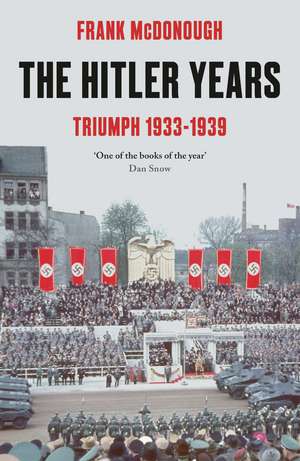
The Hitler Years: Triumph 1933-1939
Autor Frank McDonoughen Limba Engleză Paperback – 12 noi 2020
Remarcăm în The Hitler Years o structură narativă riguroasă, ce propune o succesiune cronologică a evenimentelor care au definit ascensiunea și consolidarea puterii naziste între 1933 și 1939. Frank McDonough nu se limitează la o descriere generală, ci construiește o analiză detaliată, an de an, facilitând înțelegerea modului în care mecanismele statului au fost deturnate. Volumul echilibrează varietatea mărturiilor supraviețuitorilor cu rigoarea datelor din surse primare, oferind o perspectivă lucidă asupra perioadei de 'triumf' care a precedat catastrofa mondială.
Credem că forța acestui volum rezidă în capacitatea autorului de a expune transformarea ideologiei în birocrație criminală. De la intimidările timpurii din anii '20 până la implementarea Legilor de la Nürnberg, Frank McDonough ghidează cititorul prin labirintul deciziilor politice care au condus la Holocaust. Această abordare continuă metodologia începută în The Weimar Years, unde analiza declinului democrației germane pregătea terenul pentru acest al patrulea volum al seriei. Dacă în The Gestapo autorul se concentra pe aparatul de teroare, aici lărgește cadrul pentru a include întreaga societate germană.
În peisajul istoriografic actual, The Hitler Years completează excelent lucrarea Hitler and Nazi Germany de Frank Mcdonough. În timp ce titlul menționat oferă un context educațional larg, volumul de față adaugă profunzime prin detaliile specifice perioadei 1933-1939 și prin bogăția ilustrațiilor. De asemenea, lucrarea oferă o contrapondere necesară pentru The Third Reich de Richard Overy, punând un accent mai mare pe evoluția graduală a persecuției de stat și pe documentarea minuțioasă a tranziției de la violența de stradă la cea instituționalizată.
Preț: 64.65 lei
Preț vechi: 93.22 lei
-31%
Carte disponibilă
Livrare economică 31 octombrie-14 noiembrie
Livrare express 20-24 octombrie pentru 54.80 lei
Specificații
ISBN-10: 1789544696
Pagini: 480
Ilustrații: 2 x 8pp col
Dimensiuni: 128 x 196 x 34 mm
Greutate: 0.35 kg
Editura: Bloomsbury Publishing
Colecția Apollo
Locul publicării:London, United Kingdom
V-ar putea interesa
-
 MoneyMartin Amis-24%Preț: 59.77 lei79.08 lei
 -
 The Man Who Sold The WorldPeter Doggett-52%Preț: 62.02 lei129.37 lei
 -
 The Lucifer Effect: How Good People Turn EvilPhilip G. Zimbardo-23%Preț: 94.68 lei122.93 lei
De ce să citești această carte
Recomandăm această carte cititorilor pasionați de istorie care caută o analiză sobră și accesibilă a Germaniei naziste. Veți câștiga o înțelegere profundă a modului în care propaganda și birocrația au conlucrat pentru a normaliza persecuția. Este o resursă esențială pentru cei care doresc să exploreze mecanismele puterii absolute, fiind scrisă de unul dintre cei mai apreciați cronicari ai secolului XX.
Descriere
'One of the books of the year' Dan Snow
'A masterclass in the history of Nazi Germany' Get History
'What makes this volume really stand out is its stylish design and more than 80 coloured photographs' Military History
On 30 January 1933, Adolf Hitler was appointed the German Chancellor of a coalition government by President Hindenburg. Within a few months he had installed a dictatorship, jailing and killing his leftwing opponents, terrorising the rest of the population and driving Jews out of public life. He embarked on a crash programme on militaristic Keynesianism, reviving the economy and achieving full employment through massive public works, vast armaments spending and the cancellations of foreign debts. After the grim years of the Great Depression, Germany seemed to have been reborn as a brutal and determined European power.
Over the course of the years from 1933 to 1939, Hitler won over most of the population to his vision of a renewed Reich. In these years of domestic triumph, cunning manoeuvres, pitting neighbouring powers against each other and biding his time, we see Hitler preparing for the moment that would realise his ambition. But what drove Hitler's success was also to be the fatal flaw of his regime: a relentless belief in war as the motor of greatness, a dream of vast conquests in Eastern Europe and an astonishingly fanatical racism.
In The Hitler Years, Frank McDonough charts the rise and fall of the Third Reich under Hitler's hand. The first volume, Triumph, ends after Germany's comprehensive military defeat of Poland in 1939.
Recenzii
What makes this volume really stand out is its stylish design and more than 80 coloured photographs, punctuating the account of Hitler's slow but inevitable march to war
With an eye for telling detail, McDonough tells the monstrous but well-known story in an attractive fresh way
One of the books of the year
An expert, disheartening account of the first seven years of Hitler's chancellorship... Hitler biographies are not in short supply, but this one is worthy of study
Triumph is the more interesting for pushing back against the cartoon of Hitler as all-conquering monster-supermensch. Instead it demonstrates the slow creep of the Nazi state takeover, the caution with which Hitler had to move, the resistance that he often faced and his surprising, instinctive flexibility
McDonough points to the starker reality. In Nazi Germany, citizens worked more hours for less pay. Nor was there any great altering of class consciousness or redistribution of wealth as there had been in, say, the Soviet Union. The other central claim this excellent book makes is that Hitler's road to power was one where flexibility co-existed in tandem with shifting political events in real time. The historian insists that Nazi Germany was not a totalitarian society in the way that Stalinist Russia was. Hitler's appointment as Chancellor of Germany in January 1933, after all, was both legal and constitutional. There was no violent revolution as there had been in Russia in 1917 or France in 1789
The book unfolds like a thrilling Scorsese-directed gangster movie. It could certainly form the basis of a blockbuster. McDonough treats his readers to all the fascinating insights one would expect from a rich career of study as he dedicates an entire chapter to each year of Adolf Hitler's evil rule in the 1930s
This first volume of McDonough's mega two-volume history is aptly subtitled, 'Triumph', for that is what it is. Everybody even remotely interested in Nazi Germany should have an empty space on their bookshelf, waiting to be filled by volume 2. McDonough's prose matches the rigour of Kershaw, the wit of Evans and the fluency of Shirer. But he brings a new and distinctive clarity to this subject which is all too often lost in the thematic or obscured by the overly academic
I've read every book written about the 2nd Word War, I think. Frank McDonough's latest is the clearest, most brilliant writing on the drumbeat to conflict I've ever absorbed. Cannot wait for volume 2
McDonough presents Hitler as 'a master of flexibility and improvisation' in his takeover of the German government, and delves deeply into his power struggles and shifting alliances with business leaders, civil service bureaucrats, and military officials
A nuanced overview of the early days of Nazi Germany... A work that will bridge the divide between popular and academic audiences