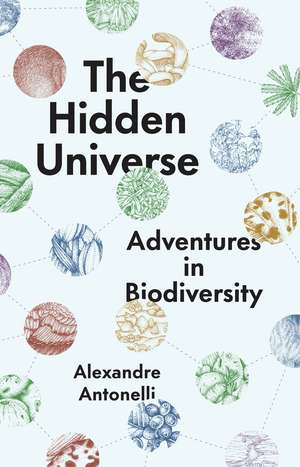
The Hidden Universe: Adventures in Biodiversity
Autor Alexandre Antonellien Limba Engleză Hardback – 12 sep 2022
Observăm în The Hidden Universe o abordare interdisciplinară riguroasă, care conectează genetica, ecologia și politicile publice pentru a deconstrui conceptul complex al biodiversității. Alexandre Antonelli nu se limitează la o descriere a naturii, ci integrează date despre securitatea alimentară, medicină și materiale de construcție, demonstrând cum varietatea biologică susține infrastructura vieții umane. Apreciem modul în care autorul utilizează expertiza sa de director științific pentru a explica mecanismele evolutive și funcțiile ecosistemice, oferind o perspectivă tehnică dar accesibilă asupra a ceea ce el numește „materia întunecată” a vieții.
Cititorii familiarizați cu Biodiversity de John Spicer vor aprecia modul în care acest volum actualizează urgența climatică și aduce în discuție soluții pragmatice, nu doar cauze și consecințe. Structura cărții este una progresivă, pornind de la definirea componentelor invizibile ale vieții (gene și specii), trecând prin valorile intrinseci și utilitare ale naturii, și culminând cu o analiză a amenințărilor actuale. Subliniem relevanța ultimelor capitole, care transformă teoria în acțiune prin propunerea unor soluții la scară largă, dar și prin recomandări practice pentru spațiul domestic.
Spre deosebire de abordările pur teoretice, The Hidden Universe funcționează ca un ghid strategic. Tonul este precis, ancorat în realitatea de teren a cercetării contemporane, făcând din acest titlu o resursă valoroasă pentru înțelegerea crizei actuale a mediului. Autorul reușește să sintetizeze complexitatea biologică fără a simplifica excesiv miza supraviețuirii speciilor, oferind un cadru de referință pentru oricine dorește să înțeleagă rolul biodiversității ca instrument activ de combatere a degradării planetare.
Preț: 127.04 lei
Carte disponibilă
Livrare economică 30 octombrie-13 noiembrie
Specificații
ISBN-10: 0226821870
Pagini: 256
Ilustrații: 26 halftones
Dimensiuni: 140 x 216 x 36 mm
Greutate: 0.48 kg
Ediția:First Edition
Editura: University of Chicago Press
Colecția University of Chicago Press
V-ar putea interesa
-
 Biodiversity Conservation: A Very Short IntroductionDavid W. Macdonald-18%Preț: 58.79 lei72.09 lei
 -
 -13%Preț: 131.16 lei151.45 lei
 -
 Biodiversity and Climate Change: Transforming the BiosphereThomas E. LovejoyPreț: 262.64 lei
 -
 The Future Of LifeProfessor Edward O. Wilson-28%Preț: 66.87 lei92.41 lei
 -
 Fragile WebJonathan Silvertown-17%Preț: 88.29 lei106.74 lei
 -
 BiodiversityJohn SpicerPreț: 59.04 lei
 -
 The Decline and Fall of the Human EmpireHenry Gee-34%Preț: 80.86 lei122.38 lei
 -
 Ocean: Earth's Last Wilderness - THE LANDMARK NEW BOOK BY DAVID ATTENBOROUGHSir David AttenboroughPreț: 158.83 lei
 -
 -28%Preț: 149.32 lei206.69 lei
 -
 Our StoryColin Butfield-21%Preț: 130.21 lei165.17 lei
 -
 Before They VanishPaul R. EhrlichPreț: 179.46 lei
 -
 -26%Preț: 57.95 lei78.44 lei
 -
 Lost WondersTom LathanPreț: 79.10 lei
 -
 A Life on Our PlanetDavid Attenborough-18%Preț: 76.61 lei93.99 lei
 -
 Half-EarthEdward O. WilsonPreț: 94.15 lei
 -
 KingdomWill MillardPreț: 223.50 lei
 -
 Thinking Small and LargePeter ForbesPreț: 107.54 lei
 -
 The Kew Gardens Salad BookJenny LinfordPreț: 163.97 lei
 -
 Human NatureKate MarvelPreț: 136.91 lei
 -
 Life on a Little-Known PlanetElizabeth KolbertPreț: 193.02 lei
De ce să citești această carte
Recomandăm această carte celor care doresc să depășească nivelul discuțiilor generale despre mediu. Cititorul câștigă o înțelegere profundă a legăturii dintre genetică și stabilitatea ecosistemelor, primind în același timp un set de instrumente practice pentru conservare. Este o lectură esențială pentru studenții la ecologie și pentru cetățenii care vor să înțeleagă cum pot influența politicile de mediu, oferind un motiv concret pentru protejarea biodiversității: propria noastră supraviețuire.
Despre autor
Alexandre Antonelli este un om de știință de origine braziliană, recunoscut la nivel internațional pentru contribuțiile sale în domeniul biologiei evolutive și al conservării. În prezent, ocupă funcția de director de știință la una dintre cele mai prestigioase instituții de cercetare botanică și micologică din lume. Expertiza sa acoperă studiul biodiversității la nivel global, cu un accent deosebit pe modul în care speciile se formează și se adaptează în timp. Prin activitatea sa, Antonelli îmbină cercetarea academică de vârf cu eforturile de educare a publicului larg asupra urgenței protejării patrimoniului natural al planetei.
Descriere scurtă
We are now living in an environmental emergency. As climate change, habitat loss, and other threats have placed almost one-fifth of all species on Earth at risk of extinction in the coming decades, a deeper understanding of biodiversity has never been more important. Biodiversity encompasses the rich variety of all life on Earth—the building blocks of life that provide invaluable sources of food, medicine, clothing, building materials, and more.
Marking the arrival of a bold new voice in popular science, The Hidden Universe shows readers what’s at stake in the fight to protect and restore biodiversity, but also what can and should be done now to protect our planet and ourselves for the future. As director of science at one of the world’s largest research organizations in plant and fungal sciences, Brazilian-born scientist Alexandre Antonelli is ideally suited to reveal the wonders of biodiversity at a genetic, species, and ecosystem level—what biodiversity is, how it works, and why it is the most important tool in our battle against climate change. Antonelli offers recommendations for large-scale political changes, as well as smaller, practical steps that readers can implement in their own lives and homes. With Antonelli as our guide, The Hidden Universe helps us imagine a future where biodiversity is not just preserved but cherished.
Notă biografică
Extras
Hubble’s discovery built on the knowledge and dedicated work of many others before him, who had been equally keen to explain and measure what they saw in the skies. Some of them remain unsung heroes of science, like Henrietta Leavitt, whose mere gender excluded her from all due recognition among the exclusively male astronomers at the Harvard College Observatory where she started work in 1893. It was Leavitt who discovered a way to confidently measure the distance to stellar objects far away – an insight which allowed Hubble’s estimation of the observable universe. In the years that followed, Hubble went on to map dozens of other galaxies outside our own.
In 1990, space exploration was boosted again by a space telescope which, perhaps not surprisingly, was named in Hubble’s honor. It showed us in clear, colorful images that the universe is immensely larger and more astonishing than anyone could ever have imagined. Today, astronomists think there are a staggering 200 billion galaxies and one billion trillion stars in the observable universe. To put that in perspective, if every star was the size of a pea, you could cover the entire Earth with a two-kilometer-thick layer of peas. We have no idea how many planets there are, but since the existence of the first exoplanet (a planet that orbits a star outside our solar system) was confirmed in 1995, we have found over 4,300 and counting.
On planet Earth, biodiversity – the variety of life – is our ‘hidden universe.’ Its components are far more abundant, numerous, complex and interwoven than most people may realize. In Africa, our ancestors began to explore biodiversity very early on in our evolutionary history and were guided by the most basic needs of food, shelter and comfort. For hundreds of thousands of years, they tasted most things they came across. They used their senses to explore the plants growing around them and observed what other animals ate. They discovered that some plants had edible roots, but the leaves would make them sick, some plants produced sweet juicy fruits while others were bitter, and some plants were best avoided at all costs. They gradually increased their diet to include many different parts of plants, fungi, mammals, birds, fish, insects and spiders. They learned which trees provided the best wood for making fires, which animals had the best fur for keeping them warm, and which fruits were most delicious.
As our human ancestors left eastern Africa and reached other parts of the world, they made new discoveries. On every continent, the exploration of nature began immediately after their arrival. There was often abundant prey, but they had to learn how to hunt it, or satisfy themselves by scavenging on carcasses. They gathered many different sorts of nuts and berries. In some places, animals were easier to catch but fewer in number, like in the Indonesian island of Flores. The island is so tiny and food resources so limited that, when our human relatives arrived there about a million years ago, natural selection consistently benefited small individuals, leading to the evolution of a separate species. An adult Homo floresiensis was only about a meter tall (3.3 feet), which is shorter than most humans with dwarfism today and about the same size as the island’s own species of dwarf elephant. In the Levant, another relative of ours, Homo erectus – which inhabited many parts of Africa and Eurasia for some 1.5 million years – relied on elephants, hippos, rhinos and other large animals as a source of a fat-rich diet.
As the brain size and cognitive abilities of our ancestors increased, they became increasingly better at developing tools for hunting and processing plants and animals. The development of thousands of local languages allowed them to communicate what they had discovered about the species around them and their uses. In China, archaeological evidence for herbal medicines began some 8,000 years ago. By 4,000 years ago, the Sumerians had left written accounts demonstrating their use of plants like cumin, mint and liquorice. There’s scientific debate on this topic, so it may be wisest not to include this as it is only tangential information.
While most information associated with species was passed around by word of mouth, the Greeks attempted to synthesize all knowledge available at the time. In the fourth century BCE, Aristotle wrote down everything that was known to him about animals. Shortly after that, his apprentice Theophrastus did the same, but focusing on plants. Knowledge about species continued to grow, and discoveries piled up. Farmers experimented with ever more species, which increased the nutritional value of our diet and the range of climates and regions in which we could grow food. Traditional Chinese medicine – characterized by the prescription of many different plants and animals to treat all sorts of ailments – became increasingly popular across much of eastern Asia.
However, by the time western societies entered the Scientific Revolution of the seventeenth and eighteenth centuries, things had got messy. No comprehensive summaries of plant and animal knowledge had been written in Europe for almost 2,000 years, and people from different countries struggled to communicate their knowledge about species. Even when they could use the same language – usually Latin, among scientists – they didn’t have a standardized way to name species. The dog rose – a common wild rose in Europe, whose fruits can be turned into a nutritious soup if you dry them and remove the hairy seeds – would be called Rosa sylvestris inodora seu canina by one person and Rosa sylvestris alba cum rubore, folio glabro by another. Not only was it a burden to learn all the different names a species could have, but also those names were often long and awkward. Misunderstandings were common and could be disastrous. In the carrot family, for instance, some of our best foods and spices – including carrots, celery, anise, coriander and parsley – could easily be confused with some of the most poisonous wild plants known, due to their similar flowers and leaves.
The person who brought order to chaos was the Swedish naturalist Carl Linnaeus. As a child, growing up in the countryside among farm animals and a rich wild flora, Linnaeus was already collecting and asking his father for help in naming everything he found – from flowers to insects and fish. He traveled the country on horseback, gathering specimens and detailing notes of every species he saw. In 1735, aged just 28, Linnaeus published the first edition of his Systema Naturæ (‘System of Nature’), where he proposed a strictly hierarchical classification of all living things. Like the traditional Russian Matryoshka dolls, each category was contained within slightly bigger ones: species were grouped into genera, which were grouped into families, orders, classes and, finally, kingdoms. Applying this classification system, he was the first scientist to document, for instance, that whales and dolphins are more closely related to land mammals such as pigs, than to fish like tuna, despite their very different appearance and behavior. Perhaps most importantly of all, Linnaeus proposed that every species ought to be given a single binary name: Felis catus for the domestic cat, Falco peregrinus for the peregrine falcon, and Rosa canina for the rose mentioned above. His naming and classification system was so simple and useful that it came as a relief to many, and, with many refinements, it has survived to this day.
Cuprins
SETTING THE SCENE: TWO UNIVERSES
How many species?
Unveiling the ‘dark matter’ of life
Life in peril
PART ONE – BIODIVERSITY: MORE THAN MEETS THE EYE
Chapter 1: Species
Chapter 2: Genes
Chapter 3: Evolution
Chapter 4: Functions
Chapter 5: Ecosystems
PART TWO – THE VALUES OF BIODIVERSITY
Chapter 6: For Us
Chapter 7: For Nature
Chapter 8: For Itself
PART THREE – THE THREATS TO BIODIVERSITY
Chapter 9: Habitat Loss
Chapter 10: Exploitation
Chapter 11: Climate Change
Chapter 12: Other Hazards and Dangers
PART FOUR – SAVING BIODIVERSITY
Chapter 13: Large-Scale Solutions
Chapter 14: What Can We Do?
Epilogue: Looking Ahead
Acknowledgements
Glossary
Further reading
Picture credits
Index