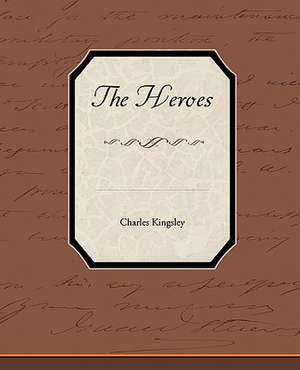
The Heroes
Autor Charles Kingsleyen Limba Engleză Paperback – 9 mar 2010
Follow along as Perseus with his winged sandals travels the world to defeat the Gorgon Medusa, and saves Andromeda from the sea monster Cretus...
Join the Argonauts who face many trials as they travel with Jason to find the Golden Fleece...
Accompany Theseus as he enters the labyrinth to meet the terrible Minotaur...
This edition is presented complete and unabridged with 56 beautiful illustrations.
Preț: 98.87 lei
Puncte Express: 148
Carte tipărită la comandă
Livrare economică 08-22 decembrie
Livrare prin curier în România Termenul estimat este afișat lângă disponibilitate.
Transport gratuit de la 400.00 lei Plată online sau ramburs, în funcție de opțiunile comenzii.
Retur gratuit în 14 zile Comandă securizată și suport în română.
Specificații
ISBN-13: 9781438537542
ISBN-10: 1438537549
Pagini: 122
Dimensiuni: 191 x 235 x 8 mm
Greutate: 0.24 kg
Editura: BOOK JUNGLE
ISBN-10: 1438537549
Pagini: 122
Dimensiuni: 191 x 235 x 8 mm
Greutate: 0.24 kg
Editura: BOOK JUNGLE
V-ar putea interesa
-
 Standing at the Edge of MadnessVernon Steve WeakleyPreț: 246.79 lei
 -
 Standing at the Edge of MadnessVernon Steve WeakleyPreț: 178.84 lei
 -
 Charles Kingsley, His Letters and Memories of His Life - Volume 2Charles KingsleyPreț: 462.51 lei
 -
 Glaucus; Or, the Wonders of the ShoreCharles KingsleyPreț: 139.35 lei
 -
 Discipline, and Other SermonsCharles KingsleyPreț: 154.48 lei
 -
 Alton Locke - Volume IICharles KingsleyPreț: 157.64 lei
 -
 The Human MachineE. Arnold BennettPreț: 83.22 lei
 -
 Cheri the Last of CheriColettePreț: 173.95 lei
 -
 Apple GrowingM. C. BurrittPreț: 94.21 lei
 -
 Her Father s DaughterGene Stratton-PorterPreț: 167.89 lei
 -
 Howard Pyle S Book of PiratesHoward PylePreț: 115.78 lei
 -
 Sir Walter Raleigh and His TimeCharles KingsleyPreț: 84.44 lei
 -
 His FamilyPoole Ernest PoolePreț: 193.34 lei
 -
 The Bohemians of the Latin QuarterMurger Henri MurgerPreț: 188.97 lei
 -
 The Calling of Dan MatthewsBell Wright Harold Bell WrightPreț: 164.98 lei
 -
 New Atlantis - BaconFrancis BaconPreț: 99.63 lei
 -
 The Banquet (Il Convito)Dante AlighieriPreț: 137.83 lei
 -
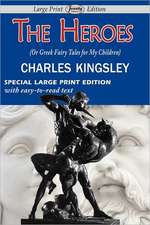 The Heroes (or Greek Fairy Tales for My Children)Charles KingsleyPreț: 85.75 lei
 -
 Preț: 151.60 lei
 -
 Im Schatten des HalbmondsAndreas SchäferPreț: 116.57 lei
 -
 Von der guten alten Zeit zur guten neuen ZeitJohanna SedlmaierPreț: 102.12 lei
 -
 GroßstadtromeosDirk LüthjePreț: 139.24 lei
 -
 HypatiaCharles KingsleyPreț: 127.91 lei
 -
 Conversacion Al SurMarta TrabaPreț: 111.88 lei
Notă biografică
Charles Kingsley was a broad church priest of the Church of England, a university lecturer, a social reformer, a historian, a novelist, and a poet. He lived from 12 June 1819 to 23 January 1875. He is known for his involvement in Christian socialism, the working men's college, and the establishment of labor cooperatives, which were unsuccessful but inspired later labor reforms. He was Charles Darwin's friend and correspondent. The eldest child of the Reverend Charles Kingsley and his wife, Mary Lucas Kingsley, Kingsley was born in Holne, Devon. Both his sister Charlotte Chanter (1828-1882) and brother Henry Kingsley (1830-1876) were writers. He was the uncle of the explorer and scientist Mary Kingsley and the father of the novelist Lucas Malet (Mary St. Leger Kingsley, 1852-1931). (1862-1900). The early years of Charles Kingsley were spent in Barnack, Northamptonshire, and Clovelly, Devon, where his father served as Curate from 1826 to 1832 and Rector from 1832 to 1836. Before attending King's College London and the University of Cambridge, he received his education at Bristol Grammar School and Helston Grammar School. Charles enrolled in Cambridge's Magdalene College in 1838 and earned his degree there in 1842.