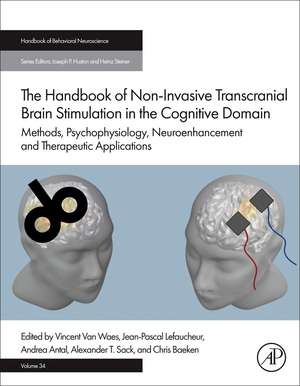
The Handbook of Non-Invasive Transcranial Brain Stimulation in the Cognitive Domain: Methods, Psychophysiology, Neuroenhancement and Therapeutic Applications: Handbook of Behavioral Neuroscience, cartea 34
Editat de Vincent Van Waes, Jean-Pascal Lefaucheur, Andrea Antal, Alexander T. Sack, Chris Baekenen Limba Engleză Hardback – 15 dec 2025
These multimodal brain stimulation approaches present innovative avenues for potential treatments. By integrating both theoretical and practical perspectives, this handbook not only reviews existing data but also opens new horizons for future research and clinical applications, providing invaluable insights for professionals in the field.
- Enables better understanding of the neuronal functions and neuromodulation techniques and their applications in the cognitive domain
- Provides an update on the current development of non-invasive brain stimulation techniques and their future potential
- Reviews and assesses clinical results obtained in the treatment of the cognitive aspects of various psychiatric or neurological diseases



Preț: 1206.85 lei
Preț vechi: 1785.56 lei
-32% Precomandă
Puncte Express: 1810
Preț estimativ în valută:
213.56€ • 249.05$ • 187.51£
213.56€ • 249.05$ • 187.51£
Carte nepublicată încă
Doresc să fiu notificat când acest titlu va fi disponibil:
Se trimite...
Preluare comenzi: 021 569.72.76
Specificații
ISBN-13: 9780443266027
ISBN-10: 0443266026
Pagini: 592
Dimensiuni: 216 x 276 mm
Greutate: 0.45 kg
Editura: ELSEVIER SCIENCE
Seria Handbook of Behavioral Neuroscience
ISBN-10: 0443266026
Pagini: 592
Dimensiuni: 216 x 276 mm
Greutate: 0.45 kg
Editura: ELSEVIER SCIENCE
Seria Handbook of Behavioral Neuroscience
Cuprins
Part 1 – Methods
1. The principles and methods of non-invasive transcranial brain stimulation
2. How to design a NIBS study in the cognitive domain: pitfalls
Part 2 – Preclinic – Psychophysiology A. Animals
3. Use of tDCS, rTMS, and TUS in Rodents: Contributions to Understanding the Neurobiological Mechanisms Involved
4. Use of tDCS, rTMS, and TUS in Non-Human Primates: Contributions to Understanding the Neurobiological Mechanisms Involved
5. Implications of tDCS in Alleviating Psychiatric Disorders: Insights from Animal Models
6. Implications of tDCS in Alleviating Psychiatric Disorders: Insights from Animal Models
7. Use of tDCS to Treat Neurological Disorders: Insights from Animal Studies.
8. Implication of Glial Cells in the Effects of tDCS in Mice
9. NIBS and neuroplasticity / Blood-Brain Barrier Permeability in rodent
10. Accelerated rTMS in the canine species B. Healthy
11. Non-invasive transcranial brain stimulation for the study of Perception and ATTENTION
12. Non-invasive transcranial brain stimulation for the study of REASONING / COMPUTATION / PROBLEM SOLVING
13. Non-invasive transcranial brain stimulation for the study of DECISION MAKING
14. Non-invasive transcranial brain stimulation for the study of MEMORY
15. Non-invasive transcranial brain stimulation for the study of LEARNING
16. Non-invasive transcranial brain stimulation for the study of LANGUAGE
17. Non-invasive transcranial brain stimulation for NEUROENHANCEMENT
Part 3 – Therapeutic Applications (Cognition)
18. Non-invasive transcranial brain stimulation to treat ATTENTION DISORDERS (ADHD)
19. Non-invasive transcranial brain stimulation to treat AUTISM SPECTRUM DISORDERS
20. Non-invasive transcranial brain stimulation to treat ADDICTION
21. Non-invasive transcranial brain stimulation to treat MOOD / PTSD
22. Non-invasive transcranial brain stimulation to treat ANXIETY / OCD
23. Non-invasive transcranial brain stimulation to treat PSYCHOSIS
24. Non-invasive transcranial brain stimulation to treat COGNITIVE ASPECTS OF OTHER PSYCHIATRIC DISEASES
25. Non-invasive transcranial brain stimulation to treat VISUOSPATIAL NEGLECT
26. Non-invasive transcranial brain stimulation for LANGUAGE REHABILITATION
27. Non-invasive transcranial brain stimulation to treat MILD COGNITIVE IMPAIRMENT & DEMENTIA
28. Non-invasive transcranial brain stimulation to treat COGNITIVE ASPECTS OF TRAUMATIC BRAIN INJURY
29. Non-invasive transcranial brain stimulation to treat COGNITIVE ASPECTS OF MULTIPLE SCLEROSIS
30. Non-invasive transcranial brain stimulation to treat CHRONIC FATIGUE SYNDROME and POST-COVID FATIGUE
31. Non-invasive transcranial brain stimulation to treat COGNITIVE ASPECTS OF CHRONIC PAIN SYNDROMES
32. Non-invasive transcranial brain stimulation to treat COGNITIVE ASPECTS OF OTHER NEUROLOGICAL DISEASES
Part 4 – Ethics/Regulation
1. The principles and methods of non-invasive transcranial brain stimulation
2. How to design a NIBS study in the cognitive domain: pitfalls
Part 2 – Preclinic – Psychophysiology A. Animals
3. Use of tDCS, rTMS, and TUS in Rodents: Contributions to Understanding the Neurobiological Mechanisms Involved
4. Use of tDCS, rTMS, and TUS in Non-Human Primates: Contributions to Understanding the Neurobiological Mechanisms Involved
5. Implications of tDCS in Alleviating Psychiatric Disorders: Insights from Animal Models
6. Implications of tDCS in Alleviating Psychiatric Disorders: Insights from Animal Models
7. Use of tDCS to Treat Neurological Disorders: Insights from Animal Studies.
8. Implication of Glial Cells in the Effects of tDCS in Mice
9. NIBS and neuroplasticity / Blood-Brain Barrier Permeability in rodent
10. Accelerated rTMS in the canine species B. Healthy
11. Non-invasive transcranial brain stimulation for the study of Perception and ATTENTION
12. Non-invasive transcranial brain stimulation for the study of REASONING / COMPUTATION / PROBLEM SOLVING
13. Non-invasive transcranial brain stimulation for the study of DECISION MAKING
14. Non-invasive transcranial brain stimulation for the study of MEMORY
15. Non-invasive transcranial brain stimulation for the study of LEARNING
16. Non-invasive transcranial brain stimulation for the study of LANGUAGE
17. Non-invasive transcranial brain stimulation for NEUROENHANCEMENT
Part 3 – Therapeutic Applications (Cognition)
18. Non-invasive transcranial brain stimulation to treat ATTENTION DISORDERS (ADHD)
19. Non-invasive transcranial brain stimulation to treat AUTISM SPECTRUM DISORDERS
20. Non-invasive transcranial brain stimulation to treat ADDICTION
21. Non-invasive transcranial brain stimulation to treat MOOD / PTSD
22. Non-invasive transcranial brain stimulation to treat ANXIETY / OCD
23. Non-invasive transcranial brain stimulation to treat PSYCHOSIS
24. Non-invasive transcranial brain stimulation to treat COGNITIVE ASPECTS OF OTHER PSYCHIATRIC DISEASES
25. Non-invasive transcranial brain stimulation to treat VISUOSPATIAL NEGLECT
26. Non-invasive transcranial brain stimulation for LANGUAGE REHABILITATION
27. Non-invasive transcranial brain stimulation to treat MILD COGNITIVE IMPAIRMENT & DEMENTIA
28. Non-invasive transcranial brain stimulation to treat COGNITIVE ASPECTS OF TRAUMATIC BRAIN INJURY
29. Non-invasive transcranial brain stimulation to treat COGNITIVE ASPECTS OF MULTIPLE SCLEROSIS
30. Non-invasive transcranial brain stimulation to treat CHRONIC FATIGUE SYNDROME and POST-COVID FATIGUE
31. Non-invasive transcranial brain stimulation to treat COGNITIVE ASPECTS OF CHRONIC PAIN SYNDROMES
32. Non-invasive transcranial brain stimulation to treat COGNITIVE ASPECTS OF OTHER NEUROLOGICAL DISEASES
Part 4 – Ethics/Regulation
Recenzii
Predicting brain activity is important for diagnosis. Controlling it is critical for disease. There are only a limited number of ways brain activity can be controlled non-invasively, each with advantages and shortcomings. These critical issues are debated in the didactic chapters of this volume, contributed by top experts in these fields, covering transcranial magnetic and electrical stimulation and ultrasound stimulation. The principle of “primum non nocere” (first, do no harm) is discussed by several authors, emphasizing the need to learn more about the mechanisms of these methods. The reader will walk away with the important message that non-invasive perturbation, especially its closed-loop (on-demand) version, is on its way to effectively compete with pharmaceuticals with much fewer side effects.
-György Buzsáki, MD, PhD. Author of the Rhythms of the Brain (OUP, 2006).
-György Buzsáki, MD, PhD. Author of the Rhythms of the Brain (OUP, 2006).