The Hand that Feeds
en Limba Engleză Hardback – 13 mai 2025
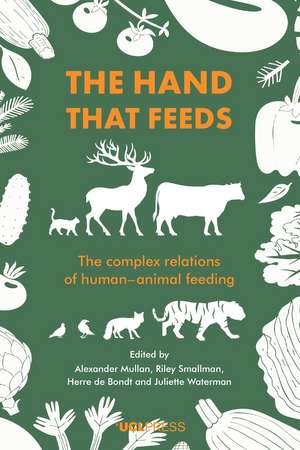
Feeding animals is never a neutral act—whether in zoos, farms, backyards, or city streets, it shapes relationships, environments, and even entire ecosystems. The Hand that Feeds takes a deeper look into the complex and often-overlooked dynamics of human-animal feeding, moving beyond its utilitarian functions to explore the emotional, ethical, and ecological entanglements it creates. Through case studies spanning history to the present, this work discloses how feeding alters animal behaviors and reflects broader cultural and moral values. Why do we nurture some animals while exterminating others? How do feeding practices blur the lines between wild and domesticated life? What happens when acts of care lead to unintended harm?
Addressing everything from garden bird feeders to contested urban wildlife policies, the authors illuminate the deep significance of food in human-animal interactions. An invigorating read for scholars in environmental studies, anthropology, and history, The Hand that Feeds challenges us to reconsider the act of feeding as a powerful force in shaping multispecies worlds.
Preț: 391.55 lei
Nou
Puncte Express: 587
Preț estimativ în valută:
69.29€ • 81.25$ • 60.85£
69.29€ • 81.25$ • 60.85£
Carte indisponibilă temporar
Doresc să fiu notificat când acest titlu va fi disponibil:
Se trimite...
Preluare comenzi: 021 569.72.76
Specificații
ISBN-13: 9781800088313
ISBN-10: 1800088310
Pagini: 258
Ilustrații: 8 figures, 8 tables
Dimensiuni: 156 x 234 x 19 mm
Greutate: 0.56 kg
Editura: UCL Press
ISBN-10: 1800088310
Pagini: 258
Ilustrații: 8 figures, 8 tables
Dimensiuni: 156 x 234 x 19 mm
Greutate: 0.56 kg
Editura: UCL Press
Notă biografică
Alexander Mullan is a PhD student at the University of Roehampton. Riley Smallman is a zooarchaeological PhD student at the University of Exeter. Herre de Bondt is a PhD student at the University of Roehampton. Juliette Waterman is a PhD student in archaeology at the University of Reading.
Cuprins
List of figures
List of tables
List of contributors
Acknowledgements
Need to Feed: An Introduction to Underrepresented Aspects of Animal Feeding
Gaia Mortier and Felix Sadebeck
1 A Raw Egg on An Empty Stomach: Feeding Ill Cattle in Roman Antiquity
Felix Sadebeck
2 Food for Flight: Feeding of Captive Raptors in Medieval Britain Hannah Britton and Arthur Redmonds
3 ‘I live off them, they live off me’: Exploring the Human-Flea Feeding Relationship in the History of Flea Circuses
Gaia Mortier
4 Human-raptor Relationships in Urban Spaces: the History of Red Kites (Milvus milvus) and Human Food in Britain
Juliette Waterman
5 Feed the Birds but Stone the Crows: The Role of Food in Conflict with Corvids throughout British History
Riley Smallman
6 Whose Food, whose Health? Moral and Ecological Hierarchies of Urban Stray Cats and Pigeons
Giovanna Capponi and Herre de Bondt
7 Feeding Farm Animals: Perceptions and Performances of the ‘Good Farmer’ amongst Regenerative Farmers
Hannah C. Mortimer
8 The Adventures of a Birch Branch; Or, a Narrative Ethnography of Browse Feeding at the Highland Wildlife Park
Alex Mullan
9 You are what you Eat: Dietary Drivers of Morphological Change
David Cooper and Andrew C. Kitchener
10 The Effects of Red Fox Chronic Exposure to Metals on Health and the Environment
Blessing Chidimuro
11 The Pros, Cons and Contrary Consequences of Conservation Feeding: Anthropogenic Feeding of the Red Kite (Milvus milvus) in Britain
Virginia Thomas
Conclusion – In Conversation: Non-Utilitarian Feeding, Interdisciplinarity and the Future of Feeding Research
Herre de Bondt , Hannah Britton , David Cooper , Gaia Mortier , Hannah C. Mortimer , Felix Sadebeck , Virginia Thomas and Juliette Waterman
Index
List of tables
List of contributors
Acknowledgements
Need to Feed: An Introduction to Underrepresented Aspects of Animal Feeding
Gaia Mortier and Felix Sadebeck
1 A Raw Egg on An Empty Stomach: Feeding Ill Cattle in Roman Antiquity
Felix Sadebeck
2 Food for Flight: Feeding of Captive Raptors in Medieval Britain Hannah Britton and Arthur Redmonds
3 ‘I live off them, they live off me’: Exploring the Human-Flea Feeding Relationship in the History of Flea Circuses
Gaia Mortier
4 Human-raptor Relationships in Urban Spaces: the History of Red Kites (Milvus milvus) and Human Food in Britain
Juliette Waterman
5 Feed the Birds but Stone the Crows: The Role of Food in Conflict with Corvids throughout British History
Riley Smallman
6 Whose Food, whose Health? Moral and Ecological Hierarchies of Urban Stray Cats and Pigeons
Giovanna Capponi and Herre de Bondt
7 Feeding Farm Animals: Perceptions and Performances of the ‘Good Farmer’ amongst Regenerative Farmers
Hannah C. Mortimer
8 The Adventures of a Birch Branch; Or, a Narrative Ethnography of Browse Feeding at the Highland Wildlife Park
Alex Mullan
9 You are what you Eat: Dietary Drivers of Morphological Change
David Cooper and Andrew C. Kitchener
10 The Effects of Red Fox Chronic Exposure to Metals on Health and the Environment
Blessing Chidimuro
11 The Pros, Cons and Contrary Consequences of Conservation Feeding: Anthropogenic Feeding of the Red Kite (Milvus milvus) in Britain
Virginia Thomas
Conclusion – In Conversation: Non-Utilitarian Feeding, Interdisciplinarity and the Future of Feeding Research
Herre de Bondt , Hannah Britton , David Cooper , Gaia Mortier , Hannah C. Mortimer , Felix Sadebeck , Virginia Thomas and Juliette Waterman
Index