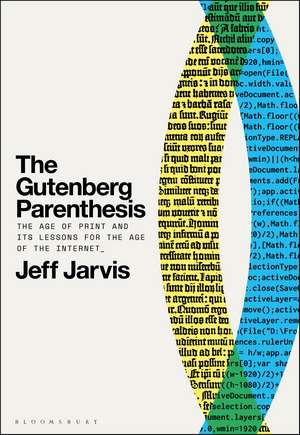
The Gutenberg Parenthesis: The Age of Print and Its Lessons for the Age of the Internet
Autor Prof Jeff Jarvisen Limba Engleză Hardback – 27 iul 2023
PROSE AWARDS MEDIA AND CULTURAL STUDIES FINALIST 2024
The Gutenberg Parenthesis traces the epoch of print from its fateful beginnings to our digital present - and draws out lessons for the age to come.
The age of print is a grand exception in history. For five centuries it fostered what some call print culture - a worldview shaped by the completeness, permanence, and authority of the printed word. As a technology, print at its birth was as disruptive as the digital migration of today. Now, as the internet ushers us past print culture, journalist Jeff Jarvis offers important lessons from the era we leave behind.
To understand our transition out of the Gutenberg Age, Jarvis first examines the transition into it. Tracking Western industrialized print to its origins, he explores its invention, spread, and evolution, as well as the bureaucracy and censorship that followed. He also reveals how print gave rise to the idea of the mass - mass media, mass market, mass culture, mass politics, and so on - that came to dominate the public sphere.
What can we glean from the captivating, profound, and challenging history of our devotion to print? Could it be that we are returning to a time before mass media, to a society built on conversation, and that we are relearning how to hold that conversation with ourselves? Brimming with broader implications for today's debates over communication, authorship, and ownership, Jarvis' exploration of print on a grand scale is also a complex, compelling history of technology and power.
Preț: 111.34 lei
Preț vechi: 207.58 lei
-46%
Puncte Express: 167
Carte disponibilă
Livrare economică 06-20 noiembrie
Livrare express 23-29 octombrie pentru 137.82 lei
Livrare prin curier în România Termenul estimat este afișat lângă disponibilitate.
Transport gratuit de la 400.00 lei Plată online sau ramburs, în funcție de opțiunile comenzii.
Retur gratuit în 14 zile Comandă securizată și suport în română.
Specificații
ISBN-13: 9781501394829
ISBN-10: 1501394827
Pagini: 328
Dimensiuni: 162 x 232 x 30 mm
Greutate: 0.63 kg
Editura: Bloomsbury Publishing
Colecția Bloomsbury Academic
Locul publicării:New York, United States
ISBN-10: 1501394827
Pagini: 328
Dimensiuni: 162 x 232 x 30 mm
Greutate: 0.63 kg
Editura: Bloomsbury Publishing
Colecția Bloomsbury Academic
Locul publicării:New York, United States
Cuprins
Part I. THE GUTENBERG PARENTHESIS
1. The Parenthesis
2. Print's Presumptions
3. Trepidation
Part II. INSIDE THE PARENTHESIS
4. What Came Before
5. How to Print
6. Gutenberg
7. After the Bible
8. Print Spreads
9. The Troubles
10. Creation with Print
11. The Birth of the Newspaper
12. Print Evolves: Until 1800
13. Aesthetics of Print
14. Steam and the Mechanization of Print
15. Electricity and the Industrialization of Media
16. The Meaning of It All
Part III. LEAVING THE PARENTHESIS
17. Conversation vs. Content
18. Death to the Mass
19. Creativity and Control
20. Institutional Revolutions
Afterword: And What of the Book?
Acknowledgements
Notes
Bibliography
Index
Colophon
1. The Parenthesis
2. Print's Presumptions
3. Trepidation
Part II. INSIDE THE PARENTHESIS
4. What Came Before
5. How to Print
6. Gutenberg
7. After the Bible
8. Print Spreads
9. The Troubles
10. Creation with Print
11. The Birth of the Newspaper
12. Print Evolves: Until 1800
13. Aesthetics of Print
14. Steam and the Mechanization of Print
15. Electricity and the Industrialization of Media
16. The Meaning of It All
Part III. LEAVING THE PARENTHESIS
17. Conversation vs. Content
18. Death to the Mass
19. Creativity and Control
20. Institutional Revolutions
Afterword: And What of the Book?
Acknowledgements
Notes
Bibliography
Index
Colophon
Recenzii
An accomplished and detailed survey of life between the brackets.
A refreshingly sanguine take.
Provocative and fizzing with ideas.
The Gutenberg Parenthesis follows the development of printing and its impact on society right up to the present day . Jarvis's tempo is . fast and compelling, sweeping the reader along from Gutenberg to the present digital predicament facing society.
Jarvis writes to be understood, not to be deciphered. The translation of diverse historical sources and academic secondary works into a book that is accessible to non-specialists, vivid, and yet profound, is a great achievement of the author.
The Gutenberg Parenthesis is a hopeful treatise that addresses the anxieties of social change and transformation. [.] Jarvis's book is a brilliant compilation of multidisciplinary research and scholarly debates (including frequent appearances by Elizabeth Eisenstein, Marshall McLuhan, and Adrian Johns) that would make a great addition to reference lists in foundational Book History courses. Packed with entertaining print culture trivia, it also promises to interest general readers as well as print culture and digital humanities scholars.
Jeff Jarvis is the ideal guide for this fast-paced history of communication. Shrewd, witty and always generous to his fellow authors, this book is crammed with pointed observation and profound reflection on the present and future of information culture. As print transitions to the digital age, Jarvis explores the potentialities and dangers of unbridled access to information as a realist who sees a path to sanity as our media turbulence finds a new normal.
Puts a sharp focus on how journalism will evolve in the digital age.
Jeff Jarvis magisterially charts how the invention of printing shifted power from individuals and communities to experts and the undifferentiated 'masses,' and then brilliantly shows how the internet is reversing this half-millenium shift. Information in print became a controlled commodity with enforced scarcity that reinforced language and institutional borders and power. Initially extending the reach of thought, printing shaped that thought; the medium became the message, on steroids. Digital now makes possible and even insists upon richer, less controlled exchange of ideas, including fakes. What we need, Jarvis makes clear, is not censorship of our chaotic global conversation but clear goals, guardrails, and institutions to ensure inclusion, accuracy, and privacy. We are all facing this together, and are now all on notice to take up Jarvis' challenge.
Jeff Jarvis' The Gutenberg Parenthesis invites disenchanted media users to scour the history of print for lessons that may help us build a better future for media. No one has thought as nimbly as Jarvis about how communications shape societies, and his polemic gives hope for these disenchanted times.
[Jeff Jarvis] explores the opening of the Gutenberg Parenthesis and the developments within it in granular and compelling detail to better understand its closing . The Gutenberg Parenthesis is an outstanding and engaging analysis of a complex and wide-ranging subject.
The Gutenberg Parenthesis is an appealing way to frame the transition into and out of the mass media age ... and what the theory and Jarvis' book do is challenge the idea that we can just adapt mass media business models to online scale, without recognising quite how much the internet has changed the fundamental way information now travels.
For those who want to think about the deep mechanics of the media industry, The Gutenberg Parenthesis should be an essential read. At the minimum, it is a valuable provocation as to how mass communication should work. At the maximum, it's the guide to a different - and imminent - era.
A refreshingly sanguine take.
Provocative and fizzing with ideas.
The Gutenberg Parenthesis follows the development of printing and its impact on society right up to the present day . Jarvis's tempo is . fast and compelling, sweeping the reader along from Gutenberg to the present digital predicament facing society.
Jarvis writes to be understood, not to be deciphered. The translation of diverse historical sources and academic secondary works into a book that is accessible to non-specialists, vivid, and yet profound, is a great achievement of the author.
The Gutenberg Parenthesis is a hopeful treatise that addresses the anxieties of social change and transformation. [.] Jarvis's book is a brilliant compilation of multidisciplinary research and scholarly debates (including frequent appearances by Elizabeth Eisenstein, Marshall McLuhan, and Adrian Johns) that would make a great addition to reference lists in foundational Book History courses. Packed with entertaining print culture trivia, it also promises to interest general readers as well as print culture and digital humanities scholars.
Jeff Jarvis is the ideal guide for this fast-paced history of communication. Shrewd, witty and always generous to his fellow authors, this book is crammed with pointed observation and profound reflection on the present and future of information culture. As print transitions to the digital age, Jarvis explores the potentialities and dangers of unbridled access to information as a realist who sees a path to sanity as our media turbulence finds a new normal.
Puts a sharp focus on how journalism will evolve in the digital age.
Jeff Jarvis magisterially charts how the invention of printing shifted power from individuals and communities to experts and the undifferentiated 'masses,' and then brilliantly shows how the internet is reversing this half-millenium shift. Information in print became a controlled commodity with enforced scarcity that reinforced language and institutional borders and power. Initially extending the reach of thought, printing shaped that thought; the medium became the message, on steroids. Digital now makes possible and even insists upon richer, less controlled exchange of ideas, including fakes. What we need, Jarvis makes clear, is not censorship of our chaotic global conversation but clear goals, guardrails, and institutions to ensure inclusion, accuracy, and privacy. We are all facing this together, and are now all on notice to take up Jarvis' challenge.
Jeff Jarvis' The Gutenberg Parenthesis invites disenchanted media users to scour the history of print for lessons that may help us build a better future for media. No one has thought as nimbly as Jarvis about how communications shape societies, and his polemic gives hope for these disenchanted times.
[Jeff Jarvis] explores the opening of the Gutenberg Parenthesis and the developments within it in granular and compelling detail to better understand its closing . The Gutenberg Parenthesis is an outstanding and engaging analysis of a complex and wide-ranging subject.
The Gutenberg Parenthesis is an appealing way to frame the transition into and out of the mass media age ... and what the theory and Jarvis' book do is challenge the idea that we can just adapt mass media business models to online scale, without recognising quite how much the internet has changed the fundamental way information now travels.
For those who want to think about the deep mechanics of the media industry, The Gutenberg Parenthesis should be an essential read. At the minimum, it is a valuable provocation as to how mass communication should work. At the maximum, it's the guide to a different - and imminent - era.