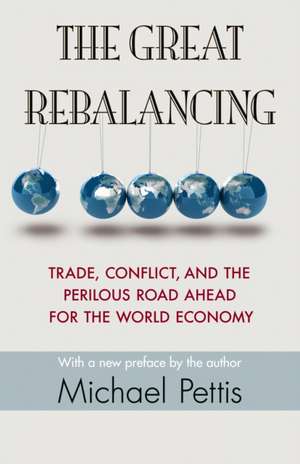
The Great Rebalancing
Autor Michael Pettisen Limba Engleză Paperback – 26 oct 2014
În volumul The Great Rebalancing – Trade, Conflict, and the Perilous Road Ahead for the World Economy, economistul Michael Pettis propune o perspectivă riguroasă asupra fragilității sistemului financiar internațional, argumentând că instabilitatea actuală nu este un accident, ci rezultatul unor distorsiuni profunde în modelele de economisire și consum ale marilor puteri. Premisa centrală a lucrării este că dezechilibrele comerciale masive, adesea ignorate sau înțelese greșit, au fost catalizatorul crizei globale și continuă să amenințe redresarea economică. Autorul demonstrează cum politici naționale aparent izolate, precum subvenționarea artificială a capitalului în China sau austeritatea impusă în Europa de către Germania, creează unde de șoc care se propagă la nivel mondial. Considerăm că forța acestui volum rezidă în capacitatea de a demonta mituri economice populare, oferind în schimb o analiză structurală a modului în care fluxurile de capital dictează dinamica politică. Michael Pettis nu se limitează la o descriere a simptomelor, ci analizează mecanismele prin care rolul dolarului ca monedă de rezervă obligă Statele Unite să absoarbă excesul de economisire global, afectând propria bază industrială. Stilul este unul analitic și prospectiv, anticipând perioade de ajustare dureroasă, inclusiv o posibilă „decadă pierdută” pentru economia chineză. Complementar lucrării Globalisation Fractures de Charles Dumas, care explorează riscurile datoriei publice și fracturile globalizării, volumul de față adaugă o dimensiune esențială prin concentrarea pe mecanismele interne de reechilibrare necesare pentru a evita un colaps sistemic. În timp ce Transpacific Rebalancing pune accent pe coordonarea politicilor între regiunile de pe malurile Pacificului, The Great Rebalancing oferă o viziune mai integrată, legând boom-ul materiilor prime din America Latină de politicile de investiții din Asia și de criza datoriilor din Europa. Este o lectură densă, publicată de Princeton University Press, care transformă datele macroeconomice într-o narațiune coerentă despre viitorul nostru comun.
Preț: 111.58 lei
Carte disponibilă
Livrare economică 14-28 noiembrie
Specificații
ISBN-10: 0691163626
Pagini: 256
Dimensiuni: 140 x 216 x 15 mm
Greutate: 0.24 kg
Ediția:Revizuită
Editura: Princeton University Press
V-ar putea interesa
-
 -21%Preț: 460.44 lei584.48 lei
 -
 Preț: 103.56 lei
 -
 For Strippers OnlyLydia CPreț: 91.66 lei
 -
 Show Worth: Build, Grow, and Forever Understand Your Credit ScoreShashonna DuckworthPreț: 145.32 lei
 -
 The Strategy BookJohn HalePreț: 190.38 lei
 -
 Budgeting Is CrapSamantha BoardmanPreț: 55.46 lei
 -
 Avoiding the FallMichael PettisPreț: 106.57 lei
 -
 Dont Just Start A Business Build An EmpireGerald E WashingtonPreț: 155.72 lei
 -
 Global Burden of Armed Violence 2015Geneva Declaration Secretariat-64%Preț: 107.40 lei299.03 lei
 -
 -15%Preț: 437.43 lei514.62 lei
 -
 Preț: 462.00 lei
 -
 Swedesboro and Woolwich TownshipRussell C ShivelerPreț: 129.38 lei
 -
 Stop Collaborate and ListenTina Marie WohlfieldPreț: 94.89 lei
 -
 Preț: 108.59 lei
 -
 The Journey of Collective ImpactLiz WeaverPreț: 129.99 lei
 -
 Why Me? And No Gold Watch!Rick AtkinsonPreț: 126.51 lei
 -
 Preț: 260.47 lei
 -
 American BuyoutRobert C WhitehairPreț: 107.55 lei
 -
 How to be a ThousandaireCatherine AdamsonPreț: 145.18 lei
 -
 BITCOIN - Geld ohne StaatAaron Koenig-20%Preț: 100.49 lei125.61 lei
 -
 Beautiful Brains change tomorrow... todayThy-Diep TaPreț: 115.90 lei
De ce să citești această carte
Recomandăm această carte analiștilor economici, studenților la relații internaționale și celor interesați de mecanismele din spatele titlurilor de știri financiare. Cititorul va obține o înțelegere clară a motivelor pentru care modelele economice actuale ale Chinei și Germaniei sunt nesustenabile pe termen lung. Este un instrument esențial pentru a descifra conflictele comerciale contemporane și pentru a anticipa direcția în care se îndreaptă economia globală sub presiunea reechilibrării obligatorii.
Descriere scurtă
"This is a brilliant book, one that absolutely must be read by all who are concerned with globalization's future. Michael Pettis debunks the reigning conventional wisdom about international trade, finance, and globalization, and provides the most clear-eyed, unbiased, and unvarnished insights into how the Chinese economy works. From Chinese savers to Greek debtors to American bankers, Pettis shows how we are all connected--and what to prepare for on the road ahead."--Clyde Prestowitz, author of The Betrayal of American Prosperity
"Michael Pettis has written an essential guide to the macroeconomic imbalances that bedevil today's global economy. We ignore his message at our peril."--Dani Rodrik, author of The Globalization Paradox
"This is a profoundly interesting exploration of the causes of the trade and capital imbalances that produced the 2008 financial crisis. Michael Pettis argues that the structural gap between China's domestic consumption and production is the central reason for its pursuit of export-led growth through currency undervaluation. His analysis focuses valuable attention on the deep domestic reforms required in all the major trading countries for the 'great rebalancing' of their international accounts--and the avoidance of continuing crises."--Robert Skidelsky, author of Keynes: The Return of the Master
Notă biografică
Descriere
How trade imbalances spurred on the global financial crisis and why we aren't out of trouble yetChina's economic growth is sputtering, the Euro is under threat, and the United States is combating serious trade disadvantages. Another Great Depression? Not quite. Noted economist and China expert Michael Pettis argues instead that we are undergoing a critical rebalancing of the world economies. Debunking popular misconceptions, Pettis shows that severe trade imbalances spurred on the recent financial crisis and were the result of unfortunate policies that distorted the savings and consumption patterns of certain nations. Pettis examines the reasons behind these destabilizing policies, and he predicts severe economic dislocations--a lost decade for China, the breaking of the Euro, and a receding of the U.S. dollar—that will have long-lasting effects.Pettis explains how China has maintained massive—but unsustainable—investment growth by artificially lowering the cost of capital. He discusses how Germany is endangering the Euro by favoring its own development at the expense of its neighbors. And he looks at how the U.S. dollar's role as the world's reserve currency burdens America's economy. Although various imbalances may seem unrelated, Pettis shows that all of them—including the U.S. consumption binge, surging debt in Europe, China's investment orgy, Japan's long stagnation, and the commodity boom in Latin America—are closely tied together, and that it will be impossible to resolve any issue without forcing a resolution for all.Demonstrating how economic policies can carry negative repercussions the world over, The Great Rebalancing sheds urgent light on our globally linked economic future.