Cantitate/Preț
Produs

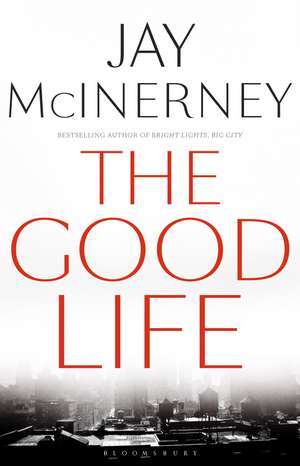
The Good Life

Autor Jay McInerney
en Limba Engleză Paperback – 7 sep 2016
_______________'A shrewd, acidic portrait of literary life in Manhattan at the turn of this already frightful century' - Guardian'A beautiful, affecting novel, one of the best yet inspired by 9/11' - Sunday Telegraph'Engrossing from start to finish, this compassionate novel depicts a very human response to tragedy' - Mail on Sunday_______________Jay McInerney's classic novel of New York in the shadow of 9/11 tells a story of love, family and conflicting desiresTen years on from Brightness Falls, Russell Calloway is still a literary editor; his wife Corrine has sacrificed her career to watch anxiously over their children. Across town Luke McGavock, a wealthy ex-investment banker, is taking a sabbatical from moneymaking, struggling to reconnect with his socially resplendent wife Sasha and their angst-ridden teenage daughter, Ashley. These two Manhattan families are teetering on the brink of change when 9/11 happens. Through the lens of catastrophe, The Good Life explores that territory between hope and despair, love and loss, regret and fulfilment. This is Jay McInerney doing what he does best, presenting us with life in New York City, in all its moral complexity._______________
Citește tot Restrânge

Toate formatele și edițiile

Toate formatele și edițiile Preț Express
Paperback (2) 5510 lei  3-5 săpt.
  Bloomsbury Publishing – 7 sep 2016 5510 lei  3-5 săpt.
  Vintage Books USA – 14 apr 2007 10990 lei  3-5 săpt.

Preț: 5510 lei

Preț vechi: 7579 lei
-27% Nou

Puncte Express: 83

Preț estimativ în valută:
975 1143$ 856£

Carte disponibilă

Livrare economică 19 ianuarie-02 februarie 26

Preluare comenzi: 021 569.72.76

Specificații

ISBN-13: 9781408876961
ISBN-10: 1408876965
Pagini: 368
Dimensiuni: 129 x 198 x 30 mm
Greutate: 0.26 kg
Ediția:New Edition
Editura: Bloomsbury Publishing
Colecția Bloomsbury Paperbacks
Locul publicării:London, United Kingdom

Caracteristici

The Good Life and Brightness Days will be republished with a new cover look alongside the final book, Bright, Precious Things, in September 2016

Notă biografică

Jay McInerney came to prominence in 1984 with his first novel Bright Lights, Big City. He is the author of six further novels: Ransom, Story of My Life, Brightness Falls, The Last of the Savages, Model Behaviour and The Good Life, two short story collections, and two non-fiction books on wine, one of which was the acclaimed A Hedonist in the Cellar. He writes a wine column for the Wall Street Journal and is a regular contributor to the Guardian, the New York Times Book Review and Corriere della Sera. He lives in Manhattan and Bridgehampton, New York.

Recenzii

'This story is a simple one, but McInerney delivers it with grace and wit. He does what a good novelist should: he takes an abstract idea and gives it life'
A shrewd, acidic portrait of literary life in Manhattan at the turn of this already frightful century
Engrossing from start to finish, this compassionate novel depicts a very human response to tragedy
McInerney's most fully imagined novel as it is his most ambitious and elegiac
'The subject of The Good Life is the cataclysm of 9/11, and McInerney lays claim to it with the authority and conviction of a native master ... McInerney here joins a small number of dissident novelists, headed by Norman Mailer, who change the way we look at American history'
'While those who read and fell in love with Brightness Falls all those years ago will devour The Good Life with relish, this is something which will appeal to those who have never read him before'
'Moving, thoughtful and altogether surprising in its portrayal of passion thwarted by circumstance, of all the 9/11 books this is possibly the only one that will pass the test of time'
A beautiful, affecting novel, one of the best yet inspired by 9/11

Extras

Summer used to be as endless as the ocean when she was a girl and her family rented the gray shingled cottage on Nantucket. Now, she found it hard to believe she was already back in Manhattan and the kids were in school and she was already racing home, late again, feeling guilty that she'd lingered over a drink with Casey Reynes. The kids had been home for hours after their first day in first grade, and she had yet to hear about it.

Women blamed themselves; men blamed anything but.

This was Corrine's interpretation of the guilt nipping at her high heels as she cantered up Hudson Street from the subway, passing the hand-lettered sign in the window of their Chinese takeout: FRESHLY GROUNDED COFFEE. Guilt about leaving the kids for so long, about not helping Russell with dinner, about attempting to restart her long-dormant professional life. Oh, to be grounded herself. Seven-fifteen by her watch. Still attuned to the languorous rhythm of the summer—they'd just closed up the house in Sagaponack four days ago—she'd barely had time to kiss the kids good-bye this morning and now the guests would be arriving at any minute, Russell frenzied with cooking and child care.

Bad mother, bad wife, bad hostess. Bad.

When she had yearned to be a mother, imagining what it would be like to be a parent, it had been easy to conjure the joy . . . the scenes of tenderness, the Pieta moments. What you don't picture are the guilt and the fear that take up residence at the front of your brain, like evil twins you didn't bargain for. Fear because you're always worried about what might go wrong, especially if your kids were born, as hers were, three months early. You can never forget the sight of them those first few days, intubated under glass, veined eggshell skulls and pink writhing limbs—the image stays with you even as they grow, reminding you of just how fragile these creatures are, how flimsy your own defenses. And guilt because you can never possibly do enough. There's never enough time. No matter how much love and attention you lavish on them, you're always afraid that it will never be enough.

Corrine had become a connoisseur of guilt; not for her the stabbing thrust of regret for an ill-conceived act—but, rather, the dull and steady throb of chronic guilt, even as she'd done her best to rearrange her life around her kids, quitting her job to take care of them and, over the past two years, working highly flexible hours on a screenplay and on a project that was the obverse of a busman's holiday—a start-up venture called Momtomtom.com, which had been on the verge of a big launch this past spring, when the Internet bubble started to deflate and the venture capital dried up. This afternoon, she'd spent four hours making a presentation to a possible backer, hustling for seed money for the Web site. As these prospects dimmed, she'd been trying to set up meetings on the screenplay, an adaptation of Graham Greene's The Heart of the Matter. And here were the theoretical bookends of her existence, the maternal and the romantic—the latter submerged and almost extinct. In fact, that had been her secret intention in writing this script: to try to rekindle the romance and fan it back to life.

Corrine hadn't wanted to be one of those mothers who paid someone else to raise her kids; for the first five years, to the astonishment of her friends and former colleagues, she'd stayed at home. Manhattan was an existential town, in which identity was a function of professional accomplishment; only the very young and the very rich were permitted to be idle. The latter, like her friend Casey Reynes, had their charities and their personal assistants and inevitably managed to convey the impression that all this constituted an exhausting grind. Russell had initially supported her maternal ideal, though, as the years went by and their peers bought vacation homes in the Hamptons, he couldn't consistently disguise his resentment over their straitened finances, or his sense that his stay-at-home wife had become translucent, if not invisible, within the walls of their loft—a nanny without salary.

Writing a screenplay was, in their circle, code for being unemployed; finishing the first draft failed to produce the sense of accomplishment she'd expected. A screenplay, after all, was a kind of theoretical object, a recipe rather than the meal itself. And thus far she hadn't had much luck in assembling the ingredients. So when the kids entered preschool last year, she had tried to turn her obsession with child rearing into a profession—formalizing the body of knowledge she'd acquired as a full-time city mother into a viable on-line resource. If that plan didn't work out, she would have to return to the job marketplace, as much for her own self-esteem as to defray the $34,000 tuition fees for the kids.

A homeless man was encamped in the shadow of construction scaffolding across the street from her building—a rarer sight than it would have been ten years ago. A young, dirt-caked slacker with a ragged goatee, a bull terrier on a leash, and a paper coffee cup at his feet. As Corrine hurried past, he said, "Hey, beautiful. I need a blow job. I need a place in the Hamptons. I need a movie role."

She paused, registering the humor—and her husband would have loved this, storing it away with all the other anecdotes he used to illustrate his wife's hilarious singularity—but instead of laughing, she was thinking about needs. What we need in order to make life bearable.

Suddenly coming to her senses, the panhandler gaping at her.

"I need romance," said Corrine, dropping a dollar in the wishing well of his cup. "Whatever happened to the romance?"

She burst into her apartment, aching for her children, who over the course of the interminable afternoon might have died, dashed their heads against the edge of the coffee table she kept vowing to replace, been kidnapped, or forgotten her entirely. Corrine would have been less surprised at any of these scenarios than she was to see Hilary on the sofa, playing with the kids.

"Mom, guess what. You won't believe! Aunt Hilary's here."

Her daughter, Storey, loved to deliver news and make announcements.

It's true—she wouldn't believe. Last Corrine knew, her little sister had been in L.A. She'd tried calling as recently as last week, only to be told the number had been disconnected. And now here she was in TriBeCa, reclining on Corrine's couch with Jeremy in her lap. No matter that Corrine had seen her dozens of times in the intervening years: Hilary was preserved, in Corrine's mind, semifrozen at the age of fifteen, the last year they'd shared a domicile, so that it was always a surprise to see her as a woman, and a pretty convincing one at that. Only a few evanescent lines at the corners of her eyes hinted that she'd passed thirty a few years before.

The first thing Corrine did, pure reflex, was to scoop Jeremy up into her arms and hug him, but instead of clutching her, he squirmed.

"Hey, sis." Hilary rose from the couch, stretching lithe and catlike in her leopard top. As if to preserve Corrine's illusion of her youthfulness, she still moved and dressed like a teenager, and had the body to carry it off. "Thought I'd surprise you."

"I'm . . . I am." Corrine belatedly hugged her sister with the arm not holding Jeremy—a sister sandwich, with her son—their son?—in the middle. Surprised, yes, Corrine thought . . . although at some point unpredictability becomes a pattern. "You look . . . great," Corrine said.

"Thanks."

"Aunt Hilary's been in Paris," Storey said.

"Paris?"

Jeremy squirmed out of Corrine's grasp and dropped onto the ottoman.

"Well, actually I came from London today, but I've been in Paris for the past two weeks."

"She met Madeleine," Storey said, holding up her favorite book. "Can you believe it, Mom? Aunt Hilary knows her. Why didn't you tell us she knows Madeline?"

"I had no idea," Corrine said, casting a reproving glance at her sister. "Although, actually, now that I think about it, I'm not surprised at all. Your aunt Hilary knows just about everybody in the whole world."

"The whole world?"

"Your mom's just making a little joke."

It was true—you couldn't watch a movie or open a magazine without Hilary dropping intimate remarks about the two-dimensional icons therein. Why shouldn't she know Madeline?

"Aunt Hilary saw her at the Eiffel Tower with Miss Clavel and the other little girls."

"What's so great about Madeline?" Jeremy asked. "She's just a little girl."

Just like Hilary to tell Storey she was acquainted with a fictional character, fiction being her great specialty. Corrine didn't want Storey getting mocked for relating this triumph at school. She was feeling ambivalent enough about the Fluffies—the fairylike creatures that she had conjured up for the kids when they were three, who had their own biographies and their own little house in the kids' bedroom. They'd been through this once before when Hilary claimed to be great friends with Barbie—to whom she bore more than a passing resemblance.

"Corrine," Hilary said, "why are you looking at me that way?"

"What way?" Storey demanded. "What way is she looking at you? Mom, what does she mean?"

Jeremy was bouncing up and down on the sofa.

"Have you got a place to stay?"

"Collin has this loft in SoHo? But I have to call his neighbors for the keys. I think I may have the wrong number or something."

As if, Corrine thought, she was supposed to know who Collin was. Some fucking drug dealer, minor English aristocrat, or bass player, if experience was any guide. She gestured toward the couch. "You're welcome to the guest suite." Theirs was one of those old tunnel-style TriBeCa lofts, shaped like Manhattan itself, long and skinny, the most space they could find for the money back in 1990, when the area was still considered remote—an eighteen-by-eighty-foot rectangle with a single bathroom carved out of commercial space in the seventies. They'd walled off first one bedroom in the back and then another when the children were born, and kept telling themselves, as the years slipped past, that they'd probably move by the time the kids needed separate bedrooms. Which they did now. The experts said six was the age, but somehow all of the possible solutions seemed to require more cash than they commanded.

Russell was calling out from behind the kitchen counter. She wondered how he was taking this.

"Can Aunt Hilary give us our bath?" Storey asked. "Please please please."

"I suppose so," said Corrine.

"Race you to the bathroom," Storey told her brother.

"We will walk to the bathroom," Corrine said, grabbing hold of the back of Jeremy's shirt. Last week, he'd slipped and bruised his forehead—so Corrine reminded herself as she tried to justify the note of irritation in her voice.

Russell, meanwhile, was in his cooking frenzy in what they called the kitchen, retaining the nomenclature of residences with discrete rooms, flailing away with his ten-inch German chef's knife, juggling his beloved copper pots and French steel pans, which weighed as much as the unused dumbbells in the bedroom closet, the heft of which seemed to her to have as much to do with the macho aesthetics of amateur chefdom as with heat distribution. Cooking was a new sphere of masculine competition; Russell and Washington and his chef friend Carlo had lately taken to comparing notes on butchers and cutlery the way they used to deconstruct stereo equipment, garage bands, and young novelists. For fifteen years, Russell had been perfectly happy with their Calphalon pots, a wedding present from Macy's, until Washington told him the sous-chef at JoJo said they were for pussies.

She kissed him on the cheek."I promise I had no idea," she whispered. "I haven't spoken to her in weeks—months, probably. You're not furious, are you?"

"Don't worry, she exonerated you."

She put a finger to her lips. Russell seemed incapable of speaking at any volume but loud, a characteristic ill-suited to loft living.

"At least she didn't show up with some head-banger or felon in tow." She put her arms around her husband's ribs. "Is she going to spoil your perfect seating chart? I don't see how we can—"

"No big deal," Russell said, chopping away at a leek.

Corrine could hardly believe her ears. Russell was a maniac about his dinner parties. He was capable of throwing a tantrum if Corrine added someone at the last minute. It was one of the few areas of life in which he was prissy. When he put on his chef/host hat, everything had to be just so. Not to mention the fact that he'd grown tired of the saga of the prodigal sister-in-law, although he wouldn't admit it.

She shook her head. "You mean you won't have a heart attack if there's an uneven number at the table?"

"Actually, Salman canceled this afternoon. And then Jim called and said Cody Erhardt was in town and would I mind if he joined us."

Now she understood. "Did Salman have an excuse?"

"He's got a deadline and he leaves on his book tour tomorrow."

Corrine could tell he was disappointed, though he liked to act as if having Salman Rushdie over to dinner was no big deal. That was one of the things she hated about New York, how you were supposed to be cool and take for granted the awe-inspiring people and events you'd fantasized about back home in Altoona or Amherst. By the time you were behind the velvet ropes or sitting at the front booth, you were probably too jaded to admit how lucky you felt or to enjoy it the way you once imagined you would have.


From the Hardcover edition.

Descriere

Descriere de la o altă ediție sau format:
Hailed by "Newsweek" as "a superb and humane social critic," McInerney has written a novel rich with characters and events, both comic and harrowing, revealing the moral complexities in New York after the 9/11 attacks as well as the toll taken on those lucky enough to have survived them.