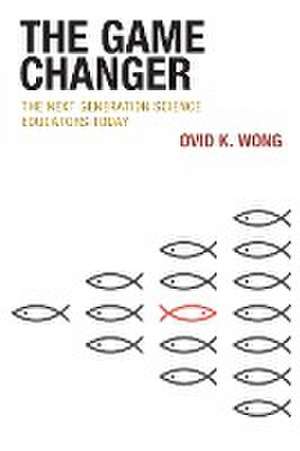
The Game Changer: The Next Generation Science Educators Today
Autor Ovid K. Wongen Limba Engleză Paperback – 8 iun 2023
Preț: 177.78 lei
Preț vechi: 238.04 lei
-25%
Puncte Express: 267
Carte tipărită la comandă
Livrare economică 01-15 decembrie
Livrare prin curier în România Termenul estimat este afișat lângă disponibilitate.
Transport gratuit de la 400.00 lei Plată online sau ramburs, în funcție de opțiunile comenzii.
Retur gratuit în 14 zile Comandă securizată și suport în română.
Specificații
ISBN-13: 9781475863444
ISBN-10: 1475863446
Pagini: 178
Dimensiuni: 146 x 226 x 14 mm
Greutate: 0.27 kg
Editura: Bloomsbury Publishing
Colecția Rowman & Littlefield
Locul publicării:New York, United States
ISBN-10: 1475863446
Pagini: 178
Dimensiuni: 146 x 226 x 14 mm
Greutate: 0.27 kg
Editura: Bloomsbury Publishing
Colecția Rowman & Littlefield
Locul publicării:New York, United States
Cuprins
Preface
Chapter: 1 Looking back and moving forward in history
Chapter 2: Auditing the science education initiatives
Chapter 3: Executing the intended purpose of a science education policy
Chapter 4: The intellectual and social emotional foundations of 2+2=4 versus 2+2=22
Chapter 5: What is the contemporary landscape of science education?
Chapter 6: How do you fill the cup of science learning?
Acronyms
About the Author
Index
Chapter: 1 Looking back and moving forward in history
Chapter 2: Auditing the science education initiatives
Chapter 3: Executing the intended purpose of a science education policy
Chapter 4: The intellectual and social emotional foundations of 2+2=4 versus 2+2=22
Chapter 5: What is the contemporary landscape of science education?
Chapter 6: How do you fill the cup of science learning?
Acronyms
About the Author
Index
Recenzii
Wong provides a historical review of national science initiatives from Sputnik in 1957 to Next Generation Science Standards (NGSS) in 2013. He examines qualitative and quantitative investigations of science education challenges in the context of general education issues and goals. He describes how examining the science literacy measures in the National Assessment of Education Progress, the Program for International Student Assessment, and the Trends in International Mathematics and Science Study may lead to curricular change. Recognizing that the NGSS is a major game changer in science education, even with possible reinterpretations by local and state curriculum developers, he discusses the influences of social-emotional learning, teacher-centered and student-centered philosophies, and the contemporary landscape of science. Wong examines the major divisions in science in schools and concludes with ideas on curriculum development for science education: starting with what the learner knows, defining learning outcomes, relying on conceptual learning and teaching, practicing these concepts, and using technology appropriately as a tool for learning and teaching. Recommended. Undergraduates through faculty; professionals.
Great reading for both the experienced science teacher as well as the novice. Professor Wong has produced a book that leads us through the history of the last seventy plus years from Sputnik to where we are today in science education with the New Generation Science Standards (NGSS). In doing so, he describes in detail the complex interactions between the teacher, student, and subject matter during a number of generational program changes. As one might surmise, these interactions are as involved as the sciences themselves, but presented with such clarity when integrated with the NGSS as to cause the reader to thoughtfully consider their own practice with the goal of becoming a true "Game Changer".
Dr. Wong successfully attempts, like few others, to recount the vast expanse of scientific discoveries and evolution of science education and provide a cohesive background for science educators. His concise summary and appraisal of facts, time line, and educational issues in tandem with insightful metaphorical stories and examples help provide the structure with which to build a sound philosophy of teaching science. Additional focus on conceptual teaching and educational technology for the 'teacher's tool box' is practical and helpful. He does not overlook the learner, emphasizing that education is an art and science with the outcome of achieving student success that also requires conveying acceptance, inclusion, and attention to their social emotional skills.
Finally - a highly interesting, motivating explanation of science, its current state in education and the answer to what we should do with it in the field now to move science education forward!
Great reading for both the experienced science teacher as well as the novice. Professor Wong has produced a book that leads us through the history of the last seventy plus years from Sputnik to where we are today in science education with the New Generation Science Standards (NGSS). In doing so, he describes in detail the complex interactions between the teacher, student, and subject matter during a number of generational program changes. As one might surmise, these interactions are as involved as the sciences themselves, but presented with such clarity when integrated with the NGSS as to cause the reader to thoughtfully consider their own practice with the goal of becoming a true "Game Changer".
Dr. Wong successfully attempts, like few others, to recount the vast expanse of scientific discoveries and evolution of science education and provide a cohesive background for science educators. His concise summary and appraisal of facts, time line, and educational issues in tandem with insightful metaphorical stories and examples help provide the structure with which to build a sound philosophy of teaching science. Additional focus on conceptual teaching and educational technology for the 'teacher's tool box' is practical and helpful. He does not overlook the learner, emphasizing that education is an art and science with the outcome of achieving student success that also requires conveying acceptance, inclusion, and attention to their social emotional skills.
Finally - a highly interesting, motivating explanation of science, its current state in education and the answer to what we should do with it in the field now to move science education forward!