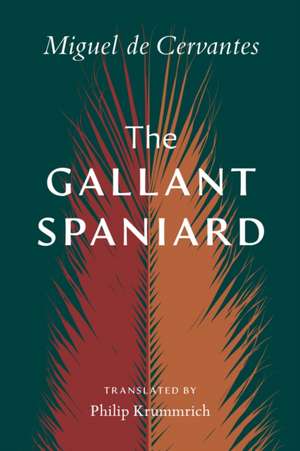
The Gallant Spaniard
Autor Miguel de Cervantes Traducere de Philip Krummrichen Limba Engleză Paperback – 15 sep 2023
This edition, translated by Philip Krummrich, consists of a critical introduction and a full verse translation of the play with notes.
| Toate formatele și edițiile | Preț | Express |
|---|---|---|
| Paperback (1) | 132.59 lei 3-5 săpt. | |
| Vanderbilt University Press – 15 sep 2023 | 132.59 lei 3-5 săpt. | |
| Hardback (1) | 563.11 lei 6-8 săpt. | |
| Vanderbilt University Press – 15 sep 2023 | 563.11 lei 6-8 săpt. |
Preț: 132.59 lei
Puncte Express: 199
Preț estimativ în valută:
23.47€ • 27.42$ • 20.37£
23.47€ • 27.42$ • 20.37£
Carte disponibilă
Livrare economică 29 ianuarie-12 februarie
Preluare comenzi: 021 569.72.76
Specificații
ISBN-13: 9780826506023
ISBN-10: 082650602X
Pagini: 170
Dimensiuni: 152 x 229 x 10 mm
Greutate: 0.26 kg
Editura: Vanderbilt University Press
Colecția Vanderbilt University Press
ISBN-10: 082650602X
Pagini: 170
Dimensiuni: 152 x 229 x 10 mm
Greutate: 0.26 kg
Editura: Vanderbilt University Press
Colecția Vanderbilt University Press
V-ar putea interesa
-
 The Culture Shock ProjectAinesey "Annie" Rodriguez-AnamanPreț: 153.74 lei
 -
 (Try Not To) Forget MeShi CollantesPreț: 100.10 lei
 -
 If This Lands On Your HandsShi CollantesPreț: 69.35 lei
 -
 Preț: 55.01 lei
 -
 À toi en moiMatthieu DornierPreț: 81.49 lei
 -
 El Ingenioso Hidalgo Don Quijote de La ManchaMiguel CervantesPreț: 116.68 lei
 -
 Los Trabajos de Persiles y SigismundaMiguel CervantesPreț: 115.97 lei
 -
 Viaje del ParnasoMiguel CervantesPreț: 45.39 lei
 -
 La GalateaMiguel CervantesPreț: 106.44 lei
 -
 Novelas EjemplaresMiguel CervantesPreț: 125.61 lei
 -
 Shakespeare for SociopathsKristin GarthPreț: 65.29 lei
 -
 Preț: 129.49 lei
 -
 Preț: 91.31 lei
 -
 AnábasisJenofontePreț: 150.36 lei
 -
 Lo que lleva el rey GasparAzorínPreț: 199.23 lei
Recenzii
"Krummrich's competent full verse translation of The Gallant Spaniard is the first English edition of one of Cervantes's most daring plays. Its nuanced and emphathetic staging of Christian-Muslim relations in Imperial Spain will appeal to Cervantine readers everywhere. This is a much needed addition to the translated body of Cervantes's theater."
—Moisés R. Castillo, author of Indios en escena: La representación del amerindio en el teatro del Siglo de Oro
"The Gallant Spaniard is one of the most surprising and interesting works for the contemporary Cervantes reader, exploring otherness, war, and humanity with ethical complexity. This first English translation does the work justice because, despite the difficulties of respecting the original verse, it achieves admirable accuracy in meaning as well as idiomatic naturalness in language."
—Mercedes Alcalá Galán, author of "Con esta carga nacemos las mujeres": Discursos sobre el cuerpo femenino en la España de Cervantes
"The Gallant Spaniard truly advances Cervantes's scholarship and Golden Age theatre by adding new titles to the repertory through translation."
—Esther Fernández, author of To Embody the Marvelous: The Making of Illusions in Early Modern Spain
—Moisés R. Castillo, author of Indios en escena: La representación del amerindio en el teatro del Siglo de Oro
"The Gallant Spaniard is one of the most surprising and interesting works for the contemporary Cervantes reader, exploring otherness, war, and humanity with ethical complexity. This first English translation does the work justice because, despite the difficulties of respecting the original verse, it achieves admirable accuracy in meaning as well as idiomatic naturalness in language."
—Mercedes Alcalá Galán, author of "Con esta carga nacemos las mujeres": Discursos sobre el cuerpo femenino en la España de Cervantes
"The Gallant Spaniard truly advances Cervantes's scholarship and Golden Age theatre by adding new titles to the repertory through translation."
—Esther Fernández, author of To Embody the Marvelous: The Making of Illusions in Early Modern Spain
Notă biografică
Miguel de Cervantes Saavedra (1547–1616) is widely considered the greatest writer in the history of the Spanish language. He authored lauded works of verse, theater, and prose, chief among them Don Quixote.
Philip Krummrich is a professor of comparative literature at Morehead State University.
Philip Krummrich is a professor of comparative literature at Morehead State University.
Extras
Cervantes spent some five years in captivity in Algiers, waiting to be ransomed and masterminding a series of daring but unsuccessful escape attempts. The experience left him with a wealth of material and understandably mixed feelings about the Muslims. Throughout his subsequent writing career he returns to North African settings and themes, in several plays and in the Captive’s Tale in Chapters 39-42 of the first part of Don Quixote. Sometimes he demonizes the Muslims; in other cases, as in The Gallant Spaniard, they are almost indistinguishable from their Christian counterparts.
Cervantes could have drawn on several written sources for the background regarding the siege of Oran. He also had the opportunity to hear from eyewitnesses who had participated in the defense of the town of Oran when he was sent there on behalf of the king in 1581. There is some uncertainty as to when he actually wrote The Gallant Spaniard, but by the time he tried to peddle it and the rest of his Eight Comedies and Eight Interludes, near the end of his life, North African themes no longer appealed to the playgoing public. Fascinating though The Gallant Spaniard has proven to scholars as part of Cervantes’s body of work, it never made it to the stage during his lifetime, and it remains a work far better suited to reading than to performance. The visual effects that Cervantes calls for, such as Alimuzel riding in on a horse, are easy enough to imagine, but impractical to stage.
Cervantes could have drawn on several written sources for the background regarding the siege of Oran. He also had the opportunity to hear from eyewitnesses who had participated in the defense of the town of Oran when he was sent there on behalf of the king in 1581. There is some uncertainty as to when he actually wrote The Gallant Spaniard, but by the time he tried to peddle it and the rest of his Eight Comedies and Eight Interludes, near the end of his life, North African themes no longer appealed to the playgoing public. Fascinating though The Gallant Spaniard has proven to scholars as part of Cervantes’s body of work, it never made it to the stage during his lifetime, and it remains a work far better suited to reading than to performance. The visual effects that Cervantes calls for, such as Alimuzel riding in on a horse, are easy enough to imagine, but impractical to stage.
Cuprins
Introduction
Cervantes and The Gallant Spaniard
Translator’s Note
Cervantes in English
Critical Statements on the Play
Selected Bibliography
Act I
Act II
Act III
Cervantes and The Gallant Spaniard
Translator’s Note
Cervantes in English
Critical Statements on the Play
Selected Bibliography
Act I
Act II
Act III
Descriere
The first English translation of Miguel de Cervantes's El gallardo español